Kirjojen hintavertailu – 12 903 724 kirjaa ja 27 kauppaa

Kirjailija

Michiel Steyaert

Kirjat ja teokset yhdessä paikassa: 58 kirjaa, julkaisuja vuosilta 1993–2021, suosituimpiin kuuluu Design of Multi-Bit Delta-Sigma A/D Converters. Vertaile teosten hintoja ja tarkista saatavuus suomalaisista kirjakaupoista.

58 kirjaa

Kirjojen julkaisuvuodet: 1993–2021.

Ultra-Wideband Pulse-based Radio

Ultra-Wideband Pulse-based Radio

Wim Vereecken; Michiel Steyaert

Springer
2009
sidottu
Today’s booming expanse of personal wireless radio communications is a rich source of new challenges for the designer of the underlying enabling te- nologies. Personal communication networks are designed from a fundam- tally different perspective than broadcast service networks, such as radio and television. While the focus of the latter is on reliability and user comfort, the emphasis of personal communication devices is on throughput and mobility. However, because the wireless channel is a shared transmission medium with only very limited resources, a trade-off has to be made between mobility and the number of simultaneous users in a con?ned geographical area. Accord- 1 ing to Shannon’s theorem on channel capacity, the overall data throughput of a communication channel bene?ts from either a linear increase of the tra- mission bandwidth, or an (equivalent) exponential increase in signal quality. Consequently, it is more bene?cial to think in terms of channel bandwidth than it is to pursue a high transmission power. All the above elements are embodied in the concept of spatial ef?ciency. By describing the throughput of a system 2 in terms of bits/s/Hz/m , spatial ef?ciency takes into account that the use of a low transmission power reduces the operational range of a radio transmission, and as such enables a higher reuse rate of the same frequency spectrum.
Design of High Voltage xDSL Line Drivers in Standard CMOS

Design of High Voltage xDSL Line Drivers in Standard CMOS

Bert Serneels; Michiel Steyaert

Springer-Verlag New York Inc.
2008
sidottu
“Design of high voltage xDSL line drivers in standard CMOS” fits in the quest for highly efficient fully integrated xDSL modems for central office applications. The book focusses on the line driver, the most demanding building block of the xDSL modem for lowering power. To reduce the cost, the cheapest technology is selected: standard CMOS, without any extra process options to increase the nominal supply voltage. The emphasis lies on the analysis, design and implementation of high voltage highly efficient line drivers in mainstream CMOS. “Design of high voltage xDSL line drivers in standard CMOS” covers the total design flow of monolithic CMOS high voltage circuits. The book is essential reading for analog design engineers and researchers in the field and is also suitable as a text book for an advanced course on the subject.
Broadband Opto-Electrical Receivers in Standard CMOS

Broadband Opto-Electrical Receivers in Standard CMOS

Carolien Hermans; Michiel Steyaert

Springer-Verlag New York Inc.
2007
sidottu
Broadband Opto-Electrical Receivers in Standard CMOS starts from the basic fundamentals necessary for the design of opto-electronic interface circuits. The book continues with an in-depth analysis of the photodiode, transimpedance amplifier (TIA) and limiting amplifier (LA). To thoroughly understand the light detection mechanisms in silicon, first a one-dimensional and second a two-dimensional model is developed. Analytical design equations are derived to guide the design of the amplifying circuits. For the TIA, the focus is on the sensitivity-speed trade-off. For the LA, a high gain-bandwidth is pursued. Several practical design examples reveal the subtleties and challenges encountered during the design of high-performance analog circuits. Broadband Opto-Electrical Receivers in Standard CMOS covers the total design flow of monolithic CMOS optical receivers. All material is experimentally verified with several CMOS implementations, with ultimately a fully integrated Gbit/s optical receiver front-end including photodiode, TIA and LA.
RF Power Amplifiers for Mobile Communications

RF Power Amplifiers for Mobile Communications

Patrick Reynaert; Michiel Steyaert

Springer-Verlag New York Inc.
2006
sidottu
RF Power Amplifiers for Mobile Communications fits in the quest for fully integrated CMOS transceivers. The book tackles both high efficiency and high linearity PA design in low-voltage CMOS, and has a strong emphasis on theory, design and implementation. The book is conceived as a design guide for those actively involved in the design of CMOS wireless transceivers. RF Power Amplifiers for Mobile Communications starts from the basic theory of power amplification from the viewpoint of CMOS integration. The design of switching RF power amplifiers in CMOS is explored and CMOS PA design at low supply voltage using parallel amplification is discussed. Combining both efficiency and linearity is one of the major issues in CMOS PA design for wireless and mobile communications and is subsequently tackled. Different linearization techniques and approaches are discussed and polar modulation is clarified in greater detail. Finally, two CMOS PAimplementations are thoroughly covered. RF Power Amplifiers for Mobile Communications offers the reader an intuitive insight in Power Amplification as well as the necessary mathematical background. The book is essential reading for RF design engineers and researchers in the field and is also suitable as a text book for an advanced course on the subject.
Low-Power Low-Voltage Sigma-Delta Modulators in Nanometer CMOS

Low-Power Low-Voltage Sigma-Delta Modulators in Nanometer CMOS

Libin Yao; Michiel Steyaert; Willy M Sansen

Springer-Verlag New York Inc.
2006
sidottu
Low-Power Low-Voltage Sigma-Delta Modulators in Nanometer CMOS addresses the low-power low-voltage Sigma-Delta ADC design in nanometer CMOS technologies at both the circuit-level and the system level. The low-power low-voltage Sigma-Delta modulator design at the circuit level is introduced. A design example is presented in this book. This design is the first published Sigma-Delta design in a 90-nm CMOS technology and reaches a very high figure-of-merit. At the system level, a novel systematic study on the full feedforward Sigma-Delta topology is presented in this book. As a design example, a fourth-order single-loop full feedforward Sigma-Delta modulator design in a 130-nm pure digital CMOS technology is presented. This design is the first design using the full feedforward Sigma-Delta topology and reaches the highest conversion speed among all the 1-V Sigma-Delta modulators to date.
LNA-ESD Co-Design for Fully Integrated CMOS Wireless Receivers

LNA-ESD Co-Design for Fully Integrated CMOS Wireless Receivers

Paul Leroux; Michiel Steyaert

Springer-Verlag New York Inc.
2005
sidottu
LNA-ESD Co-Design for Fully Integrated CMOS Wireless Receivers fits in the quest for complete CMOS integration of wireless receiver front-ends. With a combined discussion of both RF and ESD performance, it tackles one of the final obstacles on the road to CMOS integration. The book is conceived as a design guide for those actively involved in the design of CMOS wireless receivers. The book starts with a comprehensive introduction to the performance requirements of low-noise amplifiers in wireless receivers. Several popular topologies are explained and compared with respect to future technology and frequency scaling. The ESD requirements are introduced and related to the state-of-the-art protection devices and circuits. LNA-ESD Co-Design for Fully Integrated CMOS Wireless Receivers provides an extensive theoretical treatment of the performance of CMOS low-noise amplifiers in the presence of ESD-protection circuitry. The influence of the ESD-protection parasitics on noise figure, gain, linearity, and matching are investigated. Several RF-ESD co-design solutions are discussed allowing both high RF-performance and good ESD-immunity for frequencies up to and beyond 5 GHz. Special attention is also paid to the layout of both active and passive components. LNA-ESD Co-Design for Fully Integrated CMOS Wireless Receivers offers the reader intuitive insight in the LNA’s behavior, as well as the necessary mathematical background to optimize its performance. All material is experimentally verified with several CMOS implementations, among which a fully integrated GPS receiver front-end. The book is essential reading for RF design engineers and researchers in the field and is also suitable as a text book for an advanced course on the subject.
Design and Analysis of High Efficiency Line Drivers for xDSL

Design and Analysis of High Efficiency Line Drivers for xDSL

Tim Piessens; Michiel Steyaert

Springer-Verlag New York Inc.
2004
sidottu
Design and Analysis of High Efficiency Line Drivers for xDSL covers the most important building block of an xDSL (ADSL, VDSL, ...) system: the line driver. Traditional Class AB line drivers consume more than 70% of the total power budget of state-of-the-art ADSL modems. This book describes the main difficulties in designing line drivers for xDSL. The most important specifications are elaborated staring from the main properties of the channel and the signal properties. The traditional (class AB), state-of-the-art (class G) and future technologies (class K) are discussed. The main part of Design and Analysis of High Efficiency Line Drivers for xDSL describes the design of a novel architecture: the Self-Oscillating Power Amplifier or SOPA.
Static and Dynamic Performance Limitations for High Speed D/A Converters

Static and Dynamic Performance Limitations for High Speed D/A Converters

Anne van den Bosch; Michiel Steyaert; Willy M.C. Sansen

Springer-Verlag New York Inc.
2004
sidottu
Static and Dynamic Performance Limitations for High Speed D/A Converters discusses the design and implementation of high speed current-steering CMOS digital-to-analog converters. Starting from the definition of the basic specifications for a D/A converter, the elements determining the static and dynamic performance are identified. Different guidelines based on scientific derivations are suggested to optimize this performance. Furthermore, a new closed formula has been derived to account for the influence of the transistor mismatch on the achievable resolution of the current-steering D/A converter. To allow a thorough understanding of the dynamic behavior, a new factor has been introduced. Moreover, the frequency dependency of the output impedance introduces harmonic distortion components which can limit the maximum attainable spurious free dynamic range. Finally, the last part of the book gives an overview on different existing transistor mismatch models and the link with the static performance of the D/A converter.
Integrated CMOS Circuits for Optical Communications

Integrated CMOS Circuits for Optical Communications

Mark Ingels; Michiel Steyaert

Springer-Verlag Berlin and Heidelberg GmbH Co. K
2003
sidottu
This work investigates the feasibility of the integration of interface circuits for op­ tical communication systems in a standard unmodified digital CMOS process. This paves the way for single chip communication systems where the optical interfaces are integrated on the same die as the required digital circuitry. The optical receiver is a key element in the optical communication link. In this work, a transimpedance amplifier, which consists of a voltage amplifier with resis­ tive feedback, is used as the first stage. Unlike for many other circuits, the optimal place of its dominant pole is the input node. It is also demonstrated that a high gain of the voltage amplifier is primordial to obtain good performances and that this may be obtained through the use of multiple stages. Noise aspects are investigated and the conclusion is drawn that the amplifier's input capacitance can be smaller than the photodiode's capacitance for optimal performance.
High Data Rate Transmitter Circuits

High Data Rate Transmitter Circuits

C.J. de Ranter; Michiel Steyaert

Springer-Verlag New York Inc.
2003
sidottu
High Data Rate Transmitter Circuits is a practical guide and introduction to the design of key RF building blocks used in high data rate transmitters. The emphasis lies on CMOS circuit techniques applicable to oscillators and upconvertors. Furthermore, a method for RF-specific design automation is exemplified by the CYCLONE tool for automated LC-VCO synthesis. Written in an easily accessible manner, High Data Rate Transmitter Circuits is essential reading for both students and practicing engineers interested in analog RF design and RF-specific design automation. The book has been praised for its pleasant and light style of writing, without losing detail on the technical side.
Systematic Design of Analog IP Blocks

Systematic Design of Analog IP Blocks

Jan Vandenbussche; Georges Gielen; Michiel Steyaert

Springer-Verlag New York Inc.
2003
sidottu
Systematic Design of Analog IP Blocks introduces a design methodology that can help to bridge the productivity gap. Two different types of designs, depending on the design challenge, have been identified: commodity IP and star IP. Each category requires a different approach to boost design productivity. Commodity IP blocks are well suited to be automated in an analog synthesis environment and provided as soft IP. The design knowledge is usually common knowledge, and reuse is high accounting for the setup time needed for the analog library. Star IP still changes as technology evolves and the design cost can only be reduced by following a systematic design approach supported by point tools to relieve the designer from error-prone, repetitive tasks, allowing him/her to focus on new ideas to push the limits of the design. To validate the presented methodologies, three different industrial-strength applications have been selected and designed accordingly.
CMOS Fractional-N Synthesizers

CMOS Fractional-N Synthesizers

Bram De Muer; Michiel Steyaert

Springer-Verlag New York Inc.
2003
sidottu
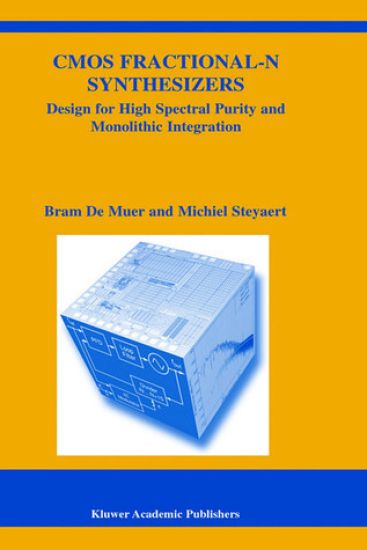
CMOS Fractional-N Synthesizers starts with a comprehensive introduction to general frequency synthesis. Different architectures and synthesizer building blocks are discussed with their relative importance on synthesizer specifications. The process of synthesizer specification derivation is illustrated with the DCS-1800 standard as a general test case. The book tackles the design of fractional-N synthesizers in CMOS on circuit level as well as system level. The circuit level focuses on high-speed prescaler design up to 12 GHz in CMOS and on fully integrated, low-phase-noise LC-VCO design. High-Q inductor integration and simulation in CMOS is elaborated and flicker noise minimization techniques are presented, ranging from bias point choice to noise filtering techniques. On a higher level, a systematic design strategy has been developed that trades off all noise contributions and fast dynamics for integrated capacitance (area). Moreover, a theoretical DeltaSigma phase noise analysis is presented, extended with a fast non-linear analysis method to accurately predict the influence of PLL non-linearities on the spectral purity of the DeltaSigma fractional-N frequency synthesizers.
CMOS Cellular Receiver Front-Ends

CMOS Cellular Receiver Front-Ends

Johan Janssens; Michiel Steyaert

Springer
2002
sidottu
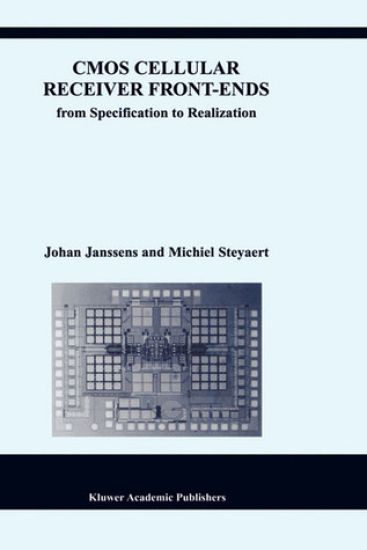
CMOS Cellular Receiver Front-Ends: from Specification to Realization deals with the design of the receive path of a highly-integrated CMOS cellular transceiver for the GSM-1800 cellular system. The complete design trajectory is covered, starting from the documents describing the standard down to the systematic development of CMOS receiver ICs that comply to the standard. The design of CMOS receivers is tackled at all abstraction levels: from architecture level, via circuit level, down to the device level, and the other way around. The theoretical core of the book discusses the fundamental and more advanced aspects of RF CMOS design. It focuses specifically on all aspects of the design of high-performance CMOS low-noise amplifiers.
Design of Low-Voltage Low-Power CMOS Delta-Sigma A/D Converters

Design of Low-Voltage Low-Power CMOS Delta-Sigma A/D Converters

Vincenzo Peluso; Michiel Steyaert; Willy M.C. Sansen

Springer
1999
sidottu
Design of Low-Voltage Low-Power CMOS Delta-Sigma A/D Converters investigates the feasibility of designing Delta-Sigma Analog to Digital Converters for very low supply voltage (lower than 1.5V) and low power operation in standard CMOS processes. The chosen technique of implementation is the Switched Opamp Technique which provides Switched Capacitor operation at low supply voltage without the need to apply voltage multipliers or low VtMOST devices. A method of implementing the classic single loop and cascaded Delta-Sigma modulator topologies with half delay integrators is presented. Those topologies are studied in order to find the parameters that maximise the performance in terms of peak SNR. Based on a linear model, the performance degradations of higher order single loop and cascaded modulators, compared to a hypothetical ideal modulator, are quantified. An overview of low voltage Switched Capacitor design techniques, such as the use of voltage multipliers, low VtMOST devices and the Switched Opamp Technique, is given. An in-depth discussion of the present status of the Switched Opamp Technique covers the single-ended Original Switched Opamp Technique, the Modified Switched Opamp Technique, which allows lower supply voltage operation, and differential implementation including common mode control techniques. The restrictions imposed on the analog circuits by low supply voltage operation are investigated. Several low voltage circuit building blocks, some of which are new, are discussed. A new low voltage class AB OTA, especially suited for differential Switched Opamp applications, together with a common mode feedback amplifier and a comparator are presented and analyzed. As part of a systematic top-down design approach, the non-ideal charge transfer of the Switched Opamp integrator cell is modeled, based upon several models of the main opamp non-ideal characteristics. Behavioral simulations carried out with these models yield the required opamp specifications that ensure that the intended performance is met in an implementation. A power consumption analysis is performed. The influence of all design parameters, especially the low power supply voltage, is highlighted. Design guidelines towards low power operation are distilled. Two implementations are presented together with measurement results. The first one is a single-ended implementation of a Delta-Sigma ADC operating with 1.5V supply voltage and consuming 100 &mgr;W for a 74 dB dynamic range in a 3.4 kHz bandwidth. The second implementation is differential and operates with 900 mV. It achieves 77 dB dynamic range in 16 kHz bandwidth and consumes 40 &mgr;W. Design of Low-Voltage Low-Power CMOS Delta-Sigma A/D Converters is essential reading for analog design engineers and researchers.

Wireless CMOS Frequency Synthesizer Design

Wireless CMOS Frequency Synthesizer Design

J. Craninckx; Michiel Steyaert

Springer
1998
sidottu
The recent boom in the mobile telecommunication market has trapped the interest of almost all electronic and communication companies worldwide. New applications arise every day, more and more countries are covered by digital cellular systems and the competition between the several providers has caused prices to drop rapidly. The creation of this essentially new market would not have been possible without the ap­ pearance of smalI, low-power, high-performant and certainly low-cost mobile termi­ nals. The evolution in microelectronics has played a dominant role in this by creating digital signal processing (DSP) chips with more and more computing power and com­ bining the discrete components of the RF front-end on a few ICs. This work is situated in this last area, i. e. the study of the full integration of the RF transceiver on a single die. Furthermore, in order to be compatible with the digital processing technology, a standard CMOS process without tuning, trimming or post-processing steps must be used. This should flatten the road towards the ultimate goal: the single chip mobile phone. The local oscillator (LO) frequency synthesizer poses some major problems for integration and is the subject of this work. The first, and also the largest, part of this text discusses the design of the Voltage­ Controlled Oscillator (VCO). The general phase noise theory of LC-oscillators is pre­ sented, and the concept of effective resistance and capacitance is introduced to char­ acterize and compare the performance of different LC-tanks.
CMOS Wireless Transceiver Design

CMOS Wireless Transceiver Design

Jan Crols; Michiel Steyaert

Springer
1997
sidottu
The world of wireless communications is changing very rapidly since a few years. The introduction of digital data communication in combination with digital signal process­ ing has created the foundation for the development of many new wireless applications. High-quality digital wireless networks for voice communication with global and local coverage, like the GSM and DECT system, are only faint and early examples of the wide variety of wireless applications that will become available in the remainder of this decade. The new evolutions in wireless communications set new requirements for the trans­ ceivers (transmitter-receivers). Higher operating frequencies, a lower power consump­ tion and a very high degree of integration, are new specifications which ask for design approaches quite different from the classical RF design techniques. The integrata­ bility and power consumption reduction of the digital part will further improve with the continued downscaling of technologies. This is however completely different for the analog transceiver front-end, the part which performs the interfacing between the antenna and the digital signal processing. The analog front-end's integratability and power consumption are closely related to the physical limitations of the transceiver topology and not so much to the scaling of the used technology. Chapter 2 gives a detailed study of the level of integration in current transceiver realization and analyzes their limitations. In chapter 3 of this book the complex signal technique for the analysis and synthesis of multi-path receiver and transmitter topologies is introduced.
Analog VLSI Integration of Massive Parallel Signal Processing Systems
When comparing conventional computing architectures to the architectures of biological neural systems, we find several striking differences. Conventional computers use a low number of high performance computing elements that are programmed with algorithms to perform tasks in a time sequenced way; they are very successful in administrative applications, in scientific simulations, and in certain signal processing applications. However, the biological systems still significantly outperform conventional computers in perception tasks, sensory data processing and motory control. Biological systems use a completely dif­ ferent computing paradigm: a massive network of simple processors that are (adaptively) interconnected and operate in parallel. Exactly this massively parallel processing seems the key aspect to their success. On the other hand the development of VLSI technologies provide us with technological means to implement very complicated systems on a silicon die. Especially analog VLSI circuits in standard digital technologies open the way for the implement at ion of massively parallel analog signal processing systems for sensory signal processing applications and for perception tasks. In chapter 1 the motivations behind the emergence of the analog VLSI of massively parallel systems is discussed in detail together with the capabilities and !imitations of VLSI technologies and the required research and developments. Analog parallel signal processing drives for the development of very com­ pact, high speed and low power circuits. An important technologicallimitation in the reduction of the size of circuits and the improvement of the speed and power consumption performance is the device inaccuracies or device mismatch.
High-Performance CMOS Continuous-Time Filters

High-Performance CMOS Continuous-Time Filters

José Silva-Martínez; Michiel Steyaert; Willy M.C. Sansen

Springer
1993
sidottu
High-Performance CMOS Continuous-Time Filters is devoted to the design of CMOS continuous-time filters. CMOS is employed because the most complex integrated circuits have been realized with this technology for two decades. The most important advantages and drawbacks of continuous-time filters are clearly shown. The transfer function is one of the most important filter parameters but several others (like intermodulation distortion, power-supply rejection ratio, noise level and dynamic range) are fundamental in the design of high-performance systems. Special attention is paid to the practical aspects of the design, which shows the difference between an academic design and an industrial design. A clear understanding of the behavior of the circuits and techniques is preferred over complex equations or interpretation of simulated results. Step-by-step design procedures are very often used to clarify the use of the techniques and topologies. The organization of this text is hierarchical, starting with the design consideration of the basic building blocks and ending with the design of several high-performance continuous-time filters. Most of the circuits have been fabricated, theoretically analyzed and simulated, and silicon measurement results are compared with each other. High-Performance CMOS Continuous-Time Filters can be used as a text book for senior or graduate courses on this topic and can also be useful for industrial engineers as a reference book.