Kirjojen hintavertailu – 12 903 725 kirjaa ja 27 kauppaa

Kirjailija

Michio Inagaki

Kirjat ja teokset yhdessä paikassa: 7 kirjaa, julkaisuja vuosilta 2003–2026, suosituimpiin kuuluu Biomass-Derived Carbons. Vertaile teosten hintoja ja tarkista saatavuus suomalaisista kirjakaupoista.

7 kirjaa

Kirjojen julkaisuvuodet: 2003–2026.

Biomass-Derived Carbons

Biomass-Derived Carbons

Michio Inagaki; Yukie Saito; Ming-Ming Chen; Feiyu Kang

Elsevier - Health Sciences Division
2026
nidottu
Biomass-Derived Carbons: Science and Applications provides a comprehensive explanation of the synthesis and structure of biomass-derived carbons. The book's focus on energy storage (such as supercapacitors and rechargeable batteries) and environmental remediation (including pollutant removal and water desalination) directly addresses the practical application needs of professionals in these fields. The inclusion of sustainability as a key theme, particularly in terms of selecting biomass precursors and understanding the environmental impact of these materials, directly responds to the growing demand for sustainable materials and processes. The book also discusses carbonization and activation techniques, so that readers are aware of the latest advancements in material processing and modification, which is crucial for researchers and students in the field. The book's interdisciplinary approach ensures that it covers the convergence of material science, chemistry, and environmental engineering, helping readers understand how biomass-derived carbons can solve challenges across various sectors. Finally, the book's in-depth exploration of various biomass sources and their applications helps industry professionals understand the commercial potential and scalability of these materials, providing them with the insights needed to navigate market trends and economic feasibility in the field.
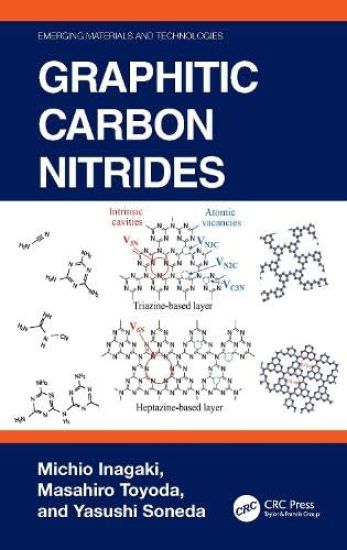
Graphitic Carbon Nitrides

Graphitic Carbon Nitrides

Michio Inagaki; Masahiro Toyoda; Yasushi Soneda

TAYLOR FRANCIS LTD
2026
sidottu
Graphitic carbon nitrides (g-C3N4) have attracted much attention as visible-light active photocatalysts. This book focuses on the synthesis, structure modifications, and applications of these advanced carbon materials. • Summarizes basic structure, texture, and similarities with carbon materials. • Explores applications in water splitting, H2O2-production, CO2-conversion to low-molecular weight hydrocarbons, and degradation removal of environmental pollutants. • Examines visible light irradiation and emphasizes structure modifications of pristine g-C3N4, including doping by single heteroatoms and/or molecules, • Covers formation of g-C3N4-based composites with heavy metals and co-catalysts. • Describes the conversion of g-C3M4 to diamond under high pressure. Authored by leading authorities, this reference work offers the most thorough review of graphitic carbon nitrides available to aid materials engineers in harnessing these materials for a myriad of photocatalytic applications.
Porous Carbons

Porous Carbons

Feiyu Kang; Michio Inagaki; Hiroyuki Itoi

Elsevier Science Publishing Co Inc
2021
nidottu
Carbon materials form pores ranging in size and morphology, from micropores of less than 1nm, to macropores of more than 50nm, and from channel-like spaces with homogenous diameters in carbon nanotubes, to round spaces in various fullerene cages, including irregularly-shaped pores in polycrystalline carbon materials. The large quantity and rapid rate of absorption of various molecules made possible by these attributes of carbon materials are now used in the storage of foreign atoms and ions for energy storage, conversion and adsorption, and for environmental remediation. Porous Carbons: Syntheses and Applications focuses on the fabrication and application of porous carbons. It considers fabrication at three scales: micropores, mesopores, and macropores. Carbon foams, sponges, and 3D-structured carbons are detailed. The title presents applications in four key areas: energy storage, energy conversion, energy adsorption, including batteries, supercapacitors, and fuel cells and environmental remediation, emphasizing the importance of pore structures at the three scales, and the diffusion and storage of various ions and molecules. The book presents a short history of each technique and material, and assesses advantages and disadvantages. This focused book provides researchers with a comprehensive understanding of both pioneering and current synthesis techniques for porous carbons, and their modern applications.
Graphene

Graphene

Kazuyuki Takai; Seiya Tsujimura; Feiyu Kang; Michio Inagaki

Elsevier Science Publishing Co Inc
2019
nidottu
Graphene: Preparation, Properties, Applications and Prospects provides a comprehensive introduction on the science and engineering of graphene. The book is composed of 9 chapters, including a discussion on what graphene is, detailed descriptions of preparation procedures, applications based on respective properties, including electrical, chemical, mechanical, thermal and biomedical, and reviews on materials derived from graphene (graphene derivatives) and other layered materials.
Materials Science and Engineering of Carbon: Fundamentals

Materials Science and Engineering of Carbon: Fundamentals

Michio Inagaki; Feiyu Kang

Butterworth-Heinemann Inc
2014
sidottu
Materials Science and Engineering of Carbon: Fundamentals provides a comprehensive introduction to carbon, the fourth most abundant element in the universe. The contents are organized into two main parts. Following a brief introduction on the history of carbon materials, Part 1 focuses on the fundamental science on the preparation and characterization of various carbon materials, and Part 2 concentrates on their engineering and applications, including hot areas like energy storage and environmental remediation. The book also includes up-to-date advanced information on such newer carbon-based materials as carbon nanotubes and nanofibers, fullerenes and graphenes.
Advanced Materials Science and Engineering of Carbon

Advanced Materials Science and Engineering of Carbon

Michio Inagaki; Feiyu Kang; Masahiro Toyoda; Hidetaka Konno

Butterworth-Heinemann Inc
2013
sidottu
Carbon materials are exceptionally diverse in their preparation, structure, texture, and applications. In Advanced Materials Science and Engineering of Carbon, noted carbon scientist Michio Inagaki and his coauthors cover the most recent advances in carbon materials, including new techniques and processes, carbon materials synthesis, and up-to-date descriptions of current carbon-based materials, trends and applications. Beginning with the synthesis and preparation of nanocarbons, carbon nanotubes, and graphenes, the book then reviews recently developed carbonization techniques, such as templating, electrospinning, foaming, stress graphitization, and the formation of glass-like carbon. The last third of the book is devoted to applications, featuring coverage of carbon materials for energy storage, electrochemical capacitors, lithium-ion rechargeable batteries, and adsorptive storage of hydrogen and methane for environmental protection, photocatalysis, spilled oil recovery, and nuclear applications of isotropic high-density graphite.
Carbon Alloys

Carbon Alloys

E. Yasuda; Michio Inagaki; K. Kaneko; M. Endo; A. Oya; Y. Tanabe

Elsevier Science Ltd
2003
sidottu
In recent years the Japanese have funded a comprehensive study of carbon materials which incorporate other elements including boron, nitrogen and fluorine, hence the title of the project "Carbon Alloys". Coined in 1992, the phrase "Carbon Alloys" can be applied to those materials mainly composed of carbon materials in multi-component systems. The carbon atoms of each component have a physical and/or chemical interactive relationship with other atoms or compounds. The carbon atoms of the components may have different hybrid bonding orbitals to create quite different carbon components. Eiichi Yasuda and his team consider the definition of Carbon Alloys, present the results of the Carbon Alloys projects, describe typical Carbon Alloys and their uses, discuss recent techniques for their characterization, and finally, illustrate potential applications and future developments for Carbon Alloy science. The book contains over thirty chapters on these studies from as many researchers. The most modern of techniques, particularly in the area of spectroscopy, were used as diagnostic tools, and many of these are applicable to pure carbons also. Porosity in carbons received considerable attention.