Kirjailija
Miguel De Cervantes
Kirjat ja teokset yhdessä paikassa: 429 kirjaa, julkaisuja vuosilta 1989–2026, suosituimpiin kuuluu Don Quixote. Vertaile teosten hintoja ja tarkista saatavuus suomalaisista kirjakaupoista.
Nimi esiintyy myös muodoissa: Miguel de Cervantès
429 kirjaa
Kirjojen julkaisuvuodet: 1989–2026.
The Illustrious Scullery-Maid
Miguel De Cervantes
Createspace Independent Publishing Platform
2016
nidottu
In the famous city of Burgos there lived two wealthy cavaliers, one of whom was called Don Diego de Carriazo, and the other Don Juan de Avenda o. Don Diego had a son called after himself, and Don Juan another, whose name was Don Tomas de Avenda o. These two young gentlemen being the principal persons of the following tale, we shall for the sake of brevity call them Carriazo and Avenda o. Carriazo might be about thirteen or little more, when, prompted by a scampish disposition, without having had any cause to complain of bad treatment at home, he ran away from his father's house, and cast himself upon the wide world. So much did he enjoy a life of unrestricted freedom, that amidst all the wants and discomforts attendant upon it, he never missed the plenty of his father's house. He neither tired of trudging on foot, nor cared for cold or heat. For him all seasons of the year were genial spring. His sleep was as sound on a heap of straw as on soft mattresses, and he made himself as snug in a hayloft as between two Holland sheets. In short, he made such way in the profession he had chosen, that he could have given lessons to the famous Guzman de Alfarache.
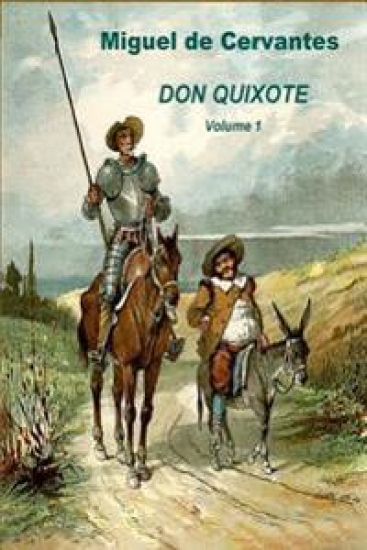
Don Quixote (spelled "Quijote" in modern Spanish) is two separate volumes, now nearly always published as one, that cover the adventures of Don Quixote, also known as the knight or man of La Mancha, a hero who carries his enthusiasm and self-deception to unintentional and comic ends. On one level, Don Quixote works as a satire of the romances of chivalry, which, though still popular in Cervantes' time, had become an object of ridicule among more demanding critics. The choice of a madman as hero also served a critical purpose, for it was "the impression of ill-being or 'in-sanity, ' rather than a finding of dementia or psychosis in clinical terms, that defined the madman for Cervantes and his contemporaries." Indeed, the concept of madness was "associated with physical or moral displacement, as may be seen in the literal and figurative sense of the adjectives eccentric, extravagant, deviant, aberrant, etc." 35] The novel allows Cervantes to illuminate various aspects of human nature. Don Quixote is noble-minded, an enthusiastic admirer of everything good and great, yet having all these fine qualities accidentally blended with a relative kind of madness. He is paired with a character of opposite qualities, Sancho Panza, a man of low self-esteem, who is a compound of grossness and simplicity. Don Quixote is cited as the first classic model of the modern romance or novel, and it has served as the prototype of the comic novel. The humorous situations are mostly burlesque, and it includes satire. Don Quixote is one of the Encyclop?dia Britannica's Great Books of the Western World, while the Russian author Fyodor Dostoyevsky called it "the ultimate and most sublime work of human thinking". 36] It is in Don Quixote that Cervantes coined the popular phrase "the proof of the pudding is in the eating" (por la muestra se conoce el pano), which still sees heavy use in the shortened form of "the proof is in the pudding", and "who walks much and reads much, knows much and sees much" (quien anda mucho y lee mucho, sabe mucho y ve mucho). Includes unique illustrations
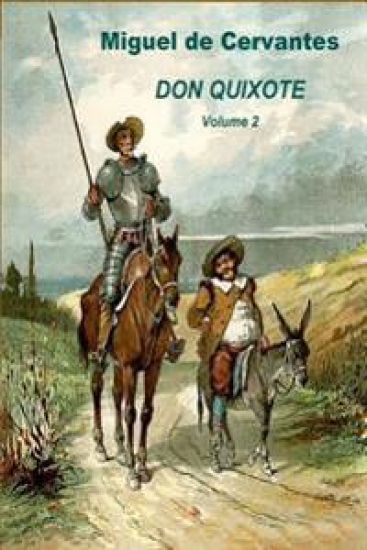
Don Quixote (spelled "Quijote" in modern Spanish) is two separate volumes, now nearly always published as one, that cover the adventures of Don Quixote, also known as the knight or man of La Mancha, a hero who carries his enthusiasm and self-deception to unintentional and comic ends. On one level, Don Quixote works as a satire of the romances of chivalry, which, though still popular in Cervantes' time, had become an object of ridicule among more demanding critics. The choice of a madman as hero also served a critical purpose, for it was "the impression of ill-being or 'in-sanity, ' rather than a finding of dementia or psychosis in clinical terms, that defined the madman for Cervantes and his contemporaries." Indeed, the concept of madness was "associated with physical or moral displacement, as may be seen in the literal and figurative sense of the adjectives eccentric, extravagant, deviant, aberrant, etc." 35] The novel allows Cervantes to illuminate various aspects of human nature. Don Quixote is noble-minded, an enthusiastic admirer of everything good and great, yet having all these fine qualities accidentally blended with a relative kind of madness. He is paired with a character of opposite qualities, Sancho Panza, a man of low self-esteem, who is a compound of grossness and simplicity. Don Quixote is cited as the first classic model of the modern romance or novel, and it has served as the prototype of the comic novel. The humorous situations are mostly burlesque, and it includes satire. Don Quixote is one of the Encyclop?dia Britannica's Great Books of the Western World, while the Russian author Fyodor Dostoyevsky called it "the ultimate and most sublime work of human thinking". 36] It is in Don Quixote that Cervantes coined the popular phrase "the proof of the pudding is in the eating" (por la muestra se conoce el pano), which still sees heavy use in the shortened form of "the proof is in the pudding", and "who walks much and reads much, knows much and sees much" (quien anda mucho y lee mucho, sabe mucho y ve mucho). Includes unique illustrations
Rinconete And Cortadillo
Miguel De Cervantes
Createspace Independent Publishing Platform
2016
nidottu
The History of Don Quixote, Vol. I
Miguel De Cervantes
Createspace Independent Publishing Platform
2015
nidottu
The History of Don Quixote, Volume II.
Miguel De Cervantes
Createspace Independent Publishing Platform
2015
nidottu
The History of Don Quixote, Vol. I,: Complete
Miguel De Cervantes
Createspace Independent Publishing Platform
2015
nidottu
The History of Don Quixote Volume II: Complete
Miguel De Cervantes
Createspace Independent Publishing Platform
2015
nidottu
Rinconete and Cortadillo
Miguel De Cervantes
Createspace Independent Publishing Platform
2015
nidottu
The Illustrious Scullery-maid
Miguel De Cervantes
Createspace Independent Publishing Platform
2015
nidottu
The Licentiate Vidriera
Miguel De Cervantes
Createspace Independent Publishing Platform
2015
nidottu
Dialogue between Scipio and Berganze
Miguel De Cervantes
Createspace Independent Publishing Platform
2015
nidottu
The Jealous Estramaduran
Miguel De Cervantes
Createspace Independent Publishing Platform
2015
nidottu