Kirjojen hintavertailu – 12 903 725 kirjaa ja 27 kauppaa

Kirjailija

Miguel De Cervantes

Kirjat ja teokset yhdessä paikassa: 429 kirjaa, julkaisuja vuosilta 1989–2026, suosituimpiin kuuluu Don Quixote. Vertaile teosten hintoja ja tarkista saatavuus suomalaisista kirjakaupoista.

Nimi esiintyy myös muodoissa: Miguel de Cervantès

429 kirjaa

Kirjojen julkaisuvuodet: 1989–2026.

Don Quijote de la Mancha

Don Quijote de la Mancha

Miguel de Cervantes; Arturo Perez-Reverte

Santillana Educacion, S.L.
2014
nidottu

Halvin toimitettuna 28,60 €

Don Quijote de la Mancha Edicion de la Real Academia Espanola RAE Adaptada por Arturo Perez-Reverte Disfruta de la esencia de El Quijote, gracias a la rigurosa y eficaz adaptacion de la Real Academia Espanola y Arturo Perez Reverte. Edicion de la RAE adaptada con gran maestria por el novelista, periodista y academico Arturo Perez-Reverte. Se eliminaron las historias paralelas y se reenumeraron y fundieron varios capitulos para facilitar la lectura sin interrupciones. Se mantiene el texto original de Cervantes sin desnaturalizarlo ni empobrecerlo. Prologos de Arturo Perez-Reverte y Dario Villanueva (Secretario de la RAE). Contiene ilustraciones originales ineditas, incluida una de Francisco de Goya. Edicion conmemorativa del III Centenario de la RAE. Don Quixote Miguel de Cervantes RAE Edition / Adapted by Arturo Perez-Reverte. This first school-oriented edition of Don Quixote ever published by the Real Academia Espanola (RAE) offers Cervantes s original text brilliantly abridged by renowned author, journalist, and scholar Arturo Perez-Reverte. This new edition gives readers of all ages and reading proficiency levels easy access to the greatest classic in Spanish literature. Enjoy the essence of Don Quixote thanks to the rigorous and compelling adaptation by the Real Academia Espanola and Arturo Perez-Reverte. RAE edition masterfully adapted by novelist, journalist, and academic Arturo Perez-Reverte. Eliminates parallel stories, and combines and renumbers various chapters to facilitate uninterrupted reading. Maintains Cervantes s original text"
Don Quixote Part 3 of 3: In Spanish and English

Don Quixote Part 3 of 3: In Spanish and English

Miguel De Cervantes

Createspace Independent Publishing Platform
2014
nidottu
The novel "Don Quixote" is over four hundred years old (first appearing in 1605, fifteen years prior to the Mayflower reaching the shores of Massachusetts), yet it is still alive and "fresh" today. Russian author Fyodor Dostoyevsky called Don Quixote "the ultimate and most sublime work of human thinking." Samuel "Mark Twain" Clemens admitted that his most-revered work, "The Adventures of Huckleberry Finn" was based on -- or at least heavily influenced by -- this satirical picaresque novel by Cervantes. Ernest Hemingway opined that American literature began with "Huck Finn"; thus, we can trace a literary lineage flowing from Cervantes to Twain to Hemingway and onwards. Considering the above, it is fitting that a native English speaker wanting to learn Spanish (beyond the basic phrases revolving around bathrooms and beer, as well as conversational necessities such as "How are you?," "What is your name?" etc.) would want to read Don Quixote in its original language; and, of course, a native Spanish speaker wanting to learn English could use this volume to the same end. This edition allows for that, with alternating paragraphs in the original Spanish and the translation into English. Here are some quotes about and from "Don Quixote": "I had rather you read fifty "Jumping Frogs" than one Don Quixote. Don Quixote is one of the most exquisite books that was ever written, and to lose it from the world's literature would be as the wresting of a constellation from the symmetry and perfection of the firmament--but neither it nor Shakespeare are proper books for virgins to read until some hand has culled them of their grossness." - Mark Twain, in a letter to his fianc
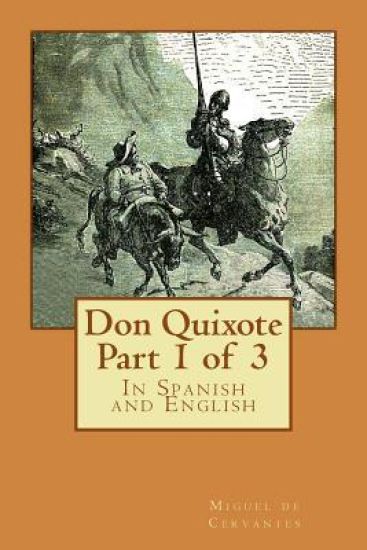
Don Quixote Part 1 of 3: In Spanish and English

Don Quixote Part 1 of 3: In Spanish and English

Miguel De Cervantes

Createspace Independent Publishing Platform
2014
nidottu
The novel "Don Quixote" is over four hundred years old (first appearing in 1605, fifteen years prior to the Mayflower reaching the shores of Massachusetts), yet it is still alive and "fresh" today. Russian author Fyodor Dostoyevsky called Don Quixote "the ultimate and most sublime work of human thinking." Samuel "Mark Twain" Clemens admitted that his most-revered work, "The Adventures of Huckleberry Finn" was based on -- or at least heavily influenced by -- this satirical picaresque novel by Cervantes. Ernest Hemingway opined that American literature began with "Huck Finn"; thus, we can trace a literary lineage flowing from Cervantes to Twain to Hemingway and onwards. Considering the above, it is fitting that a native English speaker wanting to learn Spanish (beyond the basic phrases revolving around bathrooms and beer, as well as conversational necessities such as "How are you?", "What is your name?" etc.) would want to read Don Quixote in its original language; and, of course, a native Spanish speaker wanting to learn English could use this volume to the same end. This edition allows for that, with alternating paragraphs in the original Spanish and the translation into English.
Don Quixote Of The Mancha: V14 Harvard Classics

Don Quixote Of The Mancha: V14 Harvard Classics

Miguel De Cervantes

Literary Licensing, LLC
2014
sidottu
Don Quixote of the Mancha is a classic novel written by Miguel de Cervantes. It tells the story of a man named Alonso Quixano who becomes so obsessed with books about chivalry that he loses touch with reality and decides to become a knight-errant, taking on the name Don Quixote. Together with his loyal squire, Sancho Panza, Don Quixote sets out on a series of adventures, battling windmills he believes to be giants, freeing prisoners he believes to be oppressed, and pursuing his love interest, Dulcinea del Toboso. Along the way, the novel explores themes of reality vs. illusion, the power of imagination, and the nature of heroism. This edition of the book is Volume 14 of the Harvard Classics series and includes an introduction by William Dean Howells. This Is A New Release Of The Original 1909 Edition. This scarce antiquarian book is a facsimile reprint of the old original and may contain some imperfections such as library marks and notations. Because we believe this work is culturally important, we have made it available as part of our commitment for protecting, preserving, and promoting the world's literature in affordable, high quality, modern editions, that are true to their original work.
Don Quixote

Don Quixote

Miguel De Cervantes

Createspace Independent Publishing Platform
2013
nidottu
Published in two volumes, in 1605 and 1615, Don Quixote is considered the most influential work of literature from the Spanish Golden Age and the entire Spanish literary canon. As a founding work of modern Western literature, and one of the earliest canonical novels, it regularly appears high on lists of the greatest works of fiction ever published. It has had major influence on the literary community, as evidenced by direct references in Alexandre Dumas' The Three Musketeers (1844) and Mark Twain's The Adventures of Huckleberry Finn (1884). In a 2002 list, Don Quixote was cited as the "best literary work ever written". Don Quixote, fully titled The Ingenious Gentleman Don Quixote of La Mancha (Spanish: El ingenioso hidalgo don Quijote de la Mancha), is a Spanish novel by Miguel de Cervantes Saavedra. It follows the adventures of Alonso Quijano, an hidalgo who reads so many chivalric novels that he decides to set out to revive chivalry, under the name Don Quixote. He recruits a simple farmer, Sancho Panza, as his squire, who often employs a unique, earthly wit in dealing with Don Quixote's rhetorical orations on antiquated knighthood. Don Quixote is met by the world as it is, initiating such themes as intertextuality, realism, metatheatre, and literary representation.
La Galatea

La Galatea

Miguel De Cervantes

Createspace Independent Publishing Platform
2013
nidottu
La Galatea se suele clasificar como novela pastoril, pero es un veh culo para un estudio psicol gico del amor. Cervantes tuvo durante toda su vida un alt simo concepto de su novela y la intenci n de publicar la segunda parte, pero muri sin haberlo hecho. Se ambienta en alg n lugar -entre ideal y real- a orillas del r o Tajo. Elicio y Erastro son dos pastores enamorados de Galatea, una hermos sima pastora que re ne todas las dem s virtudes de las hero nas cervantinas: discreci n, inteligencia, buen juicio, honestidad y bondad. Pero Galatea adora su independencia espiritual y no quiere verse sujeta por el yugo amoroso, as que har sufrir de desdenes a los dos pastores. El tema pastoril en la novela representa el ideal al que aspira el hombre del Renacimiento.
Don Quixote Vol II

Don Quixote Vol II

Miguel De Cervantes

Createspace Independent Publishing Platform
2012
nidottu
Don Quixote, fully titled "The Ingenious Gentleman Don Quixote of La Mancha", is a novel written by Miguel de Cervantes. The novel follows the adventures of Alonso Quijano, a hidalgo who reads too many chivalric novels and sets out to revive chivalry under the name of Don Quixote. He recruits a simple farmer, Sancho Panza, as his squire, who frequently deals with Don Quixote's rhetorical orations on antiquated knighthood with a unique, earthy wit. Published in two volumes a decade apart, in 1605 and 1615, Don Quixote is considered the most influential work of literature from the Spanish Golden Age and the entire Spanish literary canon. This is Volume II. Miguel de Cervantes (29 September 1547-22 April 1616) was a Spanish novelist, poet, and playwright. His magnum opus, Don Quixote, considered the first modern European novel, is a classic of Western literature.
Don Quixote Vol I

Don Quixote Vol I

Miguel De Cervantes

Createspace Independent Publishing Platform
2012
nidottu
Don Quixote, fully titled "The Ingenious Gentleman Don Quixote of La Mancha", is a novel written by Miguel de Cervantes. The novel follows the adventures of Alonso Quijano, a hidalgo who reads too many chivalric novels and sets out to revive chivalry under the name of Don Quixote. He recruits a simple farmer, Sancho Panza, as his squire, who frequently deals with Don Quixote's rhetorical orations on antiquated knighthood with a unique, earthy wit. Published in two volumes a decade apart, in 1605 and 1615, Don Quixote is considered the most influential work of literature from the Spanish Golden Age and the entire Spanish literary canon. This is Volume I. Miguel de Cervantes (29 September 1547-22 April 1616) was a Spanish novelist, poet, and playwright. His magnum opus, Don Quixote, considered the first modern European novel, is a classic of Western literature.
"the Bagnios of Algiers" and "the Great Sultana"

"the Bagnios of Algiers" and "the Great Sultana"

Miguel de Cervantes

University of Pennsylvania Press
2012
pokkari
Best known today as the author of Don Quixote-one of the most beloved and widely read novels in the Western tradition-Miguel de Cervantes Saavedra (1547-1616) was a poet and a playwright as well. After some early successes on the Madrid stage in the 1580s, his theatrical career was interrupted by other literary efforts. Yet, eager to prove himself as a playwright, shortly before his death he published a collection of his later plays before they were ever performed. With their depiction of captives in North Africa and at the Ottoman court, two of these, "The Bagnios of Algiers" and "The Great Sultana," draw heavily on Cervantes's own experiences as a captive, and echo important episodes in Don Quixote. They are set in a Mediterranean world where Spain and its Muslim neighbors clashed repeatedly while still remaining in close contact, with merchants, exiles, captives, soldiers, and renegades frequently crossing between the two sides. The plays provide revealing insights into Spain's complex perception of the world of Mediterranean Islam. Despite their considerable literary and historical interest, these two plays have never before been translated into English. This edition presents them along with an introductory essay that places them in the context of Cervantes's drama, the early modern stage, and the political and cultural relations between Christianity and Islam in the early modern period.