Kirjojen hintavertailu – 12 859 828 kirjaa ja 27 kauppaa

Kirjailija

Mike Slade

Kirjat ja teokset yhdessä paikassa: 10 kirjaa, julkaisuja vuosilta 2002–2021, suosituimpiin kuuluu Camberwell Assessment of Need for Adults with Developmental and Intellectual Disabilities. Vertaile teosten hintoja ja tarkista saatavuus suomalaisista kirjakaupoista.

10 kirjaa

Kirjojen julkaisuvuodet: 2002–2021.

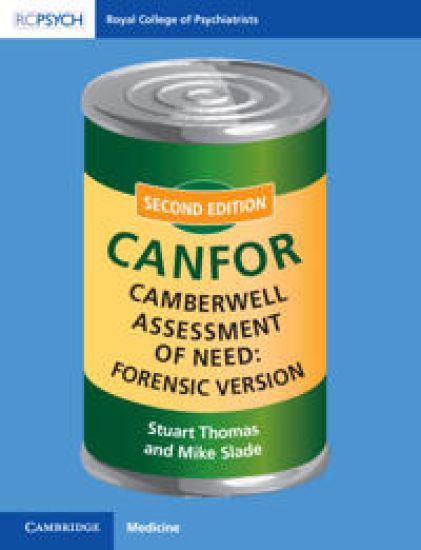
Camberwell Assessment of Need: Forensic Version

Camberwell Assessment of Need: Forensic Version

Stuart Thomas; Mike Slade

RCPsych/Cambridge University Press
2021
pokkari
The Camberwell Assessment of Need Forensic Version (CANFOR) is a tool for assessing the needs of people with mental health problems who are in contact with forensic services. It is based on the CAN, a widely used needs assessment for people with severe mental health problems. Individual needs are assessed in 25 areas of life, spanning health, social, clinical and functional domains. Comprehensive versions are available for research (CANFOR-R) and clinical use (CANFOR-C), as well as a short summary version (CANFOR-S) suitable for both research and clinical use. CANFOR was rigorously developed by a multidisciplinary team at the Institute of Psychiatry, London, and is suitable for use in all forensic mental health and prison settings. This second edition provides an update of the CANFOR tools and their application in clinical and research settings. The assessment forms are freely available to download from the CAN website (researchintorecovery.com/can) and cambridge.org.
Positive Psychotherapy for Psychosis

Positive Psychotherapy for Psychosis

Mike Slade; Tamsin Brownell; Tayyab Rashid; Beate Schrank

Routledge
2016
sidottu
Positive Psychotherapy for Psychosis describes a new psychological intervention, which for the first time applies emerging research from the field of positive psychology specifically to psychosis. The book contains guidance on adapting the approach for use in individual treatments, and on providing part of the intervention, either as individual sessions or by integrating Positive Psychotherapy for Psychosis sessions into other treatments. Divided into two sections – Theory and the Intervention Manual – this book offers methodologically rigorous research, case studies and detailed aims and instructions for clinicians and therapists. The structured, step-by-step manual, for use with clients, includes downloadable handouts, session materials, activities, guides and therapist tips. The manual will be a practical, positive and innovative resource for mental health professionals, providing all the material needed to deliver this evidence-based approach that is designed to improve wellbeing and reduce symptoms experienced by people living with psychosis. Positive Psychotherapy for Psychosis will be of interest to mental health clinicians working with people with psychosis, as well as clinical and counselling psychologists, psychiatrists, mental health nurses, psychotherapists, social workers, occupational therapists, support workers and peer support specialists.
Positive Psychotherapy for Psychosis

Positive Psychotherapy for Psychosis

Mike Slade; Tamsin Brownell; Tayyab Rashid; Beate Schrank

Routledge
2016
nidottu
Positive Psychotherapy for Psychosis describes a new psychological intervention, which for the first time applies emerging research from the field of positive psychology specifically to psychosis. The book contains guidance on adapting the approach for use in individual treatments, and on providing part of the intervention, either as individual sessions or by integrating Positive Psychotherapy for Psychosis sessions into other treatments. Divided into two sections – Theory and the Intervention Manual – this book offers methodologically rigorous research, case studies and detailed aims and instructions for clinicians and therapists. The structured, step-by-step manual, for use with clients, includes downloadable handouts, session materials, activities, guides and therapist tips. The manual will be a practical, positive and innovative resource for mental health professionals, providing all the material needed to deliver this evidence-based approach that is designed to improve wellbeing and reduce symptoms experienced by people living with psychosis. Positive Psychotherapy for Psychosis will be of interest to mental health clinicians working with people with psychosis, as well as clinical and counselling psychologists, psychiatrists, mental health nurses, psychotherapists, social workers, occupational therapists, support workers and peer support specialists.
Partnering for Recovery in Mental Health

Partnering for Recovery in Mental Health

Janis Tondora; Rebecca Miller; Mike Slade; Larry Davidson

John Wiley Sons Inc
2014
nidottu
Partnering for Recovery in Mental Health is a practical guide for conducting person and family-centered recovery planning with individuals with serious mental illnesses and their families. It is derived from the authors’ extensive experience in articulating and implementing recovery-oriented practice and has been tested with roughly 3,000 providers who work in the field as well as with numerous post-graduate trainees in psychology, social work, nursing, and psychiatric rehabilitation. It has consistently received highly favorable evaluations from health care professionals as well as people in recovery from mental illness. This guide represents a new clinical approach to the planning and delivery of mental health care. It emerges from the mental health recovery movement, and has been developed in the process of the efforts to transform systems of care at the local, regional, and national levels to a recovery orientation. It will be an extremely useful tool for planning care within the context of current health care reform efforts and increasingly useful in the future, as systems of care become more person-centered. Consistent with other patient-centered care planning approaches, this book adapts this process specifically to meet the needs of persons with serious mental illnesses and their families. Partnering for Recovery in Mental Health is an invaluable guide for any person involved directly or indirectly in the provision, monitoring, evaluation, or use of community-based mental health care.
Omega Children

Omega Children

Mike Slade

Createspace Independent Publishing Platform
2013
nidottu
Omega Children redefines the classical notion of Artificial Intelligence. This page-turning debut novel by Mike Slade follows former military officer Alison Blair as she adjusts to her new life outside the United Space Force, thrust into a world with scientists and engineers creating the first truly Synthetic Intelligence. The story examines the way cybernetic life could actually be created in a lab, and then tracks their development and maturation as they interact with each other and the society around them. What happens when these beings discover love? Jealousy? Hate? What happens when the Omega Children begin making more and more decisions for themselves. Can they be controlled? All the while the lingering question remains- Are the Omega Children actually alive, or are they simply systems following code? And how are we any different from that?
Evidence in Mental Health Care

Evidence in Mental Health Care

Stefan Priebe; Anthony Clare; Mike Slade

Routledge
2012
nidottu
Mental health care increasingly faces a challenge to be 'evidence based'. However, despite much policy activity in the UK, it's still not clear what sort of evidence researchers should be producing for mental health services, or what purchasers should be looking for. Evidence in Mental Health Care evaluates a range of different research methodologies and types of 'evidence', and includes:* a historical and conceptual analysis of what was regarded as evidence in the past, and what impact it has had in mental health care* a presentation of different methodological approaches, and a discussion of their strengths and weaknesses in providing evidence* how evidence is applied in different treatment and care modalities* different angles on the way forward for providing appropriate evidence to improve current mental health care. Evidence in Mental Health Care will prove vital for the successful extension of evidence-based evaluation to mental health services in general. It will be essential reading for researchers, students and practitioners across the range of mental health disciplines, health service managers and purchasers of services.
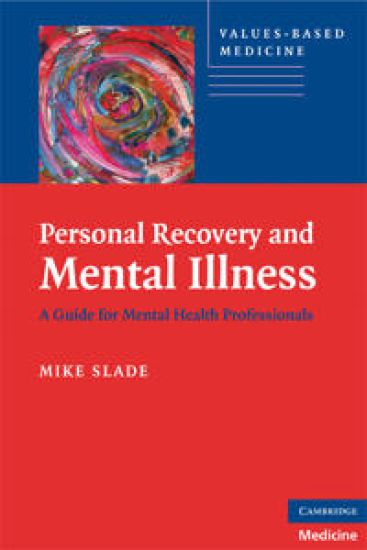
Personal Recovery and Mental Illness

Personal Recovery and Mental Illness

Mike Slade

Cambridge University Press
2009
pokkari
Recovery is a concept which has emerged from the experiences of people with mental illness. It involves a shift away from traditional clinical preoccupations such as managing risk and avoiding relapse, towards new priorities of supporting the person in working towards their own goals and taking responsibility for their own life. This book sets an agenda for mental health services internationally, by converting these ideas of recovery into an action plan for professionals. The underlying principles are explored, and five reasons identified for why supporting recovery should be the primary goal. A new conceptual basis for mental health services is described - the Personal Recovery Framework - which gives primacy to the person over the illness, and identifies the contribution of personal and social identity to recovery. These are brought to life through twenty-six case studies from around the world.
Evidence in Mental Health Care

Evidence in Mental Health Care

Stefan Priebe; Mike Slade

Routledge
2002
sidottu
Mental health care increasingly faces a challenge to be 'evidence based'. However, despite much policy activity in the UK, it's still not clear what sort of evidence researchers should be producing for mental health services, or what purchasers should be looking for. Evidence in Mental Health Care evaluates a range of different research methodologies and types of 'evidence', and includes:* a historical and conceptual analysis of what was regarded as evidence in the past, and what impact it has had in mental health care* a presentation of different methodological approaches, and a discussion of their strengths and weaknesses in providing evidence* how evidence is applied in different treatment and care modalities* different angles on the way forward for providing appropriate evidence to improve current mental health care. Evidence in Mental Health Care will prove vital for the successful extension of evidence-based evaluation to mental health services in general. It will be essential reading for researchers, students and practitioners across the range of mental health disciplines, health service managers and purchasers of services.