
Kirjojen hintavertailu – 12 903 724 kirjaa ja 27 kauppaa

Kirjailija

Mila Versteeg

Kirjat ja teokset yhdessä paikassa: 3 kirjaa, julkaisuja vuosilta 2020–2025, suosituimpiin kuuluu Comparative Constitutional Law and Politics. Vertaile teosten hintoja ja tarkista saatavuus suomalaisista kirjakaupoista.

3 kirjaa

Kirjojen julkaisuvuodet: 2020–2025.

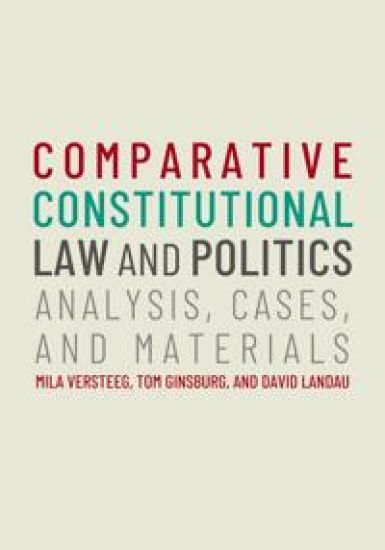
Comparative Constitutional Law and Politics

Comparative Constitutional Law and Politics

Mila Versteeg; Tom Ginsburg; David Landau

OXFORD UNIVERSITY PRESS INC
2025
sidottu

Halvin toimitettuna 284,10 €

Comparative Constitutional Law and Politics: Analysis, Cases, & Materials is the first comprehensive casebook for the field, offering students an innovative and truly global approach to comparative constitutional law. Written by leading scholars, this pioneering resource integrates state-of-the-art literature and caselaw from constitutional law with insights from social science. Its coverage reaches far beyond the traditional canon to help students understand the full reach of the field, drawing on materials from around the world in a truly global approach. Recognizing that constitution-making and interpretation are increasingly transnational, the book includes cases from six continents, addressing historical gaps in coverage. It incorporates data on global trends, and excerpts from cutting-edge scholarship and key judicial decisions, along with detailed explanations by the casebook's editors. Each chapter is organized around a key concept, beginning with a bird's-eye view of the topic that introduces the current state of scholarly and legislative debate and encourages thoughtful student engagement.
Comparative Constitutional Law and Politics

Comparative Constitutional Law and Politics

Mila Versteeg; Tom Ginsburg; David Landau

OXFORD UNIVERSITY PRESS INC
2025
nidottu
Comparative Constitutional Law and Politics: Analysis, Cases, & Materials is the first comprehensive casebook for the field, offering students an innovative and truly global approach to comparative constitutional law. Written by leading scholars, this pioneering resource integrates state-of-the-art literature and caselaw from constitutional law with insights from social science. Its coverage reaches far beyond the traditional canon to help students understand the full reach of the field, drawing on materials from around the world in a truly global approach. Recognizing that constitution-making and interpretation are increasingly transnational, the book includes cases from six continents, addressing historical gaps in coverage. It incorporates data on global trends, and excerpts from cutting-edge scholarship and key judicial decisions, along with detailed explanations by the casebook's editors. Each chapter is organized around a key concept, beginning with a bird's-eye view of the topic that introduces the current state of scholarly and legislative debate and encourages thoughtful student engagement.
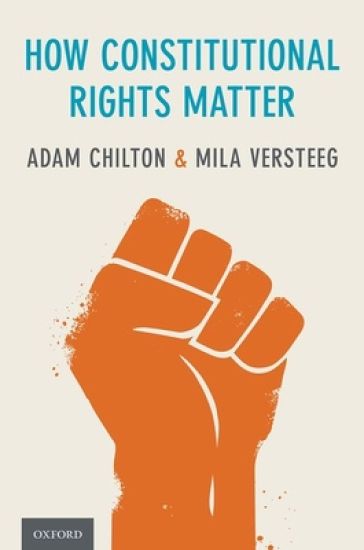
How Constitutional Rights Matter

How Constitutional Rights Matter

Adam Chilton; Mila Versteeg

Oxford University Press Inc
2020
sidottu
Does constitutionalizing rights improve respect for those rights in practice? Drawing on statistical analyses, survey experiments, and case studies from around the world, this book argues that enforcing constitutional rights is not easy, but that some rights are harder to repress than others. First, enshrining rights in constitutions does not automatically ensure that those rights will be respected. For rights to matter, rights violations need to be politically costly. But this is difficult to accomplish for unconnected groups of citizens. Second, some rights are easier to enforce than others, especially those with natural constituencies that can mobilize for their enforcement. This is the case for rights that are practiced by and within organizations, such as the rights to religious freedom, to unionize, and to form political parties. Because religious groups, trade unions and parties are highly organized, they are well-equipped to use the constitution to resist rights violations. As a result, these rights are systematically associated with better practices. By contrast, rights that are practiced on an individual basis, such as free speech or the prohibition of torture, often lack natural constituencies to enforce them, which makes it easier for governments to violate these rights. Third, even highly organized groups armed with the constitution may not be able to stop governments dedicated to rights-repression. When constitutional rights are enforced by dedicated organizations, they are thus best understood as speed bumps that slow down attempts at repression. An important contribution to comparative constitutional law, this book provides a comprehensive picture of the spread of constitutional rights, and their enforcement, around the world.