

Kirjailija
Milo Milton Quaife
Kirjat ja teokset yhdessä paikassa: 46 kirjaa, julkaisuja vuosilta 1989–2026, suosituimpiin kuuluu The Personal Narrative of James O. Pattie of Kentucky. Vertaile teosten hintoja ja tarkista saatavuus suomalaisista kirjakaupoista.
46 kirjaa
Kirjojen julkaisuvuodet: 1989–2026.


The Personal Narrative of James O. Pattie
James Ohio Pattie; Timothy (EDT) Flint; Milo Milton Quaife
Kessinger Pub
2006
pokkari
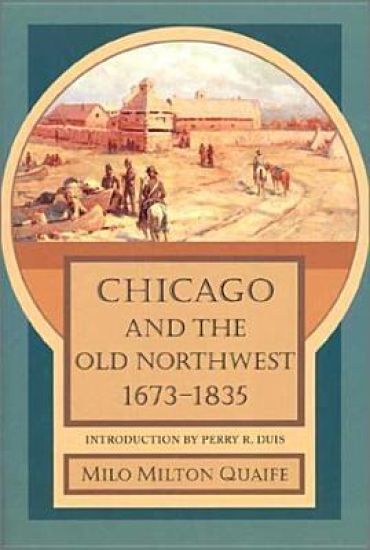
Chicago and the Old Northwest, 1673-1835
Milo Milton Quaife
University of Illinois Press
2001
nidottu
In this sweeping survey, Milo Milton Quaife traces the events leading from Chicago's emergence as a key outpost at the edge of the frontier to its establishment as the crossroads of American commerce. Strategically located at the head of the Great Lakes on the Chicago portage, one of the main highways connecting the Great Lakes-St. Lawrence waterway with the Mississippi River, Chicago was equally valued by explorers, traders, settlers, and governments. Quaife narrates the opening of trade and the course of European exploration, facilitated by the Chicago portage and subsequent construction of the Illinois and Michigan Canal. He profiles the personalities who shaped the early Chicago area, from the French explorers La Salle, Marquette, and Joliet to the ambitious Champlain, who set the course for decades to come by securing for New France the enmity of the Iroquois. Quaife provides a full description of the Indian trade, which constituted the basis of commerce in the region for the entire period covered by the book, as well as a blow-by-blow account of how old rivalries and alliances between Indian tribes complicated the English and French plans for divvying up the New World. He also describes the conflicts between natives and whites with sympathy and detail on both sides, depicting Indian attacks on white settlements as rationally motivated acts aiming toward specific goals of strategy or revenge. First published in 1913, Chicago and the Old Northwest, 1673-1835 is one of the earliest works of a man who became one of the premier scholars of his generation. In a new introduction, Chicago historian Perry R. Duis sketches Quaife's long and varied career, his influence on the history profession, and his crusade to prove that a black trader was the first permanent resident of Chicago.
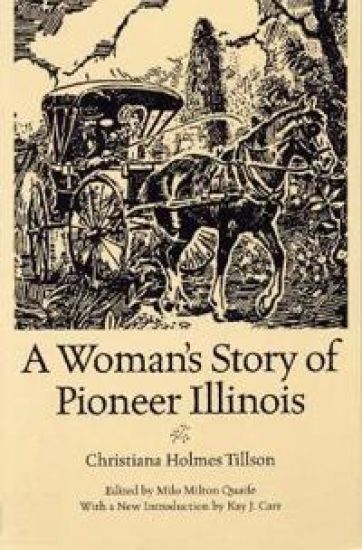
A Woman's Story of Pioneer Illinois
Christiana Holmes Tillson; Milo Milton Quaife; Kay J Carr
Southern Illinois University Press
1995
nidottu
Christiana and John Tillson moved from Massachusetts to central Illinois in 1822. Upon arriving in Montgomery County near what would soon be Hillsboro, they set up a general store and real estate business and began to raise a family. A half century later, Christiana Tillson wrote about her early days in Illinois in a memoir published by R. R. Donnelley in 1919. In it she describes her husband's rise to wealth through the speculative land boom during the 1820s and 1830s and his loss of fortune when the land business went bust after the Specie Circular was issued in 1836. The Tillsons lived quite ordinary lives in extraordinary times, notes Kay J. Carr, introducing this edition. Their views and sensibilities, Carr says, might seem strange to us, but they were entirely normal to people in the early nineteenth century. Thus Tillson's memoir provides vignettes of ordinary nineteenth-century American life.

Forty Years a Fur Trader on the Upper Missouri
Milo Milton Quaife; Charles Larpenteur
Bison Books
1989
pokkari
The son of French immigrants who settled in Maryland, Charles Larpenteur was so eager to see the real American West that he talked himself into a job with the Rocky Mountain Fur Company in 1833. When William Sublette and Robert Campbell sold out to the American Fur Company a year later they recommended the steady and sober young Larpenteur to Kenneth McKenzie, who hired him as a clerk. For forty years, as a company man and as an independent agent, the Frenchman would ply the fur trade on the upper Missouri River. Based on Larpenteur’s daily journals, this memoir is unparalleled in describing the business side and social milieu of the fur trade conducted from wintering houses and subposts in the Indian country. As Paul L. Hedren notes in his introduction, Larpenteur moved comfortably among Indians and all levels of the trade’s hierarchy. But he lived during a time of transition and decline in the business, and his vivid recital of his personal affairs often seems to bear out his feeling that he was “born for misfortune.” His lasting legacy is this book, which is reprinted from the one-volume Lakeside Classics edition of 1933.