Kirjojen hintavertailu – 12 903 724 kirjaa ja 27 kauppaa

Kirjailija

Ming Xin

Kirjat ja teokset yhdessä paikassa: 7 kirjaa, julkaisuja vuosilta 2017–2026, suosituimpiin kuuluu Cooperative Control of Multi-Agent Systems. Vertaile teosten hintoja ja tarkista saatavuus suomalaisista kirjakaupoista.

7 kirjaa

Kirjojen julkaisuvuodet: 2017–2026.

Spatial-Temporal Cooperative Guidance for Multiple Flight Vehicles

Spatial-Temporal Cooperative Guidance for Multiple Flight Vehicles

Wei Dong; Chunyan Wang; Jianan Wang; Ming Xin; Fang Deng

Springer Nature Switzerland AG
2025
sidottu
The spatial-temporal cooperative guidance problem for multiple flight vehicles has garnered significant attention in recent years due to its potential benefits in both military and civil fields. This book provides a concise but holistic introduction to this practical problem and presents a summative collection of the latest solutions to the concerned challenges, thereby providing some theoretical support for enhancing the synergism and applicability of cooperative guidance for multiple flight vehicles. This book consists of nine chapters. In Chapter 1, recent works on cooperative guidance are systematically recalled. Chapter 2 introduces the common formulation and unique challenges of the cooperative guidance problem from a practical viewpoint. In Chapter 3, a varying-gain proportional navigation guidance law with accurate time-to-go prediction is developed to realize precise control of the impact time. In Chapter 4, in response to the inherent finite-time property of the cooperative guidance problem, a fixed-time convergent error dynamic is proposed to design a 3D distributed cooperative guidance law with enhanced convergence. In Chapter 5, a command-decoupled design strategy is proposed to address the challenging spatial-temporal cooperative guidance problem through the derivation and combination of the coplanar cooperative guidance and planar pursuit guidance commands. In Chapter 6, an integrated design strategy based on rotational operations on spatial vectors is proposed to simultaneously satisfy the impact angle and time constraints. In Chapter 7, a multiple-stage cooperative guidance strategy is developed to satisfy the spatial-temporal constraints without relying on time-to-go information. In Chapter 8, a unified command augmentation method is proposed to prevent the seeker's FOV from exceeding the boundary throughout the cooperative guidance. Finally, Chapter 9 concludes this book and offers an instructive opinion on the future directions of the cooperative guidance problem in both academic and engineering investigations. Therefore, this book can not only serve as a reference for researchers who are interested in this field with systematic and inspirational perspectives, but also be a useful handbook for engineers engaged in cooperative guidance and control of multiple flight vehicles.

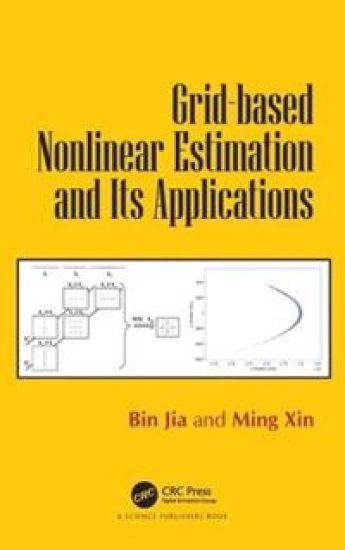
Grid-based Nonlinear Estimation and Its Applications
Grid-based Nonlinear Estimation and its Applications presents new Bayesian nonlinear estimation techniques developed in the last two decades. Grid-based estimation techniques are based on efficient and precise numerical integration rules to improve performance of the traditional Kalman filtering based estimation for nonlinear and uncertainty dynamic systems. The unscented Kalman filter, Gauss-Hermite quadrature filter, cubature Kalman filter, sparse-grid quadrature filter, and many other numerical grid-based filtering techniques have been introduced and compared in this book. Theoretical analysis and numerical simulations are provided to show the relationships and distinct features of different estimation techniques. To assist the exposition of the filtering concept, preliminary mathematical review is provided. In addition, rather than merely considering the single sensor estimation, multiple sensor estimation, including the centralized and decentralized estimation, is included. Different decentralized estimation strategies, including consensus, diffusion, and covariance intersection, are investigated. Diverse engineering applications, such as uncertainty propagation, target tracking, guidance, navigation, and control, are presented to illustrate the performance of different grid-based estimation techniques.
Cooperative Control of Multi-Agent Systems

Cooperative Control of Multi-Agent Systems

Jianan Wang; Chunyan Wang; Ming Xin; Zhengtao Ding; Jiayuan Shan

Academic Press Inc
2020
nidottu
Cooperative Control of Multi-Agent Systems: An Optimal and Robust Perspective reports and encourages technology transfer in the field of cooperative control of multi-agent systems. The book deals with UGVs, UAVs, UUVs and spacecraft, and more. It presents an extended exposition of the authors’ recent work on all aspects of multi-agent technology. Modelling and cooperative control of multi-agent systems are topics of great interest, across both academia (research and education) and industry (for real applications and end-users). Graduate students and researchers from a wide spectrum of specialties in electrical, mechanical or aerospace engineering fields will use this book as a key resource.
Grid-based Nonlinear Estimation and Its Applications
Grid-based Nonlinear Estimation and its Applications presents new Bayesian nonlinear estimation techniques developed in the last two decades. Grid-based estimation techniques are based on efficient and precise numerical integration rules to improve performance of the traditional Kalman filtering based estimation for nonlinear and uncertainty dynamic systems. The unscented Kalman filter, Gauss-Hermite quadrature filter, cubature Kalman filter, sparse-grid quadrature filter, and many other numerical grid-based filtering techniques have been introduced and compared in this book. Theoretical analysis and numerical simulations are provided to show the relationships and distinct features of different estimation techniques. To assist the exposition of the filtering concept, preliminary mathematical review is provided. In addition, rather than merely considering the single sensor estimation, multiple sensor estimation, including the centralized and decentralized estimation, is included. Different decentralized estimation strategies, including consensus, diffusion, and covariance intersection, are investigated. Diverse engineering applications, such as uncertainty propagation, target tracking, guidance, navigation, and control, are presented to illustrate the performance of different grid-based estimation techniques.
Spatial-Temporal Cooperative Guidance for Multiple Flight Vehicles

Spatial-Temporal Cooperative Guidance for Multiple Flight Vehicles

Dong Wei; Wang Chunyan; Jianan Wang; Ming Xin; Deng Fang

Springer Nature Switzerland AG
2026
Nidottu
The spatial-temporal cooperative guidance problem for multiple flight vehicles has garnered significant attention in recent years due to its potential benefits in both military and civil fields. This book provides a concise but holistic introduction to this practical problem and presents a summative collection of the latest solutions to the concerned challenges, thereby providing some theoretical support for enhancing the synergism and applicability of cooperative guidance for multiple flight vehicles. This book consists of nine chapters. In Chapter 1, recent works on cooperative guidance are systematically recalled. Chapter 2 introduces the common formulation and unique challenges of the cooperative guidance problem from a practical viewpoint. In Chapter 3, a varying-gain proportional navigation guidance law with accurate time-to-go prediction is developed to realize precise control of the impact time. In Chapter 4, in response to the inherent finite-time property of the cooperative guidance problem, a fixed-time convergent error dynamic is proposed to design a 3D distributed cooperative guidance law with enhanced convergence. In Chapter 5, a command-decoupled design strategy is proposed to address the challenging spatial-temporal cooperative guidance problem through the derivation and combination of the coplanar cooperative guidance and planar pursuit guidance commands. In Chapter 6, an integrated design strategy based on rotational operations on spatial vectors is proposed to simultaneously satisfy the impact angle and time constraints. In Chapter 7, a multiple-stage cooperative guidance strategy is developed to satisfy the spatial-temporal constraints without relying on time-to-go information. In Chapter 8, a unified command augmentation method is proposed to prevent the seeker's FOV from exceeding the boundary throughout the cooperative guidance. Finally, Chapter 9 concludes this book and offers an instructive opinion on the future directions of the cooperative guidance problem in both academic and engineering investigations. Therefore, this book can not only serve as a reference for researchers who are interested in this field with systematic and inspirational perspectives, but also be a useful handbook for engineers engaged in cooperative guidance and control of multiple flight vehicles.

China's New Strategic Layout

China's New Strategic Layout

Ming Xin

Springer Verlag, Singapore
2019
nidottu
This book, based on the Chinese dream and its basic principles, global significance, path of implementation and practical requirements, systemically explains China’s Four-Pronged Comprehensive Strategy. The Four-Pronged Comprehensive Strategy is the strategic concept of the Communist Party of contemporary China. In the coming five and even the fifty years, the economic and social development of the Chinese society will be centering on it. Comprehensively constructing a moderately prosperous society is the strategic goal, comprehensively deepening reform and advancing the law-based governance of China are the engine and guarantee in realizing the strategic goal, while strengthening the Party Self-discipline represents the strategic measures to build up a firm core leadership. The Four-Pronged Comprehensive Strategy shows not only the CPC’s view of China but also the view of world.
China's New Strategic Layout

China's New Strategic Layout

Ming Xin

Springer Verlag, Singapore
2017
sidottu
This book, based on the Chinese dream and its basic principles, global significance, path of implementation and practical requirements, systemically explains China’s Four-Pronged Comprehensive Strategy. The Four-Pronged Comprehensive Strategy is the strategic concept of the Communist Party of contemporary China. In the coming five and even the fifty years, the economic and social development of the Chinese society will be centering on it. Comprehensively constructing a moderately prosperous society is the strategic goal, comprehensively deepening reform and advancing the law-based governance of China are the engine and guarantee in realizing the strategic goal, while strengthening the Party Self-discipline represents the strategic measures to build up a firm core leadership. The Four-Pronged Comprehensive Strategy shows not only the CPC’s view of China but also the view of world.