Kirjojen hintavertailu – 12 903 724 kirjaa ja 27 kauppaa

Kirjailija

Mingqiang Wang

Kirjat ja teokset yhdessä paikassa: 3 kirjaa, julkaisuja vuosilta 2015–2024, suosituimpiin kuuluu Mathematical Foundations of Public Key Cryptography. Vertaile teosten hintoja ja tarkista saatavuus suomalaisista kirjakaupoista.

3 kirjaa

Kirjojen julkaisuvuodet: 2015–2024.

Landscape of Next Generation Sequencing Using Pattern Recognition

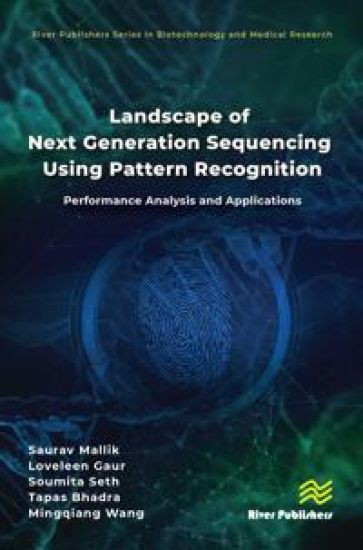
Landscape of Next Generation Sequencing Using Pattern Recognition

Saurav Mallik; Loveleen Gaur; Soumita Seth; Tapas Bhadra; Mingqiang Wang

River Publishers
2024
sidottu
This book focuses on an eminent technology called next generation sequencing (NGS) which has entirely changed the procedure of examining organisms and will have a great impact on biomedical research and disease diagnosis. Numerous computational challenges have been brought on by the rapid advancement of large-scale next-generation sequencing (NGS) technologies and their application. The term ""biomedical imaging"" refers to the use of a variety of imaging techniques (such as X-rays, CT scans, MRIs, ultrasounds, etc.) to get images of the interior organs of a human being for potential diagnostic, treatment planning, follow-up, and surgical purposes. In these circumstances, deep learning, a new learning method that uses multi-layered artificial neural networks (ANNs) for unsupervised, supervised, and semi-supervised learning, has attracted a lot of interest for applications to NGS and imaging, even when both of these data are used for the same group of patients. The three main research phenomena in biomedical research are disease classification, feature dimension reduction, and heterogeneity. AI approaches are used by clinical researchers to efficiently analyse extremely complicated biomedical datasets (e.g., multi-omic datasets. With the use of NGS data and biomedical imaging of various human organs, researchers may predict diseases using a variety of deep learning models. Unparalleled prospects to improve the work of radiologists, clinicians, and biomedical researchers, speed up disease detection and diagnosis, reduce treatment costs, and improve public health are presented by using deep learning models in disease prediction using NGS and biomedical imaging. This book influences a variety of critical disease data and medical images.
Mathematical Foundations of Public Key Cryptography

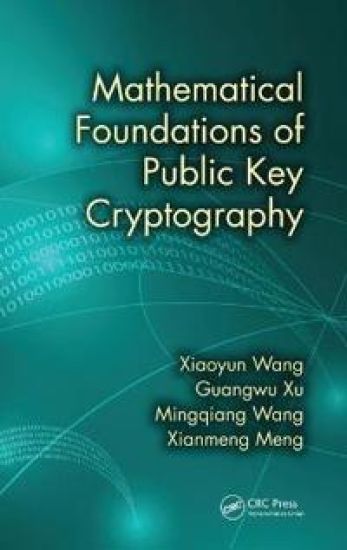
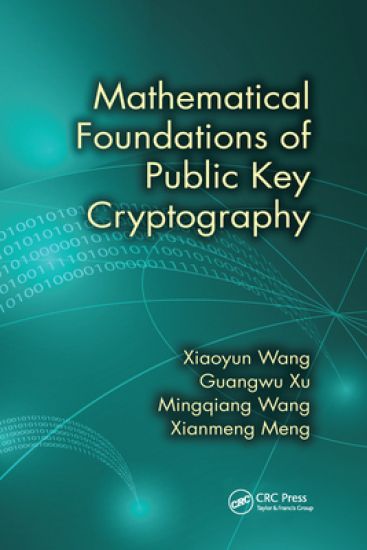
Mathematical Foundations of Public Key Cryptography

Xiaoyun Wang; Guangwu Xu; Mingqiang Wang; Xianmeng Meng

CRC Press
2020
nidottu
In Mathematical Foundations of Public Key Cryptography, the authors integrate the results of more than 20 years of research and teaching experience to help students bridge the gap between math theory and crypto practice. The book provides a theoretical structure of fundamental number theory and algebra knowledge supporting public-key cryptography. Rather than simply combining number theory and modern algebra, this textbook features the interdisciplinary characteristics of cryptography—revealing the integrations of mathematical theories and public-key cryptographic applications. Incorporating the complexity theory of algorithms throughout, it introduces the basic number theoretic and algebraic algorithms and their complexities to provide a preliminary understanding of the applications of mathematical theories in cryptographic algorithms. Supplying a seamless integration of cryptography and mathematics, the book includes coverage of elementary number theory; algebraic structure and attributes of group, ring, and field; cryptography-related computing complexity and basic algorithms, as well as lattice and fundamental methods of lattice cryptanalysis. The text consists of 11 chapters. Basic theory and tools of elementary number theory, such as congruences, primitive roots, residue classes, and continued fractions, are covered in Chapters 1-6. The basic concepts of abstract algebra are introduced in Chapters 7-9, where three basic algebraic structures of groups, rings, and fields and their properties are explained. Chapter 10 is about computational complexities of several related mathematical algorithms, and hard problems such as integer factorization and discrete logarithm. Chapter 11 presents the basics of lattice theory and the lattice basis reduction algorithm—the LLL algorithm and its application in the cryptanalysis of the RSA algorithm. Containing a number of exercises on key algorithms, the book is suitable for use as a textbook for undergraduate students and first-year graduate students in information security programs. It is also an ideal reference book for cryptography professionals looking to master public-key cryptography.
Mathematical Foundations of Public Key Cryptography

Mathematical Foundations of Public Key Cryptography

Xiaoyun Wang; Guangwu Xu; Mingqiang Wang; Xianmeng Meng

Productivity Press
2015
sidottu
In Mathematical Foundations of Public Key Cryptography, the authors integrate the results of more than 20 years of research and teaching experience to help students bridge the gap between math theory and crypto practice. The book provides a theoretical structure of fundamental number theory and algebra knowledge supporting public-key cryptography. Rather than simply combining number theory and modern algebra, this textbook features the interdisciplinary characteristics of cryptography—revealing the integrations of mathematical theories and public-key cryptographic applications. Incorporating the complexity theory of algorithms throughout, it introduces the basic number theoretic and algebraic algorithms and their complexities to provide a preliminary understanding of the applications of mathematical theories in cryptographic algorithms. Supplying a seamless integration of cryptography and mathematics, the book includes coverage of elementary number theory; algebraic structure and attributes of group, ring, and field; cryptography-related computing complexity and basic algorithms, as well as lattice and fundamental methods of lattice cryptanalysis. The text consists of 11 chapters. Basic theory and tools of elementary number theory, such as congruences, primitive roots, residue classes, and continued fractions, are covered in Chapters 1-6. The basic concepts of abstract algebra are introduced in Chapters 7-9, where three basic algebraic structures of groups, rings, and fields and their properties are explained. Chapter 10 is about computational complexities of several related mathematical algorithms, and hard problems such as integer factorization and discrete logarithm. Chapter 11 presents the basics of lattice theory and the lattice basis reduction algorithm—the LLL algorithm and its application in the cryptanalysis of the RSA algorithm. Containing a number of exercises on key algorithms, the book is suitable for use as a textbook for undergraduate students and first-year graduate students in information security programs. It is also an ideal reference book for cryptography professionals looking to master public-key cryptography.