Kirjojen hintavertailu – 12 859 828 kirjaa ja 27 kauppaa

Kirjailija

Mirjana Lozanovska

Kirjat ja teokset yhdessä paikassa: 4 kirjaa, julkaisuja vuosilta 2019–2024, suosituimpiin kuuluu Immigrant Industry. Vertaile teosten hintoja ja tarkista saatavuus suomalaisista kirjakaupoista.

4 kirjaa

Kirjojen julkaisuvuodet: 2019–2024.

Immigrant Industry

Immigrant Industry

Anoma Pieris; Mirjana Lozanovska; Dr Alexandra Dellios; Andrew Saniga

BERGHAHN BOOKS
2024
sidottu
After the end of the Second World War, migrants were critical to the spatial making of modern Australia. Major federally funded industries driving postwar nation-building programs depended on the employment of large numbers of people who had been displaced by the war. Directed to remote, rural and urban industrial sites, migrant labor and resettlement altered the nation’s physical landscape, providing Australia with its contemporary economic base. While the immigrant contribution to nation-building in cultural terms is well-known, its everyday spatial, architectural and landscape transformations remain unexamined. This book aims to bring to the foreground postwar industry and immigration to comprehensively document a uniquely Australian shaping of the built environment.

Immigrant Industry

Immigrant Industry

Anoma Pieris; Mirjana Lozanovska; Dr Alexandra Dellios; Andrew Saniga

BERGHAHN BOOKS
2024
nidottu
After the end of the Second World War, migrants were critical to the spatial making of modern Australia. Major federally funded industries driving postwar nation-building programs depended on the employment of large numbers of people who had been displaced by the war. Directed to remote, rural and urban industrial sites, migrant labor and resettlement altered the nation’s physical landscape, providing Australia with its contemporary economic base. While the immigrant contribution to nation-building in cultural terms is well-known, its everyday spatial, architectural and landscape transformations remain unexamined. This book aims to bring to the foreground postwar industry and immigration to comprehensively document a uniquely Australian shaping of the built environment.
Migrant Housing

Migrant Housing

Mirjana Lozanovska

Routledge
2020
nidottu
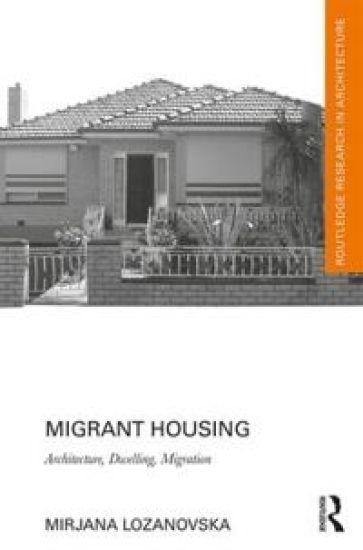
Migrant Housing, the latest book by author Mirjana Lozanovska, examines the house as the architectural construct in the processes of migration. Housing is pivotal to any migration story, with studies showing that migrant participation in the adaptation or building of houses provides symbolic materiality of belonging and the platform for agency and productivity in the broader context of the immigrant city. Migration also disrupts the cohesion of everyday dwelling and homeland integral to housing, and the book examines this displacement of dwelling and its effect on migrant housing. This timely volume investigates the poetic and political resonance between migration and architecture, challenging the idea of the ‘house’ as a singular theoretical construct. Divided into three parts, Histories and theories of post-war migrant housing, House/home and Mapping migrant spaces of home, it draws on data studies from Australia and Macedonia, with literature from Canada, Sweden and Germany, to uncover the effects of unprivileged post-war migration in the late twentieth century on the house as architectural and normative model, and from this perspective negotiates the disciplinary boundaries of architecture.
Migrant Housing

Migrant Housing

Mirjana Lozanovska

Routledge
2019
sidottu
Migrant Housing, the latest book by author Mirjana Lozanovska, examines the house as the architectural construct in the processes of migration. Housing is pivotal to any migration story, with studies showing that migrant participation in the adaptation or building of houses provides symbolic materiality of belonging and the platform for agency and productivity in the broader context of the immigrant city. Migration also disrupts the cohesion of everyday dwelling and homeland integral to housing, and the book examines this displacement of dwelling and its effect on migrant housing. This timely volume investigates the poetic and political resonance between migration and architecture, challenging the idea of the ‘house’ as a singular theoretical construct. Divided into three parts, Histories and theories of post-war migrant housing, House/home and Mapping migrant spaces of home, it draws on data studies from Australia and Macedonia, with literature from Canada, Sweden and Germany, to uncover the effects of unprivileged post-war migration in the late twentieth century on the house as architectural and normative model, and from this perspective negotiates the disciplinary boundaries of architecture.