Kirjojen hintavertailu – 12 903 725 kirjaa ja 27 kauppaa
Kirjailija
Miroslaw Lachowicz
Kirjat ja teokset yhdessä paikassa: 6 kirjaa, julkaisuja vuosilta 1991–2025, suosituimpiin kuuluu Generalized Kinetic Models In Applied Sciences: Lecture Notes On Mathematical Problems. Vertaile teosten hintoja ja tarkista saatavuus suomalaisista kirjakaupoista.
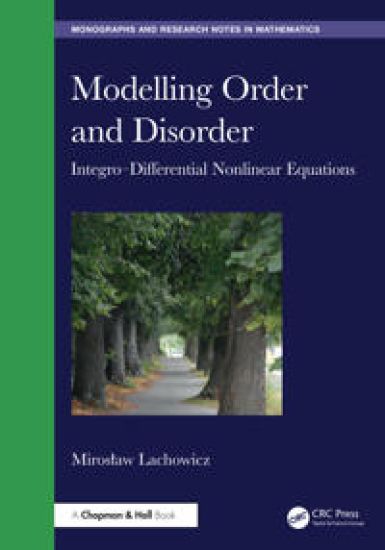
Modelling Order and Disorder: Integro–Differential Nonlinear Equations provides an overview of a general mathematical structure: integro-differential nonlinear equations. This mathematical structure provides a unified approach to model complex systems in social sciences, economics, biology, medicine, and other quantitative disciplines. The general aim of the book is to reflect possible organization and disorganization phenomena in the applied sciences, as well as to focus on non–local interactions. Features • Applications to social, biological, and physical phenomena• Suitable for researchers and post-graduate students• Open questions and perspectives on future avenues of research.
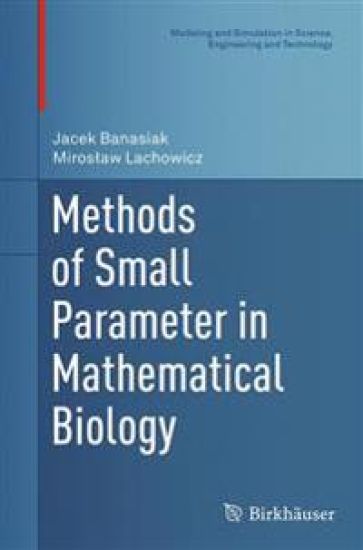
This monograph presents new tools for modeling multiscale biological processes. Natural processes are usually driven by mechanisms widely differing from each other in the time or space scale at which they operate and thus should be described by appropriate multiscale models. However, looking at all such scales simultaneously is often infeasible, costly, and provides information that is redundant for a particular application. Hence, there has been a growing interest in providing a more focused description of multiscale processes by aggregating variables in a way that is relevant to the purpose at hand and preserves the salient features of the dynamics. Many ad hoc methods have been devised, and the aim of this book is to present a systematic way of deriving the so-called limit equations for such aggregated variables and ensuring that the coefficients of these equations encapsulate the relevant information from the discarded levels of description. Since any approximation is only valid if an estimate of the incurred error is available, the tools the authors describe allow for proving that the solutions to the original multiscale family of equations converge to the solution of the limit equation if the relevant parameter converges to its critical value. The chapters are arranged according to the mathematical complexity of the analysis, from systems of ordinary linear differential equations, through nonlinear ordinary differential equations, to linear and nonlinear partial differential equations. Many chapters begin with a survey of mathematical techniques needed for the analysis. All problems discussed in this book belong to the class of singularly perturbed problems; that is, problems in which the structure of the limit equation is significantly different from that of the multiscale model. Such problems appear in all areas of science and can be attacked using many techniques. Methods of Small Parameter in Mathematical Biology will appeal to senior undergraduate and graduate students in applied and biomathematics, as well as researchers specializing in differential equations and asymptotic analysis.
This monograph presents new tools for modeling multiscale biological processes. Natural processes are usually driven by mechanisms widely differing from each other in the time or space scale at which they operate and thus should be described by appropriate multiscale models. However, looking at all such scales simultaneously is often infeasible, costly, and provides information that is redundant for a particular application. Hence, there has been a growing interest in providing a more focused description of multiscale processes by aggregating variables in a way that is relevant to the purpose at hand and preserves the salient features of the dynamics. Many ad hoc methods have been devised, and the aim of this book is to present a systematic way of deriving the so-called limit equations for such aggregated variables and ensuring that the coefficients of these equations encapsulate the relevant information from the discarded levels of description. Since any approximation is only valid if an estimate of the incurred error is available, the tools the authors describe allow for proving that the solutions to the original multiscale family of equations converge to the solution of the limit equation if the relevant parameter converges to its critical value. The chapters are arranged according to the mathematical complexity of the analysis, from systems of ordinary linear differential equations, through nonlinear ordinary differential equations, to linear and nonlinear partial differential equations. Many chapters begin with a survey of mathematical techniques needed for the analysis. All problems discussed in this book belong to the class of singularly perturbed problems; that is, problems in which the structure of the limit equation is significantly different from that of the multiscale model. Such problems appear in all areas of science and can be attacked using many techniques. Methods of Small Parameter in Mathematical Biology will appeal to senior undergraduate and graduate students in applied and biomathematics, as well as researchers specializing in differential equations and asymptotic analysis.
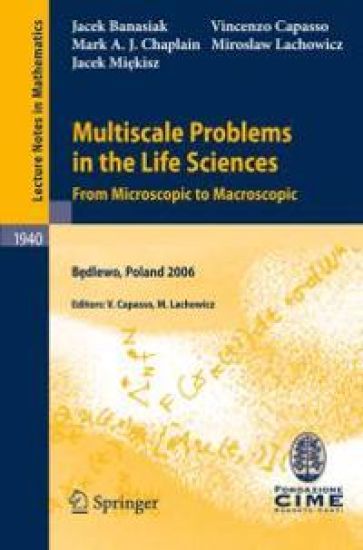
The aim of this volume that presents lectures given at a joint CIME and Banach Center Summer School, is to offer a broad presentation of a class of updated methods providing a mathematical framework for the development of a hierarchy of models of complex systems in the natural sciences, with a special attention to biology and medicine. Mastering complexity implies sharing different tools requiring much higher level of communication between different mathematical and scientific schools, for solving classes of problems of the same nature. Today more than ever, one of the most important challenges derives from the need to bridge parts of a system evolving at different time and space scales, especially with respect to computational affordability. As a result the content has a rather general character; the main role is played by stochastic processes, positive semigroups, asymptotic analysis, kinetic theory, continuum theory, and game theory.
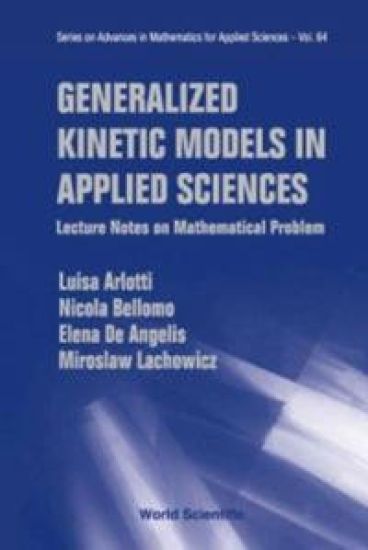
This book deals with analytic problems related to some developments and generalizations of the Boltzmann equation toward the modeling and qualitative analysis of large systems that are of interest in applied sciences. These generalizations are documented in the various surveys edited by Bellomo and Pulvirenti with reference to models of granular media, traffic flow, mathematical biology, communication networks, and coagulation models. The above literature motivates applied mathematicians to study the Cauchy problem and to develop an asymptotic analysis for models regarded as developments of the Boltzmann equation. This book aims to initiate the research plan by the analyzing afore mentioned analysis problems. The first generalization dealt with refers to the averaged Boltzmann equation, which is obtained by suitable averaging of the distribution function of the field particles into the action domain of the test particle. This model is further developed to describe equations with dissipative collisions and a class of models that are of interest in mathematical biology. In this latter case the state of the particles is defined not only by a mechanical variable but also by a biological microscopic state. The book is essentially devoted to analytic aspects and deals with the analysis of the Cauchy problem and with the development of an asymptotic theory to obtain the macroscopic description from the mesoscopic one.
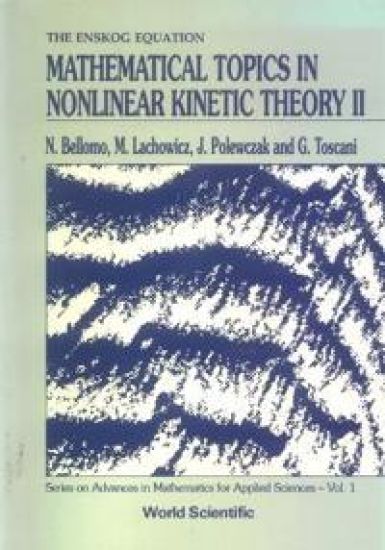
This book deals with the relevant mathematical aspects related to the kinetic equations for moderately dense gases with particular attention to the Enskog equation.