Kirjojen hintavertailu – 12 903 725 kirjaa ja 27 kauppaa

Kirjailija

Mohammed El-Katiri

Kirjat ja teokset yhdessä paikassa: 9 kirjaa, julkaisuja vuosilta 2013–2016, suosituimpiin kuuluu State-Building Challenges in a Post-Revolution Libya. Vertaile teosten hintoja ja tarkista saatavuus suomalaisista kirjakaupoista.

9 kirjaa

Kirjojen julkaisuvuodet: 2013–2016.

The Quest for Military Cooperation in North Africa: Prospects and Challenges

The Quest for Military Cooperation in North Africa: Prospects and Challenges

Mohammed El-Katiri; Strategic Studies Institute (SSI)

Lulu.com
2016
nidottu
In the aftermath of the ousting of dictatorial regimes in 2011, the fragile political and security situations in Tunisia and Libya have contributed to the emergence of new threats that menace the stability of both countries and of their neighbors. Severe terrorist incidents have become frequent throughout the region. To name but one incident, the borders that Algeria shares with those two countries exposed it to a major terrorist attack on the Tiguentourine gas facility in January 2013. The existence and recognition of common threats has prompted military-to-military cooperation among most, but not all, North African countries. Algeria, a country with a sizable military capability, has started working closely with its neighbor countries to reduce terrorist threats. Over the last 3 years, Algeria and Tunisia in particular have intensified their military cooperation to tackle terrorist groups in Tunisia and fight against illicit trafficking across their respective borders.
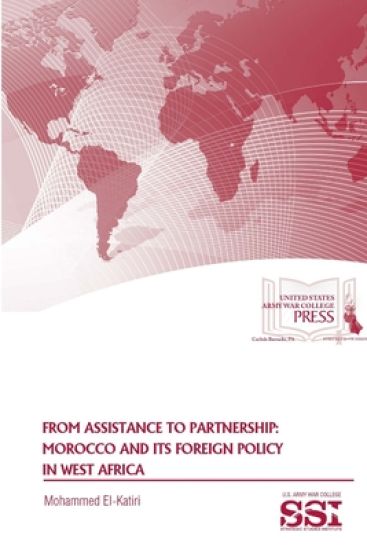
From Assistance to Partnership: Morocco and its Foreign Policy in West Africa

From Assistance to Partnership: Morocco and its Foreign Policy in West Africa

Mohammed El-Katiri; Strategic Studies Institute; U.S. Army War College

Lulu.com
2015
nidottu
Morocco is seeking to position itself as a regional security provider in West Africa. Over recent years, Morocco has emerged as a key partner for the development of variety of sectors in different West African countries, but it also aspires to contribute to peace and stability of this African sub-region that continues to face important challenges and significant threats. In particular, a range of initiatives is under way to combat religious extremism, terrorism, and transnational organized crime including illicit drug trafficking, which remains a major threat to peace and security in the region. At a time of deepening budget constraints, bilateral cooperation with reliable and moderate regional partners offers a potential means of reducing costs while still maintaining regional reach in order to pursue U. S. security objectives. Morocco's new efforts and initiative offer synergies with U. S. priorities for the region. Morocco, with its geographic location, political stability, and close cultural ties...
Strengthening Statehood Capabilities for Successful Transitions in the Middle East/North Africa Region

Strengthening Statehood Capabilities for Successful Transitions in the Middle East/North Africa Region

Mohammed El-Katiri; Strategic Studies Institute; U.S. Army War College

Lulu.com
2015
nidottu
The political transitions that followed revolutions in Egypt, Libya, and Tunisia are by no means complete. They have gone through challenging phases, characterized by political volatility and tension. These challenges and uncertainties have a profound impact on the three countries' economies and the ability of their new political elites to build credibility and political legitimacy. Each of the three countries studied in this monograph has followed a distinct path, with its own opportunities and limitations. Policy reforms during each transition have reflected individual political, security, and social realities. However, one common lesson learned from their trajectories is that their challenges are exacerbated by a deficit of human and institutional capabilities to design and implement political and economic reforms.
Regionalizing East Mediterranean Gas: Energy Security, Stability, and the U.S. Role

Regionalizing East Mediterranean Gas: Energy Security, Stability, and the U.S. Role

Mohammed El-Katiri; Strategic Studies Institute; U.S. Army War College; Laura El-Katiri

Lulu.com
2015
nidottu
In recent years the distribution of the world's exploitable energy reserves has shifted markedly. One major change is the discovery of substantial gas deposits offshore the Levant. But while these deposits have the potential to revolutionize the economies of the net energy importers, Cyprus, Lebanon, and Israel, they also bring into sharp focus long-running disputes over maritime boundaries and sovereignty. In short, these deposits provide yet another cause for conflict in an already deeply troubled region. This monograph explores both the positive and negative implications of the Eastern Mediterranean's new gas reserves for the region, and the implications of both for U. S. interests. It combines the recognized expertise of two researchers with long experience in regional and energy studies, respectively.
United States-Gulf Cooperation Council Security Cooperation in a Multipolar World

United States-Gulf Cooperation Council Security Cooperation in a Multipolar World

Mohammed El-Katiri; Strategic Studies Institute; U.S. Army War College

Lulu.com
2015
nidottu
Profound changes in regional geopolitical dynamics in the Arabian Gulf since the early-2000s render the region a highly challenging environment for U. S. foreign policy and military engagement. At a time of continuing domestic instability in Iraq and an increasingly isolated Iran, the geopolitical weight of the Gulf Cooperation Council (GCC) states has risen dramatically over the past 10 years; the GCC states' enormous economic power, coupled to some of the most stable political systems in the entire Middle East and North Africa region, call for continuously close U. S.-GCC relations in the security sphere as an important element in U. S. foreign policy.
Revival of Political Islam in the Aftermath of the Arab Uprisings: Implications for the Region and Beyond
Regime change during the Arab Spring allowed Islamist political forces that long had been marginalized to achieve political influence in Tunisia, Egypt, and Libya. Meanwhile, Morocco's first government led by an Islamist party has been in power since January 2012. This trend caused widespread concern over the future direction of these states; but despite the tragic example of Egypt, few negative predictions have yet been borne out. In this monograph, Dr. El-Katiri, a British analyst with many years of experience in reporting on the Middle East and North Africa, cautions against an overly simplistic assessment of this rise in the influence and power of political Islam. He uses an extensive range of source material to show that the political crises besetting each of these Islamist governments are not necessarily of their own making, but instead are determined by objective circumstances. He also describes how in several key respects the aims of Islamist parties are in line with U. S. aspirations for the region.