Kirjojen hintavertailu – 12 903 737 kirjaa ja 27 kauppaa

Kirjailija

Mohsen Mostafavi

Kirjat ja teokset yhdessä paikassa: 7 kirjaa, julkaisuja vuosilta 1993–2016, suosituimpiin kuuluu Tezuka Architects: the Yellow Book. Vertaile teosten hintoja ja tarkista saatavuus suomalaisista kirjakaupoista.

7 kirjaa

Kirjojen julkaisuvuodet: 1993–2016.

Tezuka Architects: the Yellow Book

Tezuka Architects: the Yellow Book

Mohsen Mostafavi

JOVIS Verlag
2016
sidottu
Mit seinem TEDtalk „The best kindergarten you've ever seen" hat der japanische Architekt Takaharu Tezuka 2 5 für Aufsehen gesorgt. Tezuka Architects: The Yellow Book gibt nun zum ersten Mal in Buchform Auskunft über die Entwurfsphilosophie des international bekannten Architekturbüros. Basierend auf einem Vortrag Tezukas an der Harvard University Graduate School of Design (GSD), führt der handliche Band am Beispiel bahnbrechender Projekte der letzten Jahre in die Gedankenwelt der Architekten ein. Bauten wie das Roof House (2 ), das Child Chemo House (2 3) oder der Fuji Kindergarten (2 7) belegen eindrucksvoll die gestalterische Kraft von Takaharu und Yui Tezuka und bezeugen, wie Architektur aktiv zum Bau einer besseren Gesellschaft beitragen kann.
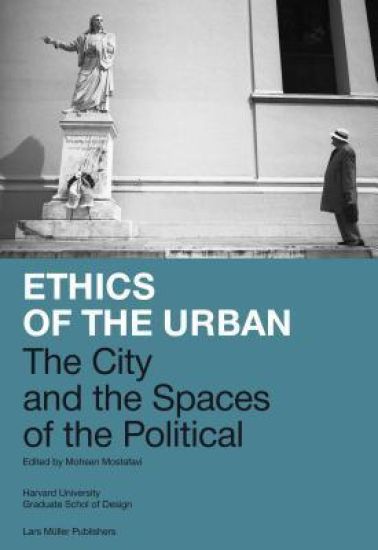
Ethics of the Urban

Ethics of the Urban

Mohsen Mostafavi

Lars Muller Publishers
2016
sidottu
Is democracy spatial? How are the physical aspects of our cities, houses, streets, and public spaces - the borders, the neighborhoods, the monuments - bearers of our values? In a world of intensifying geo-economic integration, extreme fi nancial and geopolitical volatility, deepening environmental crises, and a dramatic new wave of popular protest against both authoritarian government and capitalist speculation, cities have become leading sites for new claims on state power and new formations of political subjectivity. This volume brings together perspectives from history, sociology, art, political theory, planning, law, and design practice to explore the urban spaces of the political. A selection of contemporary photography from around the world offers a visual refl ection of this timely investigation. Contributors include: Michael Arad, Diane Davis, Keller Easterling, Gerald Frug, Mohsen Mostafavi, Chantal Mouffe, Erika Naginski, Saskia Sassen, Richard Sennett, Loic Wacquant, Krzysztof Wodiczko.
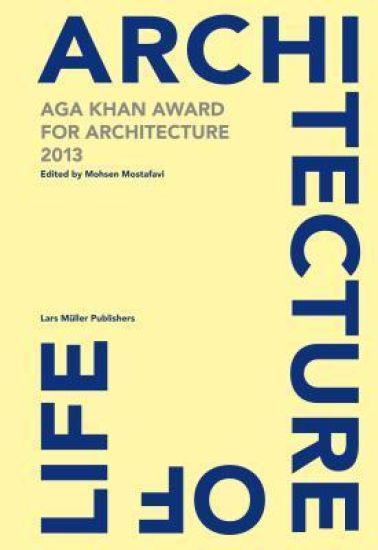
Architecture is Life

Architecture is Life

Mohsen Mostafavi

Lars Muller Publishers
2013
sidottu
The Aga Khan Award for Architecture was established by His Highness the Aga Khan in 1977 to identify and encourage excellence in architecture and other forms of intervention in the built environment of societies with a Muslim presence. The award is given every three years and recognizes all types of building projects that affect today's built environment. Smaller projects are given equal consideration as large-scale buildings. Richly illustrated and with explanatory texts, the book presents this year's shortlist and the award recipients. This year's topic is centered around the relationship between life and architecture. Numerous essays examine how architecture interacts with the life of people who inhabit it.
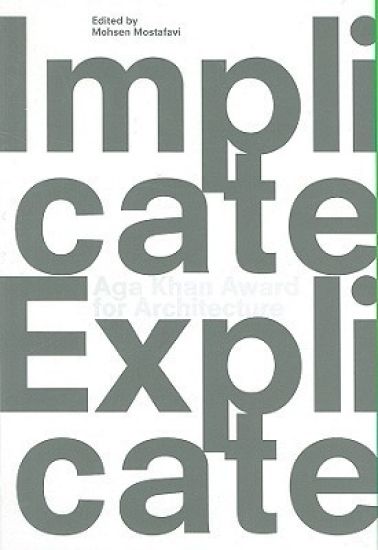
Implicate & Explicate 2010

Implicate & Explicate 2010

Mohsen Mostafavi

Lars Muller Publishers
2011
sidottu
The Aga Khan Award for Architecture was established by His Highness the Aga Khan in 1977 to identify and encourage excellence in architecture in societies where Muslims have a significant presence. The Award is given every three years and recognises all types of building projects that affect today's built environment. The book presents a shortlist of 19 projects including the winners. What these projects have in common is a commitment to design excellence despite constraints of budget, resources, climate, technology, and politics. They share this commitment as one of the necessary tools for societal betterment. The following five projects received the Aga Khan Award for Architecture 2010: Wadi Hanifa Wetlands, Riyadh, Saudi Arabia; Revitalisation of the Hypercentre of Tunis, Tunisia; Madinat Al-Zahra Museum, Cordoba, Spain; Ipekyol Textile Factory, Edirne, Turkey; Bridge School, Xiashi, Fujian, China.
GSD Platform

GSD Platform

Felipe Correa; Michael Meredith; Mohsen Mostafavi

ActarD Inc
2009
sidottu
"Platform 2" provides a sampling of the most salient research and design explorations undertaken at the Harvard Graduate School of Design (GSD) during the 2008-2009 academic year. Organized thematically, the publication identifies underlying congruencies among studio work, theses, research, lectures, conferences, and writings to unfold some of the many critical ideas and interests currently being explored in the School. Ranging in scope from detailed material fabrication to large-scale territorial and infrastructural strategies, the work spans a broad and diverse set of geographies and scenarios. In documenting this work, the publication archives and disseminates the rich intellectual momentum of the GSD. With contributions by Dirk Sijmons, Sissel Tolaas, Scheri Fultiner, Louisa Hutton, Matthias Sauerbruch, Judith Grant Long, Jose Luis Vallejo / Belinda Tato, Joshua Prince Ramus, Chris Reed, among others.
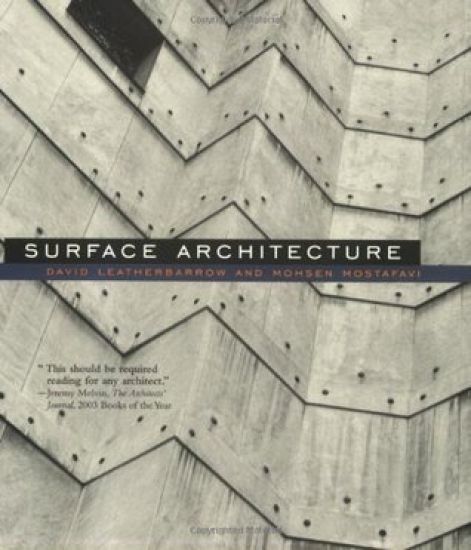
Surface Architecture

Surface Architecture

David Leatherbarrow; Mohsen Mostafavi

MIT Press
2005
pokkari
A study of the building surface, architecture's primary instrument of identity and engagement with its surroundings. Visually, many contemporary buildings either reflect their systems of production or recollect earlier styles and motifs. This division between production and representation is in some ways an extension of that between modernity and tradition. In this book, David Leatherbarrow and Mohsen Mostafavi explore ways that design can take advantage of production methods such that architecture is neither independent of nor dominated by technology. Leatherbarrow and Mostafavi begin with the theoretical and practical isolation of the building surface as the subject of architectural design. The autonomy of the surface, the "free facade," presumes a distinction between the structural and nonstructural elements of the building, between the frame and the cladding. Once the skin of the building became independent of its structure, it could just as well hang like a curtain, or like clothing. The focus of the relationship between structure and skin is the architectural surface. In tracing the handling of this surface, the authors examine both contemporary buildings and those of the recent past. Architects discussed include Albert Kahn, Ludwig Mies van der Rohe, Alison and Peter Smithson, Alejandro de la Sota, Robert Venturi, Jacques Herzog, and Pierre de Meuron. The properties of a building's surface-whether it is made of concrete, metal, glass, or other materials-are not merely superficial; they construct the spatial effects by which architecture communicates. Through its surfaces a building declares both its autonomy and its participation in its surroundings.
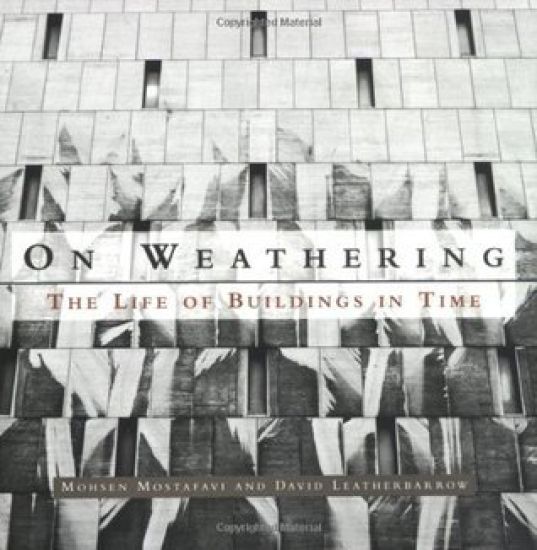
On Weathering

On Weathering

Mohsen Mostafavi; David Leatherbarrow

MIT Press
1993
pokkari
On Weathering illustrates the complex nature of the architectural project by taking into account its temporality, linking technical problems of maintenance and decay with a focused consideration of their philosophical and ethical implications. In a clear and direct account supplemented by many photographs commissioned for this book, Mostafavi and Leatherbarrow examine buildings and other projects from Alberti to Le Corbusier to show that the continual refinishing of the building by natural forces adds to, rather than detracts from, architectural meaning. Their central discovery, that weathering makes the "final" state of the construction necessarily indefinite, challenges the conventional notion of a building's completeness. By recognizing the inherent uncertainty and inevitability of weathering and by viewing the concept of weathering as a continuation of the building process rather than as a force antagonistic to it, the authors offer alternative readings of historical constructions and potential beginnings for new architectural projects.