
Kirjailija
Monier Williams
Kirjat ja teokset yhdessä paikassa: 74 kirjaa, julkaisuja vuosilta 2003–2025, suosituimpiin kuuluu A Practical Grammar of the Sanskrit Language, Arranged with Reference to the Classical Languages of Europe, for the Use of English Students. Vertaile teosten hintoja ja tarkista saatavuus suomalaisista kirjakaupoista.
Nimi esiintyy myös muodoissa: Monier-Williams
74 kirjaa
Kirjojen julkaisuvuodet: 2003–2025.

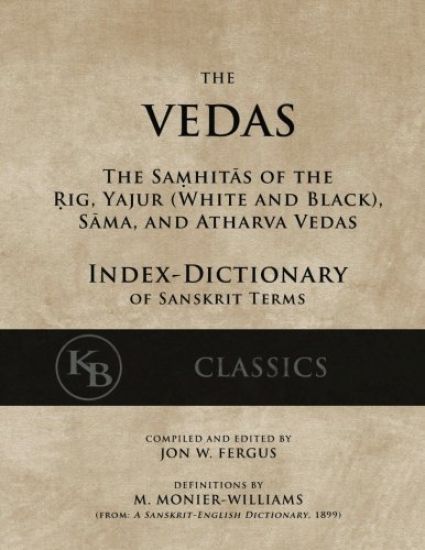
The Vedas (Index-Dictionary): For the Samhitas of the Rig, Yajur, Sama, and Atharva [single volume, unabridged]
Monier Williams; Jon W. Fergus
Createspace Independent Publishing Platform
2017
nidottu
Halvin toimitettuna 19,40 €
The present Index of Sanskrit Terms applies to the single-volume unabridged edition (978-1541294714) of the Vedas (Rig, White and Black Yajur, Sama and Atharva). Dictionary definitions are drawn from "A Sanskrit-English Dictionary" by M. Monier-Williams (1899). Four of the translations in the main volume are from Ralph Griffith, with the remaining (black yajur) from Arthur Keith. The texts have been proofed and all Sanskrit terms updated and synced between versions. From the foreword to the main volume: The Vedas (from the root vid, "to know," or "divine knowledge") are the most ancient of all the Hindu scriptures. There were originally three Vedas-the Laws of Manu always speaks of the three, as do the oldest (Mukhya) Upanishads-but a later work called the Atharvaveda has been added to these, to now constitute the fourth. The name Rigveda signifies "Veda of verses," from rig, a spoken stanza; Samaveda, the "Veda of chants," from saman, a song or chant; Yajurveda, the "Veda of sacrificial formulas," from yajus, a sacrificial text. The Atharvaveda derives its name from the sage Atharvan, who is represented as a Prajapati, the edlest son of Brahma, and who is said to have been the first to institute the fire-sacrifices. The complex nature of the Vedas and the array of texts associated with them may be briefly outlined as follows: "The Rig-Veda is the original work, the Yajur-Veda and Sama-Veda in their mantric portions are different arrangements of its hymns for special purposes. The Vedas are divided into two parts, the Mantra and Brahmana. The Mantra part is composed of suktas (hymns in verse); the Brahmana part consists of liturgical, ritualistic, exegetical, and mystic treatises in prose. The Mantra or verse portion is considered more ancient than the prose works; and the books in which the hymns are collected are called samhitas (collections). More or less closely connected with the Brahmanans (and in a few exceptional cases with the Mantra part) are two classes of treatises in prose and verse called Aranyaka and Upanishad. The Vedic writings are again divided into two great divisions, exoteric and esoteric, the former called the karma-kanda (the section of works) and the latter the jnana-kanda (section of wisdom)." (Encyclopedic Theosophical Glossary) The great antiquity of the Vedas is sufficiently proven by the fact that they are written in such an ancient form of Sanskrit, so different from the Sanskrit now used, that there is no other work like them in the literature of this "eldest sister" of all the known languages, as Prof. Max Muller calls it. Only the most learned of the Brahman Pundits can read the Vedas in their original. Furthermore, the Vedas cannot be viewed as singular works by singular authors, but rather as compilations, assembled over a great and unknown period of time. "Almost every hymn or division of a Veda is ascribed to various authors. It is generally believed that these subdivisions were revealed orally to the rishis or sages whose respective names they bear; hence the body of the Veda is known as sruti (what was heard) or divine revelation. The very names of these Vedic sages, such as Vasishtha, Visvamitra, and Narada, all of which belong to men born in far distant ages, shows that millennia must have elapsed between the different dates of their composition." (Encyclopedic Theosophical Glossary) It is generally agreed that the Vedas were finally arranged and compiled around fourteen centuries before our era; but this interferes in no way with their great antiquity, as they are acknowledged to have been long taught and passed down orally, perhaps for thousands of years, perhaps for far longer, before being finally compiled and recorded (the latter is traditionally said to have occurred on the shores of Lake Manasarovara, beyond the Himalayas).



A Practical Grammar of the Sanskrit Language Arranged with Reference to the Classical Languages of Europe
Monier Williams
Hansebooks
2016
pokkari

English Sanskrit Dictionary V2
Monier Williams
Literary Licensing, LLC
2014
nidottu
Halvin toimitettuna 46,60 €
Indian Wisdom: Or Examples Of The Religious, Philosophical And Ethical Doctrines Of The Hindus
Monier Williams
Literary Licensing, LLC
2014
sidottu
""Indian Wisdom: Or Examples Of The Religious, Philosophical And Ethical Doctrines Of The Hindus"" is a book written by Monier Williams that explores the religious, philosophical, and ethical beliefs of Hindus. The book provides examples of these beliefs through the use of Hindu scriptures, such as the Vedas and the Upanishads. It also examines the practices and rituals associated with Hinduism, such as yoga and meditation. The author delves into the various schools of Hindu philosophy, including the Vedanta and Samkhya, and discusses the concept of karma, reincarnation, and the ultimate goal of moksha or liberation. The book provides a comprehensive overview of Hinduism, its beliefs, and practices, making it an essential read for anyone interested in understanding the rich cultural heritage of India. This Is A New Release Of The Original 1876 Edition. This scarce antiquarian book is a facsimile reprint of the old original and may contain some imperfections such as library marks and notations. Because we believe this work is culturally important, we have made it available as part of our commitment for protecting, preserving, and promoting the world's literature in affordable, high quality, modern editions, that are true to their original work.

English Sanskrit Dictionary V1
Monier Williams
Literary Licensing, LLC
2014
sidottu
Halvin toimitettuna 59,20 €
The English Sanskrit Dictionary V1 is a comprehensive reference book that provides a detailed collection of English words and their corresponding Sanskrit translations. The book has been authored by Monier Williams, a renowned scholar of Sanskrit language and literature. The dictionary is divided into two sections, with the first section providing an alphabetical list of English words and their Sanskrit equivalents, and the second section listing Sanskrit words and their English translations. The book includes over 50,000 entries, making it an essential resource for students, scholars, and researchers of Sanskrit and its related fields. The English Sanskrit Dictionary V1 is an invaluable tool for anyone seeking to deepen their understanding of the Sanskrit language and its rich cultural heritage. This Is A New Release Of The Original 1851 Edition. This scarce antiquarian book is a facsimile reprint of the old original and may contain some imperfections such as library marks and notations. Because we believe this work is culturally important, we have made it available as part of our commitment for protecting, preserving, and promoting the world's literature in affordable, high quality, modern editions, that are true to their original work.

A Practical Grammar of the Sanskrit Language Arranged with Reference to the Classical Languages of Europe for the Use of English Students
Monier Williams
Literary Licensing, LLC
2014
nidottu
Indian Epic Poetry: Being the Substance of Lectures with a Full Analysis of the Ramayana Story and of the Story of the Maha-Bharata
Monier Williams
Literary Licensing, LLC
2014
nidottu
Indian Wisdom: Or Examples of the Religious, Philosophical and Ethical Doctrines of the Hindus
Monier Williams
Literary Licensing, LLC
2014
nidottu

The English Sanskrit Dictionary V2 is a comprehensive reference book that provides an extensive collection of English words and their corresponding Sanskrit translations. The book is authored by Monier Williams, a renowned Sanskrit scholar who has compiled this dictionary with the aim of making the Sanskrit language more accessible to English speakers. The dictionary is organized alphabetically, with each entry providing the English word, its pronunciation, and its Sanskrit equivalent. The book also includes a detailed introduction that explains the structure of the Sanskrit language, its grammar, and its usage. This dictionary is an essential resource for anyone studying Sanskrit or interested in exploring the rich cultural heritage of India. This Is A New Release Of The Original 1851 Edition. This scarce antiquarian book is a facsimile reprint of the old original and may contain some imperfections such as library marks and notations. Because we believe this work is culturally important, we have made it available as part of our commitment for protecting, preserving, and promoting the world's literature in affordable, high quality, modern editions, that are true to their original work.
Modern India and the Indians, Being a Series of Impressions, Notes and Essays.
Monier Williams
British Library, Historical Print Editions
2011
pokkari
Title: Modern India and the Indians, being a series of impressions, notes and essays. Publisher: British Library, Historical Print EditionsThe British Library is the national library of the United Kingdom. It is one of the world's largest research libraries holding over 150 million items in all known languages and formats: books, journals, newspapers, sound recordings, patents, maps, stamps, prints and much more. Its collections include around 14 million books, along with substantial additional collections of manuscripts and historical items dating back as far as 300 BC. The HISTORY OF ASIA collection includes books from the British Library digitised by Microsoft. This series includes ethnographic and general histories of distinct peripheral coastal regions that comprise South and East Asia. Other works focus on cultural history, archaeology, and linguistics. These books help readers understand the forces that shaped the ancient civilisations and influenced the modern countries of Asia. ++++The below data was compiled from various identification fields in the bibliographic record of this title. This data is provided as an additional tool in helping to insure edition identification: ++++ British Library Williams, Monier; 1878. 8 . T 37131

Sanskrit Manual (LARGE PRINT EDITION)
Monier Williams; A. E. Gough
KESSINGER PUBLISHING, LLC
2011
sidottu