Kirjojen hintavertailu – 12 903 735 kirjaa ja 27 kauppaa

Kirjailija

Monique Jeanblanc

Kirjat ja teokset yhdessä paikassa: 7 kirjaa, julkaisuja vuosilta 2002–2017, suosituimpiin kuuluu Paris-Princeton Lectures on Mathematical Finance 2003. Vertaile teosten hintoja ja tarkista saatavuus suomalaisista kirjakaupoista.

7 kirjaa

Kirjojen julkaisuvuodet: 2002–2017.

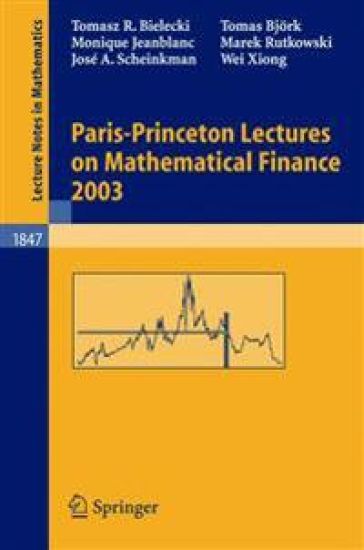
Paris-Princeton Lectures on Mathematical Finance 2003

Paris-Princeton Lectures on Mathematical Finance 2003

Tomasz R. Bielecki; Tomas Björk; Monique Jeanblanc; Marek Rutkowski; Jose A. Scheinkman; Wei Xiong

Springer-Verlag Berlin and Heidelberg GmbH Co. K
2004
nidottu
The Paris-Princeton Lectures in Financial Mathematics, of which this is the second volume, will, on an annual basis, publish cutting-edge research in self-contained, expository articles from outstanding - established or upcoming! - specialists. The aim is to produce a series of articles that can serve as an introductory reference for research in the field. It arises as a result of frequent exchanges between the finance and financial mathematics groups in Paris and Princeton. This volume presents the following articles: "Hedging of Defaultable Claims" by T. Bielecki, M. Jeanblanc, and M. Rutkowski; "On the Geometry of Interest Rate Models" by T. Björk; "Heterogeneous Beliefs, Speculation and Trading in Financial Markets" by J. A. Scheinkman, and W. Xiong.

Enlargement of Filtration with Finance in View

Enlargement of Filtration with Finance in View

Anna Aksamit; Monique Jeanblanc

Springer International Publishing AG
2017
nidottu
This volume presents classical results of the theory of enlargement of filtration. The focus is on the behavior of martingales with respect to the enlarged filtration and related objects. The study is conducted in various contexts including immersion, progressive enlargement with a random time and initial enlargement with a random variable. The aim of this book is to collect the main mathematical results (with proofs) previously spread among numerous papers, great part of which is only available in French. Many examples and applications to finance, in particular to credit risk modelling and the study of asymmetric information, are provided to illustrate the theory. A detailed summary of further connections and applications is given in bibliographic notes which enables to deepen study of the topic. This book fills a gap in the literature and serves as a guide for graduate students and researchers interested in the role of information in financial mathematics and in econometric science. A basic knowledge of the general theory of stochastic processes is assumed as a prerequisite.
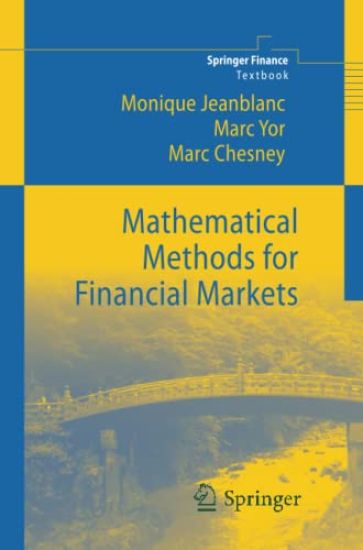
Mathematical Methods for Financial Markets

Mathematical Methods for Financial Markets

Monique Jeanblanc; Marc Yor; Marc Chesney

Springer London Ltd
2012
nidottu
Mathematical finance has grown into a huge area of research which requires a large number of sophisticated mathematical tools. This book simultaneously introduces the financial methodology and the relevant mathematical tools in a style that is mathematically rigorous and yet accessible to practitioners and mathematicians alike. It interlaces financial concepts such as arbitrage opportunities, admissible strategies, contingent claims, option pricing and default risk with the mathematical theory of Brownian motion, diffusion processes, and Lévy processes. The first half of the book is devoted to continuous path processes whereas the second half deals with discontinuous processes. The extensive bibliography comprises a wealth of important references and the author index enables readers quickly to locate where the reference is cited within the book, making this volume an invaluable tool both for students and for those at the forefront of research and practice.
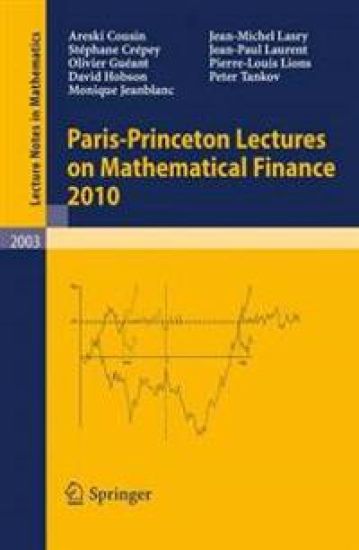
Paris-Princeton Lectures on Mathematical Finance 2010

Paris-Princeton Lectures on Mathematical Finance 2010

Areski Cousin; Stéphane Crépey; Olivier Guéant; David Hobson; Monique Jeanblanc; Jean-Michel Lasry; Jean-Paul Laurent; Pierre-Louis Lions; Peter Tankov

Springer-Verlag Berlin and Heidelberg GmbH Co. K
2010
nidottu
The Paris-Princeton Lectures in Financial Mathematics, of which this is the fourth volume, publish cutting-edge research in self-contained, expository articles from outstanding specialists - established or on the rise! The aim is to produce a series of articles that can serve as an introductory reference source for research in the field. The articles are the result of frequent exchanges between the finance and financial mathematics groups in Paris and Princeton. The present volume sets standards with five articles by: 1. Areski Cousin, Monique Jeanblanc and Jean-Paul Laurent, 2. Stéphane Crépey, 3. Olivier Guéant, Jean-Michel Lasry and Pierre-Louis Lions, 4. David Hobson and 5. Peter Tankov.
Mathematical Methods for Financial Markets

Mathematical Methods for Financial Markets

Monique Jeanblanc; Marc Yor; Marc Chesney

Springer London Ltd
2009
sidottu
Mathematical finance has grown into a huge area of research which requires a large number of sophisticated mathematical tools. This book simultaneously introduces the financial methodology and the relevant mathematical tools in a style that is mathematically rigorous and yet accessible to practitioners and mathematicians alike. It interlaces financial concepts such as arbitrage opportunities, admissible strategies, contingent claims, option pricing and default risk with the mathematical theory of Brownian motion, diffusion processes, and Lévy processes. The first half of the book is devoted to continuous path processes whereas the second half deals with discontinuous processes. The extensive bibliography comprises a wealth of important references and the author index enables readers quickly to locate where the reference is cited within the book, making this volume an invaluable tool both for students and for those at the forefront of research and practice.
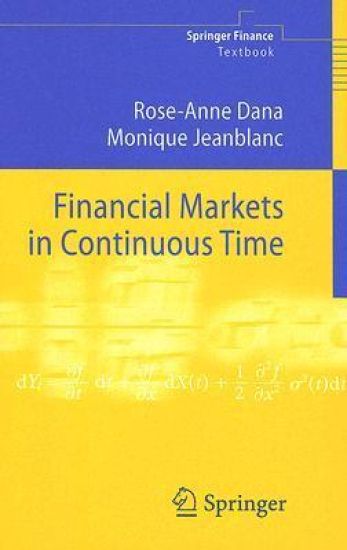
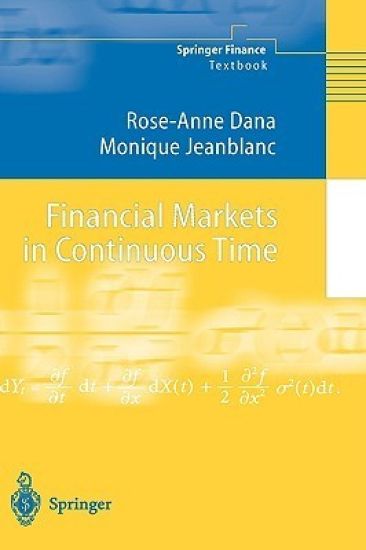
Financial Markets in Continuous Time

Financial Markets in Continuous Time

Rose-Anne Dana; Monique Jeanblanc

Springer-Verlag Berlin and Heidelberg GmbH Co. K
2007
nidottu
In modern financial practice, asset prices are modelled by means of stochastic processes, and continuous-time stochastic calculus thus plays a central role in financial modelling. This approach has its roots in the foundational work of the Nobel laureates Black, Scholes and Merton. Asset prices are further assumed to be rationalizable, that is, determined by equality of demand and supply on some market. This approach has its roots in the foundational work on General Equilibrium of the Nobel laureates Arrow and Debreu and in the work of McKenzie. This book has four parts. The first brings together a number of results from discrete-time models. The second develops stochastic continuous-time models for the valuation of financial assets (the Black-Scholes formula and its extensions), for optimal portfolio and consumption choice, and for obtaining the yield curve and pricing interest rate products. The third part recalls some concepts and results of general equilibrium theory, and applies this in financial markets. The last part is more advanced and tackles market incompleteness and the valuation of exotic options in a complete market.
Financial Markets in Continuous Time

Financial Markets in Continuous Time

Rose-Anne Dana; Monique Jeanblanc

Springer-Verlag Berlin and Heidelberg GmbH Co. K
2002
sidottu
In modern financial practice, asset prices are modelled by means of stochastic processes, and continuous-time stochastic calculus thus plays a central role in financial modelling. This approach has its roots in the foundational work of the Nobel laureates Black, Scholes and Merton. Asset prices are further assumed to be rationalizable, that is, determined by equality of demand and supply on some market. This approach has its roots in the foundational work on General Equilibrium of the Nobel laureates Arrow and Debreu and in the work of McKenzie. This book has four parts. The first brings together a number of results from discrete-time models. The second develops stochastic continuous-time models for the valuation of financial assets (the Black-Scholes formula and its extensions), for optimal portfolio and consumption choice, and for obtaining the yield curve and pricing interest rate products. The third part recalls some concepts and results of general equilibrium theory, and applies this in financial markets. The last part is more advanced and tackles market incompleteness and the valuation of exotic options in a complete market.