Kirjojen hintavertailu – 12 903 724 kirjaa ja 27 kauppaa

Kirjailija

Monique Scheer

Kirjat ja teokset yhdessä paikassa: 4 kirjaa, julkaisuja vuosilta 2014–2025, suosituimpiin kuuluu Emotional Lexicons. Vertaile teosten hintoja ja tarkista saatavuus suomalaisista kirjakaupoista.

4 kirjaa

Kirjojen julkaisuvuodet: 2014–2025.

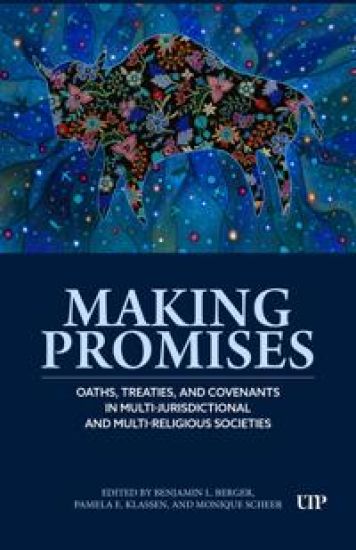
Making Promises

Making Promises

Pamela Klassen; Benjamin L. Berger; Monique Scheer

UNIVERSITY OF TORONTO PRESS
2025
sidottu
How should we understand promises as public, private, or political commitments? What are the conditions for promise-making in religiously diverse societies with competing jurisdictions and sovereignties? Making Promises addresses how promises are made meaningful not only through law, but also through appeals to transcendent powers across diverse traditions. Each contribution in this volume takes a closer look at specific kinds of promises: oaths, treaties, and covenants. The chapters reveal much about the nature of promises in multi-religious and multi-jurisdictional societies, and with contributions from scholars of religious studies, Indigenous studies, law, history, politics, and anthropology, this volume represents a comparative conversation on the making of promises. It pays close attention to Indigenous histories, visions, and conceptions of justice; comparative law within and across settler colonial states; interactions among religions and secularisms; and the ongoing importance of material culture, ritual, and emotion for these practices. At a time of human-caused environmental devastation and political upheaval, when making promises for the future seems both urgent and futile, this volume shows that promises have long been made and unmade, kept and broken, in ways that successive generations need to acknowledge and take up anew.
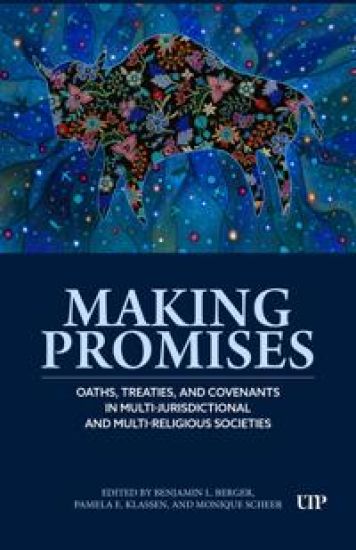
Making Promises

Making Promises

Pamela Klassen; Benjamin L. Berger; Monique Scheer

UNIVERSITY OF TORONTO PRESS
2025
pokkari
How should we understand promises as public, private, or political commitments? What are the conditions for promise-making in religiously diverse societies with competing jurisdictions and sovereignties? Making Promises addresses how promises are made meaningful not only through law, but also through appeals to transcendent powers across diverse traditions. Each contribution in this volume takes a closer look at specific kinds of promises: oaths, treaties, and covenants. The chapters reveal much about the nature of promises in multi-religious and multi-jurisdictional societies, and with contributions from scholars of religious studies, Indigenous studies, law, history, politics, and anthropology, this volume represents a comparative conversation on the making of promises. It pays close attention to Indigenous histories, visions, and conceptions of justice; comparative law within and across settler colonial states; interactions among religions and secularisms; and the ongoing importance of material culture, ritual, and emotion for these practices. At a time of human-caused environmental devastation and political upheaval, when making promises for the future seems both urgent and futile, this volume shows that promises have long been made and unmade, kept and broken, in ways that successive generations need to acknowledge and take up anew.
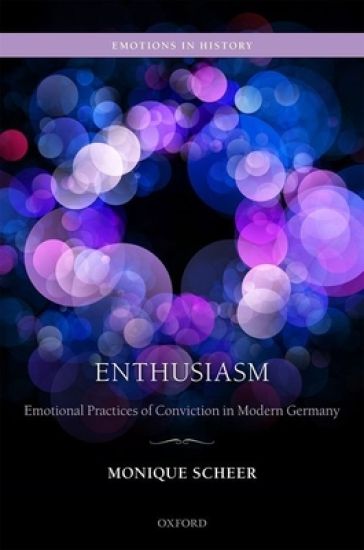
Enthusiasm

Enthusiasm

Monique Scheer

Oxford University Press
2020
sidottu
Enthusiasm seeks to contribute to a culturally and historically nuanced understanding of how emotions secure and ratify the truth of convictions. More than just pure affective intensity, enthusiasm is about something: a certainty, clarity, or truth. Neither as clearly negative as fanaticism nor as general as passion, enthusiasm specifically entails belief. For this reason, the book takes its starting point in religion, the social arena in which the concept was first debated and to which the term still gestures. Empirically based in modern German Protestantism, where religious emotion is intensely cultivated but also subject to vigorous scrutiny, it combines historical and ethnographic methods to show how enthusiasm has been negotiated and honed as a practice in Protestant denominations ranging from liberal to charismatic. The nexus of religion and emotion and how it relates to central concepts of modernity such as rationality, knowledge, interiority, and sincerity are key to understanding why moderns are so ambivalent about enthusiasm. Grounded in practice theory, Enthusiasm assumes that emotions are not an affective state we 'have' but mind-body activations we 'do', having learned to perform them in culturally specific ways. When understood as an emotional practice, enthusiasm has different styles, inflected by historical traditions, social milieus, and knowledge (even ideologies) about emotions and how they work. Enthusiasm also provides insight into how this feeling works in secular humanism as well as in politics, and why it is so contested as a practice in any context.
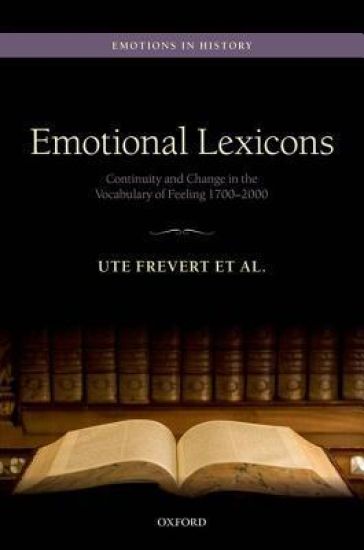
Emotional Lexicons

Emotional Lexicons

Ute Frevert; Christian Bailey; Pascal Eitler; Benno Gammerl; Bettina Hitzer; Margrit Pernau; Monique Scheer; Anne Schmidt; Nina Verheyen

Oxford University Press
2014
sidottu
Emotions are as old as humankind. But what do we know about them and what importance do we assign to them? Emotional Lexicons is the first cultural history of terms of emotion found in German, French, and English language encyclopaedias since the late seventeenth century. Insofar as these reference works formulated normative concepts, they documented shifts in the way the educated middle classes were taught to conceptualise emotion by a literary medium targeted specifically to them. As well as providing a record of changing language use (and the surrounding debates), many encyclopaedia articles went further than simply providing basic knowledge; they also presented a moral vision to their readers and guidelines for behaviour. Implicitly or explicitly, they participated in fundamental discussions on human nature: Are emotions in the mind or in the body? Can we "read" another person's feelings in their face? Do animals have feelings? Are men less emotional than women? Are there differences between the emotions of children and adults? Can emotions be "civilised"? Can they make us sick? Do groups feel together? Do our emotions connect us with others or create distance? The answers to these questions are historically contingent, showing that emotional knowledge was and still is closely linked to the social, cultural, and political structures of modern societies. Emotional Lexicons analyses European discourses in science, as well as in broader society, about affects, passions, sentiments, and emotions. It does not presume to refine our understanding of what emotions actually are, but rather to present the spectrum of knowledge about emotion embodied in concepts whose meanings shift through time, in order to enrich our own concept of emotion and to lend nuances to the interdisciplinary conversation about them.