Kirjojen hintavertailu – 12 859 828 kirjaa ja 27 kauppaa
Kirjailija
Morris Jastrow
Kirjat ja teokset yhdessä paikassa: 68 kirjaa, julkaisuja vuosilta 1905–2026, suosituimpiin kuuluu An Old Babylonian Version of the Gilgamesh Epic. Vertaile teosten hintoja ja tarkista saatavuus suomalaisista kirjakaupoista.
Explore the fascinating religious landscape of ancient Mesopotamia with "The Religion of Babylonia and Assyria" by Morris Jastrow. This meticulously prepared print edition delves into the cults and religious practices that shaped these influential civilizations. Discover the intricacies of Assyro-Babylonian beliefs, rituals, and deities, offering a comprehensive view of their spiritual world. From the grand temples to the intimate household shrines, this book illuminates the profound role religion played in daily life. A vital resource for understanding the history of religion and the ancient world, "The Religion of Babylonia and Assyria" provides invaluable insights into the enduring legacy of Babylonia and Assyria. Uncover the mysteries of ancient religion and the cults that defined these Mesopotamian societies. This work has been selected by scholars as being culturally important, and is part of the knowledge base of civilization as we know it. This work is in the public domain in the United States of America, and possibly other nations. Within the United States, you may freely copy and distribute this work, as no entity (individual or corporate) has a copyright on the body of the work. Scholars believe, and we concur, that this work is important enough to be preserved, reproduced, and made generally available to the public. We appreciate your support of the preservation process, and thank you for being an important part of keeping this knowledge alive and relevant.
Explore the fascinating religious landscape of ancient Mesopotamia with "The Religion of Babylonia and Assyria" by Morris Jastrow. This meticulously prepared print edition delves into the cults and religious practices that shaped these influential civilizations. Discover the intricacies of Assyro-Babylonian beliefs, rituals, and deities, offering a comprehensive view of their spiritual world. From the grand temples to the intimate household shrines, this book illuminates the profound role religion played in daily life. A vital resource for understanding the history of religion and the ancient world, "The Religion of Babylonia and Assyria" provides invaluable insights into the enduring legacy of Babylonia and Assyria. Uncover the mysteries of ancient religion and the cults that defined these Mesopotamian societies. This work has been selected by scholars as being culturally important, and is part of the knowledge base of civilization as we know it. This work is in the public domain in the United States of America, and possibly other nations. Within the United States, you may freely copy and distribute this work, as no entity (individual or corporate) has a copyright on the body of the work. Scholars believe, and we concur, that this work is important enough to be preserved, reproduced, and made generally available to the public. We appreciate your support of the preservation process, and thank you for being an important part of keeping this knowledge alive and relevant.
Rediscover one of humanity's oldest stories in "An Old Babylonian Version of the Gilgamesh Epic," a foundational work of ancient literature. This meticulously prepared print edition presents the epic poetry of Gilgamesh, a tale originating in Mesopotamia and echoing through Babylonian and Assyrian history. As an anonymous work, the epic offers profound insights into the beliefs, values, and anxieties of a long-vanished world. Explore themes of mortality, friendship, and the search for meaning in this cornerstone of world literature. Its influence resonates across cultures and millennia, making it essential reading for anyone interested in ancient history, religion, or the origins of storytelling. Delve into this remarkable piece of Assyro-Babylonian literature and experience the enduring power of epic poetry. This work has been selected by scholars as being culturally important, and is part of the knowledge base of civilization as we know it. This work is in the public domain in the United States of America, and possibly other nations. Within the United States, you may freely copy and distribute this work, as no entity (individual or corporate) has a copyright on the body of the work. Scholars believe, and we concur, that this work is important enough to be preserved, reproduced, and made generally available to the public. We appreciate your support of the preservation process, and thank you for being an important part of keeping this knowledge alive and relevant.
Rediscover one of humanity's oldest stories in "An Old Babylonian Version of the Gilgamesh Epic," a foundational work of ancient literature. This meticulously prepared print edition presents the epic poetry of Gilgamesh, a tale originating in Mesopotamia and echoing through Babylonian and Assyrian history. As an anonymous work, the epic offers profound insights into the beliefs, values, and anxieties of a long-vanished world. Explore themes of mortality, friendship, and the search for meaning in this cornerstone of world literature. Its influence resonates across cultures and millennia, making it essential reading for anyone interested in ancient history, religion, or the origins of storytelling. Delve into this remarkable piece of Assyro-Babylonian literature and experience the enduring power of epic poetry. This work has been selected by scholars as being culturally important, and is part of the knowledge base of civilization as we know it. This work is in the public domain in the United States of America, and possibly other nations. Within the United States, you may freely copy and distribute this work, as no entity (individual or corporate) has a copyright on the body of the work. Scholars believe, and we concur, that this work is important enough to be preserved, reproduced, and made generally available to the public. We appreciate your support of the preservation process, and thank you for being an important part of keeping this knowledge alive and relevant.
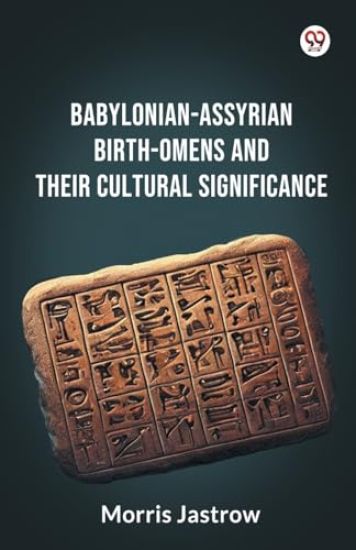
Babylonian-Assyrian Birth-Omens and Their Cultural Significance by Morris Jastrow, Jr. is a landmark work in the study of ancient Mesopotamian belief systems, focusing on how birth-omens-physical or symbolic signs observed at or before birth-were interpreted as divine messages. Drawing on a wealth of cuneiform sources, Jastrow examines how these omens were systematically recorded and used by priests and diviners to predict the future of individuals and the fate of the state. He explores the religious, medical, and astrological dimensions of these practices, revealing a worldview in which every detail of birth was deeply meaningful. This scholarly yet accessible work provides rare insight into the intersection of myth, science, and ritual in early civilization, making it essential reading for students of ancient history, religion, and cultural anthropology.
The Epic of Gilgamesh is an epic poem from ancient Mesopotamia, regarded as the earliest surviving notable literature and the second oldest religious text, after the Pyramid Texts. The literary history of Gilgamesh begins with five Sumerian poems about Bilgamesh (Sumerian for "Gilgamesh"), king of Uruk, dating from the Third Dynasty of Ur (c. 2100 BC). These independent stories were later used as source material for a combined epic in Akkadian. The first surviving version of this combined epic, known as the "Old Babylonian" version, dates back to the 18th century BC and is titled after its incipit, Shūtur eli sharrī ("Surpassing All Other Kings"). Only a few tablets of it have survived. The later Standard Babylonian version compiled by S n-lēqi-unninni dates from the 13th to the 10th centuries BC and bears the incipit Sha naqba īmuru ("He who Saw the Abyss", in unmetaphoric terms: "He who Sees the Unknown"). Approximately two-thirds of this longer, twelve-tablet version have been recovered. Some of the best copies were discovered in the library ruins of the 7th-century BC Assyrian king Ashurbanipal. The first half of the story discusses Gilgamesh, king of Uruk, and Enkidu, a wild man created by the gods to stop Gilgamesh from oppressing the people of Uruk. After Enkidu becomes civilized through sexual initiation with Shamhat, he travels to Uruk, where he challenges Gilgamesh to a test of strength. Gilgamesh wins the contest; nonetheless, the two become friends. Together, they make a six-day journey to the legendary Cedar Forest, where they plan to slay the Guardian, Humbaba the Terrible, and cut down the sacred Cedar. The goddess Ishtar sends the Bull of Heaven to punish Gilgamesh for spurning her advances. Gilgamesh and Enkidu kill the Bull of Heaven after which the gods decide to sentence Enkidu to death and kill him. In the second half of the epic, distress over Enkidu's death causes Gilgamesh to undertake a long and perilous journey to discover the secret of eternal life. He eventually learns that "Life, which you look for, you will never find. For when the gods created man, they let death be his share, and life withheld in their own hands". Nevertheless, because of his great building projects, his account of Siduri's advice, and what the immortal man Utnapishtim told him about the Great Flood, Gilgamesh's fame survived well after his death, with expanding interest in the his story. It has been translated into many languages and is featured in several works of popular fiction. The epic is regarded as a foundational work in religion and the tradition of heroic sagas, with Gilgamesh forming the prototype for later heroes like Heracles (Hercules), and the epic itself serving as an influence for Homeric epics. (wikipedia.org)
The Epic of Gilgamesh is an epic poem from ancient Mesopotamia, regarded as the earliest surviving notable literature and the second oldest religious text, after the Pyramid Texts. The literary history of Gilgamesh begins with five Sumerian poems about Bilgamesh (Sumerian for "Gilgamesh"), king of Uruk, dating from the Third Dynasty of Ur (c. 2100 BC). These independent stories were later used as source material for a combined epic in Akkadian. The first surviving version of this combined epic, known as the "Old Babylonian" version, dates back to the 18th century BC and is titled after its incipit, Shūtur eli sharrī ("Surpassing All Other Kings"). Only a few tablets of it have survived. The later Standard Babylonian version compiled by S n-lēqi-unninni dates from the 13th to the 10th centuries BC and bears the incipit Sha naqba īmuru ("He who Saw the Abyss", in unmetaphoric terms: "He who Sees the Unknown"). Approximately two-thirds of this longer, twelve-tablet version have been recovered. Some of the best copies were discovered in the library ruins of the 7th-century BC Assyrian king Ashurbanipal. The first half of the story discusses Gilgamesh, king of Uruk, and Enkidu, a wild man created by the gods to stop Gilgamesh from oppressing the people of Uruk. After Enkidu becomes civilized through sexual initiation with Shamhat, he travels to Uruk, where he challenges Gilgamesh to a test of strength. Gilgamesh wins the contest; nonetheless, the two become friends. Together, they make a six-day journey to the legendary Cedar Forest, where they plan to slay the Guardian, Humbaba the Terrible, and cut down the sacred Cedar. The goddess Ishtar sends the Bull of Heaven to punish Gilgamesh for spurning her advances. Gilgamesh and Enkidu kill the Bull of Heaven after which the gods decide to sentence Enkidu to death and kill him. In the second half of the epic, distress over Enkidu's death causes Gilgamesh to undertake a long and perilous journey to discover the secret of eternal life. He eventually learns that "Life, which you look for, you will never find. For when the gods created man, they let death be his share, and life withheld in their own hands". Nevertheless, because of his great building projects, his account of Siduri's advice, and what the immortal man Utnapishtim told him about the Great Flood, Gilgamesh's fame survived well after his death, with expanding interest in the his story. It has been translated into many languages and is featured in several works of popular fiction. The epic is regarded as a foundational work in religion and the tradition of heroic sagas, with Gilgamesh forming the prototype for later heroes like Heracles (Hercules), and the epic itself serving as an influence for Homeric epics. (wikipedia.org)
This work has been selected by scholars as being culturally important, and is part of the knowledge base of civilization as we know it. This work was reproduced from the original artifact, and remains as true to the original work as possible. Therefore, you will see the original copyright references, library stamps (as most of these works have been housed in our most important libraries around the world), and other notations in the work. This work is in the public domain in the United States of America, and possibly other nations. Within the United States, you may freely copy and distribute this work, as no entity (individual or corporate) has a copyright on the body of the work. As a reproduction of a historical artifact, this work may contain missing or blurred pages, poor pictures, errant marks, etc. Scholars believe, and we concur, that this work is important enough to be preserved, reproduced, and made generally available to the public. We appreciate your support of the preservation process, and thank you for being an important part of keeping this knowledge alive and relevant.
Morris Jastrow (1861-1921) graduated from the University of Pennsylvania where he became a Professor of Semitic languages and worked in the school's library. He served as an editor for the Jewish Publication Society's Jewish Encyclopedia from 1911-1906. A prolific researcher and writer, Jastrow published over a dozen books and became president of the American Oriental Society in 1915.
The book, Babylonian-Assyrian Birth-Omens and Their Cultural Significance, has been considered important throughout the human history, and so that this work is never forgotten we have made efforts in its preservation by republishing this book in a modern format for present and future generations. This whole book has been reformatted, retyped and designed. These books are not made of scanned copies of their original work and hence the text is clear and readable.
This book has been considered by academicians and scholars of great significance and value to literature. This forms a part of the knowledge base for future generations. We have represented this book in the same form as it was first published. Hence any marks seen are left intentionally to preserve its true nature.
Morris Jastrow Jr. (1861 - 1921), Orientalist und Bibliothekar polnischer Abstammung, schrieb zahlreiche B cher zur Religionsgeschichte, so auch das hier in drei B nden vorliegende Werk zur Religion in Babylonien und Assyrien und bietet einen umfassendes berblick ber das babylonisch-assyrische G tterpantheon, die religi se Literatur sowie ber Glaubenslehre und Kult. Nachdruck der deutschen Originalausgabe aus dem Jahr 1912.
Morris Jastrow Jr. (1861 - 1921), Orientalist und Bibliothekar polnischer Abstammung, schrieb zahlreiche B cher zur Religionsgeschichte, so auch das hier in drei B nden vorliegende Werk zur Religion in Babylonien und Assyrien und bietet einen umfassendes berblick ber das babylonisch-assyrische G tterpantheon, die religi se Literatur sowie ber Glaubenslehre und Kult. Nachdruck der deutschen Originalausgabe aus dem Jahr 1912.
Morris Jastrow Jr. (1861 - 1921), Orientalist und Bibliothekar polnischer Abstammung, schrieb zahlreiche B cher zur Religionsgeschichte, so auch das hier in drei B nden vorliegende Werk zur Religion in Babylonien und Assyrien und bietet einen umfassendes berblick ber das babylonisch-assyrische G tterpantheon, die religi se Literatur sowie ber Glaubenslehre und Kult. Nachdruck der deutschen Originalausgabe aus dem Jahr 1905.