Kirjojen hintavertailu – 12 903 724 kirjaa ja 27 kauppaa
Kirjailija
Mukul Majumdar
Kirjat ja teokset yhdessä paikassa: 10 kirjaa, julkaisuja vuosilta 1992–2022, suosituimpiin kuuluu Equilibrium, Welfare and Uncertainty: Beyond Arrow-Debreu. Vertaile teosten hintoja ja tarkista saatavuus suomalaisista kirjakaupoista.
This book summarizes some issues involved in developing a theory of decentralized resource allocation mechanism in infinite horizon economies. It constitutes a definitive account of cutting-edge research on a topic of continuing importance in price theory. .
This book summarizes some issues involved in developing a theory of decentralized resource allocation mechanism in infinite horizon economies. It constitutes a definitive account of cutting-edge research on a topic of continuing importance in price theory. .
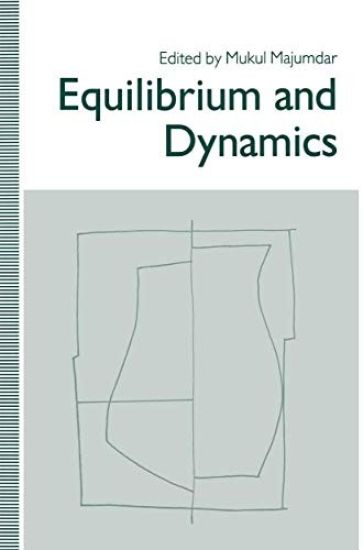
One of the fundamental themes in economic theory is the study of the role of prices in achieving an optimal allocation of resources in a competitive, decentralized economy. The book begins with a review of the basic results on the rigorous elaboration of the Walras-Pareto theory (following the lead of Arrow and Debreu) in the context of a static economy with many agents. It summarizes some subsequent research in which the limits of the price-mechanism as a successful coordination device are recognized. When economic activity is allowed with no pre-assigned terminal period, the two fundamental theorems linking competitive equilibrium allocations to Pareto optimality are challenged and the question of decentralization is carefully re-examined. With incomplete markets, and sequential trading, the concept of a Radner equilibrium is next introduced, and some of the striking properties of this are summarized. In a large economy with random shocks to preferences and/or endowments of individual agents, the implications of the celebrated laws of probability theory are explored. This book provides a clear and comprehensive analysis of the efficiency properties of general equilibrium, with many agents and an expanded list of commodities. It will be of particular interest to postgraduate and doctorate students of economic theory as well as scholars on Walrasian equilibrium, Pareto optimality and uncertainty theories.
One of the fundamental themes in economic theory is the study of the role of prices in achieving an optimal allocation of resources in a competitive, decentralized economy. The book begins with a review of the basic results on the rigorous elaboration of the Walras-Pareto theory (following the lead of Arrow and Debreu) in the context of a static economy with many agents. It summarizes some subsequent research in which the limits of the price-mechanism as a successful coordination device are recognized. When economic activity is allowed with no pre-assigned terminal period, the two fundamental theorems linking competitive equilibrium allocations to Pareto optimality are challenged and the question of decentralization is carefully re-examined. With incomplete markets, and sequential trading, the concept of a Radner equilibrium is next introduced, and some of the striking properties of this are summarized. In a large economy with random shocks to preferences and/or endowments of individual agents, the implications of the celebrated laws of probability theory are explored. This book provides a clear and comprehensive analysis of the efficiency properties of general equilibrium, with many agents and an expanded list of commodities. It will be of particular interest to postgraduate and doctorate students of economic theory as well as scholars on Walrasian equilibrium, Pareto optimality and uncertainty theories.
Over the last 40 years, Professor David Gale has played a leading role in developing two themes of fundamental importance to economic theory. As a tribute to his creative research, this volume contains contributions from some leading researchers who explore different directions in these areas.
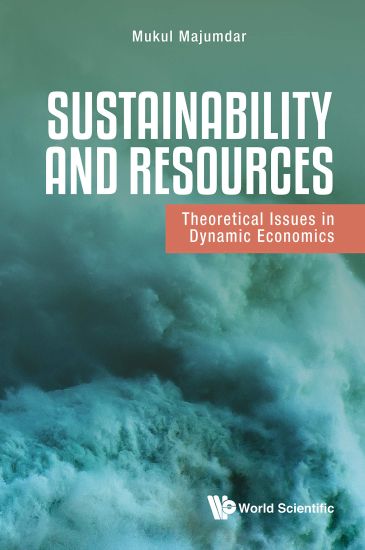
The book, Sustainability and Resources: Theoretical Issues in Dynamic Economics, presents a collection of mathematical models dealing with sustainability and resource management. The focus in Part A is on harvesting renewable resources, while Part B explores the optimal extraction of exhaustible resources. Part C introduces models dealing with uncertainty. Some are descriptive models; others have deep roots in intertemporal welfare economics. The tools of dynamic optimization developed in the 1960s are used in a formal, rigorous presentation to address wide-ranging issues that have appeared in academic research as well as policy debates on the world stage. The book also provides a self-contained treatment that is accessible to advanced undergraduate and graduate students, who are interested in dynamic models of resource allocation and social welfare, resource management, and applications of optimization theory and methods of probability theory to economics. For researchers in dynamic economics, it will be an invaluable source for formal treatment of substantive macroeconomic issues raised by policymakers. The part dealing with uncertainty and random dynamical systems (largely developed by the author and his collaborators) exposes the reader to contemporary frontiers of research on stochastic processes with novel applications to economic problems.
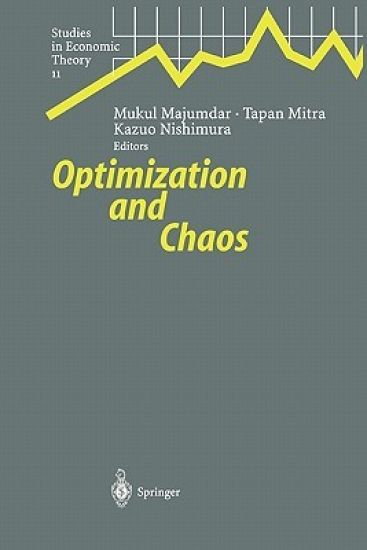
This collection of essays brings together some articles on dynamic optimization models that exhibit chaotic behavior. Chapters 3, 4, 5, 6, 7, and 9 appeared in a Symposium on Chaotic Dynamical Systems in Economic Theory (Volume 4, Number 5, 1994). Also, Chapters 10,11, and 12 appeared in the Journal of Economic The ory. We would like to thank the authors, and Academic Press for permission to reprint. We are grateful to Professor C. D. Aliprantis for suggesting the idea of a book structured around the Economic Theory Symposium, and without the support and patience of Dr. Mueller this project could not have been completed. We would like to thank Ms. Amy Gowan who cheerfully per formed the arduous task of typing the manuscript. Thanks are also due to Xiao Qing Yu, Tridip Ray and Malabika Majumdar for their help at various stages in the preparation of the manuscript. For a course on dynamic optimization addressed to students with a good background in economic theory and real analysis, one can assign Chapter 2 as a partial introduction to the basic tech niques. Chapters 3 and 4 can be assigned to provide examples of simple optmization models generating complicated behavior.
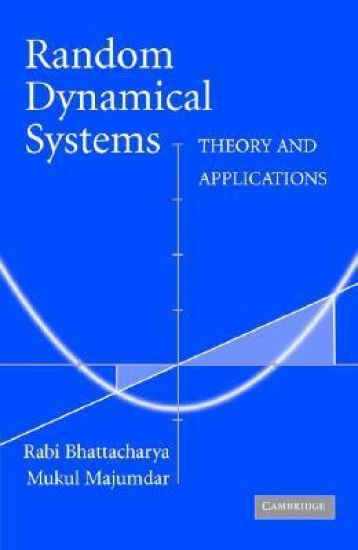
This treatment provides an exposition of discrete time dynamic processes evolving over an infinite horizon. Chapter 1 reviews some mathematical results from the theory of deterministic dynamical systems, with particular emphasis on applications to economics. The theory of irreducible Markov processes, especially Markov chains, is surveyed in Chapter 2. Equilibrium and long run stability of a dynamical system in which the law of motion is subject to random perturbations is the central theme of Chapters 3-5. A unified account of relatively recent results, exploiting splitting and contractions, that have found applications in many contexts is presented in detail. Chapter 6 explains how a random dynamical system may emerge from a class of dynamic programming problems. With examples and exercises, readers are guided from basic theory to the frontier of applied mathematical research.
This treatment provides an exposition of discrete time dynamic processes evolving over an infinite horizon. Chapter 1 reviews some mathematical results from the theory of deterministic dynamical systems, with particular emphasis on applications to economics. The theory of irreducible Markov processes, especially Markov chains, is surveyed in Chapter 2. Equilibrium and long run stability of a dynamical system in which the law of motion is subject to random perturbations is the central theme of Chapters 3-5. A unified account of relatively recent results, exploiting splitting and contractions, that have found applications in many contexts is presented in detail. Chapter 6 explains how a random dynamical system may emerge from a class of dynamic programming problems. With examples and exercises, readers are guided from basic theory to the frontier of applied mathematical research.
This collection of essays brings together some articles on dynamic optimization models that exhibit chaotic behavior. Chapters 3, 4, 5, 6, 7, and 9 appeared in a Symposium on Chaotic Dynamical Systems in Economic Theory (Volume 4, Number 5, 1994). Also, Chapters 10,11, and 12 appeared in the Journal of Economic The ory. We would like to thank the authors, and Academic Press for permission to reprint. We are grateful to Professor C. D. Aliprantis for suggesting the idea of a book structured around the Economic Theory Symposium, and without the support and patience of Dr. Mueller this project could not have been completed. We would like to thank Ms. Amy Gowan who cheerfully per formed the arduous task of typing the manuscript. Thanks are also due to Xiao Qing Yu, Tridip Ray and Malabika Majumdar for their help at various stages in the preparation of the manuscript. For a course on dynamic optimization addressed to students with a good background in economic theory and real analysis, one can assign Chapter 2 as a partial introduction to the basic tech niques. Chapters 3 and 4 can be assigned to provide examples of simple optmization models generating complicated behavior.