Kirjojen hintavertailu – 12 903 735 kirjaa ja 27 kauppaa

Kirjailija

Murray Milgate

Kirjat ja teokset yhdessä paikassa: 4 kirjaa, julkaisuja vuosilta 2011–2016, suosituimpiin kuuluu The Fall and Rise of Keynesian Economics. Vertaile teosten hintoja ja tarkista saatavuus suomalaisista kirjakaupoista.

4 kirjaa

Kirjojen julkaisuvuodet: 2011–2016.

Ricardian Politics

Ricardian Politics

Murray Milgate; Shannon C. Stimson

Princeton University Press
2016
sidottu
Few deny that the work of economists has often embodied or stimulated significant contributions to political thought. Smith, Keynes, Hayek, and Friedman are good examples. However, the work of the great classical economist David Ricardo is not usually placed in such company. Despite Ricardo's affiliations with philosophical radicals like Bentham and James Mill, the most that previous scholars have been prepared to allow is that if Ricardo spoke to political questions at all, he addressed only economic policy. This book argues forcefully for a revision of that received opinion. Murray Milgate and Shannon Stimson show that Ricardo articulated a distinctive political vision, and that he did so in a novel and sophisticated way by linking arguments for democratic reform with the conclusions of political economy. Ricardian Politics examines compelling but neglected evidence of how Ricardo deployed economic theory to construct a new view of politics. Milgate and Stimson analyze the case he made for a more inclusive political society and for a more representative and democratic government, discuss how his argument was structured by his economics, and explicitly draw out comparisons with Bentham and James Mill. Ricardo wrote at a critical moment, which saw the consolidation of capitalist industry and the emergence of modern democratic political ideology. By attending to the historical context, this book recovers a more accurate picture of his thought, while contributing to the current renewal of research on the relationship between economic and political thought in early nineteenth-century Britain. Originally published in 1991. The Princeton Legacy Library uses the latest print-on-demand technology to again make available previously out-of-print books from the distinguished backlist of Princeton University Press. These editions preserve the original texts of these important books while presenting them in durable paperback and hardcover editions. The goal of the Princeton Legacy Library is to vastly increase access to the rich scholarly heritage found in the thousands of books published by Princeton University Press since its founding in 1905.
Ricardian Politics

Ricardian Politics

Murray Milgate; Shannon C. Stimson

Princeton University Press
2014
pokkari
Few deny that the work of economists has often embodied or stimulated significant contributions to political thought. Smith, Keynes, Hayek, and Friedman are good examples. However, the work of the great classical economist David Ricardo is not usually placed in such company. Despite Ricardo's affiliations with philosophical radicals like Bentham and James Mill, the most that previous scholars have been prepared to allow is that if Ricardo spoke to political questions at all, he addressed only economic policy. This book argues forcefully for a revision of that received opinion. Murray Milgate and Shannon Stimson show that Ricardo articulated a distinctive political vision, and that he did so in a novel and sophisticated way by linking arguments for democratic reform with the conclusions of political economy. Ricardian Politics examines compelling but neglected evidence of how Ricardo deployed economic theory to construct a new view of politics. Milgate and Stimson analyze the case he made for a more inclusive political society and for a more representative and democratic government, discuss how his argument was structured by his economics, and explicitly draw out comparisons with Bentham and James Mill. Ricardo wrote at a critical moment, which saw the consolidation of capitalist industry and the emergence of modern democratic political ideology. By attending to the historical context, this book recovers a more accurate picture of his thought, while contributing to the current renewal of research on the relationship between economic and political thought in early nineteenth-century Britain. Originally published in 1991. The Princeton Legacy Library uses the latest print-on-demand technology to again make available previously out-of-print books from the distinguished backlist of Princeton University Press. These editions preserve the original texts of these important books while presenting them in durable paperback and hardcover editions. The goal of the Princeton Legacy Library is to vastly increase access to the rich scholarly heritage found in the thousands of books published by Princeton University Press since its founding in 1905.
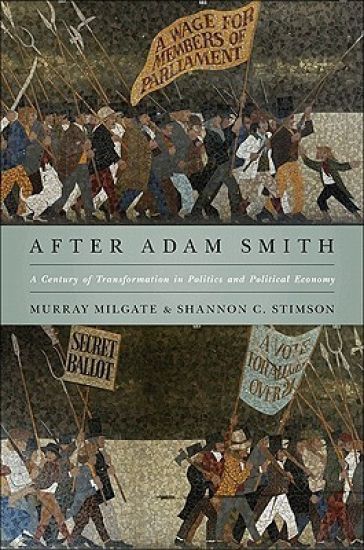
After Adam Smith

After Adam Smith

Murray Milgate; Shannon C. Stimson

Princeton University Press
2011
pokkari
Few issues are more central to our present predicaments than the relationship between economics and politics. In the century after Adam Smith's Wealth of Nations the British economy was transformed. After Adam Smith looks at how politics and political economy were articulated and altered. It considers how grand ideas about the connections between individual liberty, free markets, and social and economic justice sometimes attributed to Smith are as much the product of gradual modifications and changes wrought by later writers. Thomas Robert Malthus, David Ricardo, James Mill, John Stuart Mill, and other liberals, radicals, and reformers had a hand in conceptual transformations that culminated in the advent of neoclassical economics. The population problem, the declining importance of agriculture, the consequences of industrialization, the structural characteristics of civil society, the role of the state in economic affairs, and the possible limits to progress were questions that underwent significant readjustments as the thinkers who confronted them in different times and circumstances reworked the framework of ideas advanced by Smith--transforming the dialogue between politics and political economy. By the end of the nineteenth century an industrialized and globalized market economy had firmly established itself. By exploring how questions Smith had originally grappled with were recast as the economy and the principles of political economy altered during the nineteenth century, this book demonstrates that we are as much the heirs of later images of Smith as we are of Smith himself. Many writers helped shape different ways of thinking about economics and politics after Adam Smith. By ignoring their interventions we risk misreading our past--and also misusing it--when thinking about the choices at the interface of economics and politics that confront us today.
The Fall and Rise of Keynesian Economics

The Fall and Rise of Keynesian Economics

John Eatwell; Murray Milgate

Oxford University Press Inc
2011
sidottu
During the 1970s, when doctrines like monetarism and new classical macroeconomics ushered in an era of neoliberal economic policymaking, Keynesian economics was pushed aside. It was almost forgotten that when Keynesian thinking had dominated economic policymaking in the middle decades of the twentieth century, it had underwritten postwar economic reconstruction in both Europe and Japan, and was largely responsible for the unprecedented prosperity and stable growth of the 1950s and 1960s. The global financial crisis and recession changed all that. Influential voices in progressive economics circles began to remind us how useful Keynesian ways of thinking could be again, especially in assisting us to come to terms with our economic predicaments. When politicians across the globe were confronted with economic crisis, almost by accident they introduced pragmatic and workable measures that bore all the hallmarks of Keynesianism. This book is about this fall and rise of Keynesian economics. Eatwell and Milgate range widely across the landscape that defines their subject matter. They consider how powerful Keynesian ideas can be when applied to our past and present economic problems. They show how helpful these ideas are in explaining why we came to find ourselves in the mess we are in. They examine where and how the analytical and methodological foundations of conventional macroeconomic wisdom went wrong. They set out a blueprint for an alternative that provides a clearer, more consistent, and more applicable approach to understanding how markets work. They also highlight the interpretive shortcomings that have come to characterize Keynes scholarship itself. They do all of this within the context of a provocative reconsideration of some of the most pressing economic problems that confront financial markets and the global economy today.