
Kirjojen hintavertailu – 12 903 735 kirjaa ja 27 kauppaa

Kirjailija

Murray Peake

Kirjat ja teokset yhdessä paikassa: 2 kirjaa, julkaisuja vuosilta 2021–2022, suosituimpiin kuuluu Essay on Machines in General (1786). Vertaile teosten hintoja ja tarkista saatavuus suomalaisista kirjakaupoista.

2 kirjaa

Kirjojen julkaisuvuodet: 2021–2022.

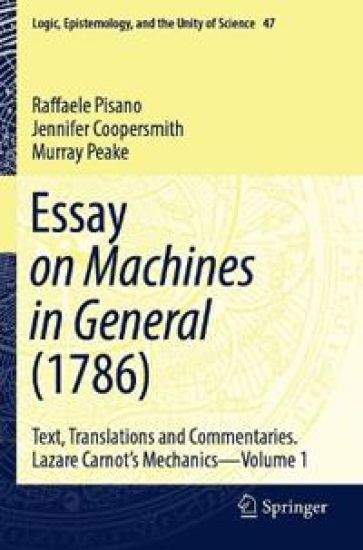
Essay on Machines in General (1786)

Essay on Machines in General (1786)

Raffaele Pisano; Jennifer Coopersmith; Murray Peake

Springer Nature Switzerland AG
2022
nidottu
This book offers insights relevant to modern history and epistemology of physics,mathematics and, indeed, to all the sciences and engineering disciplines emergingof 19th century. This research volume is the first of a set of three Springer books onLazare Nicolas Marguérite Carnot’s (1753–1823) remarkable work: Essay on Machines inGeneral (Essai sur les machines en général [1783] 1786). The other two forthcomingvolumes are: Principes fondamentaux de l’équilibre et du mouvement (1803) andGéométrie de position (1803). Lazare Carnot – l'organisateur de la victoire – in Essai sur le machine en général (1786)assumed that the generalization of machines was a necessity for society and its economicdevelopment. Subsequently, his new coming science applied to machines attractedconsiderable interest for technician, as well, already in the 1780’s. With no lack inrigour, Carnot used geometric and trigonometric rather than algebraic arguments, andusually went on to explain in words what the formulae contained. His main physical–mathematical concepts were the Geometric motion and Moment of activity–concept ofWork . In particular, he found the invariants of the transmission of motion (by statingthe principle of the moment of the quantity of motion) and theorized the condition ofthe maximum efficiency of mechanical machines (i.e., principle of continuity in thetransmission of power). While the core theme remains the theories and historical studies of the text, the bookcontains an extensive Introduction and an accurate critical English Translation –including the parallel text edition and substantive critical/explicative notes – of Essaisur les machines en général (1786). The authors offer much-needed insight into therelation between mechanics, mathematics and engineering from a conceptual, empiricaland methodological, and universalis point of view. As a cutting–edge writing byleading authorities on the history of physics and mathematics, and epistemologicalaspects, it appeals to historians, epistemologist–philosophers and scientists (physicists, mathematicians and applied sciences and technology).
Essay on Machines in General (1786)

Essay on Machines in General (1786)

Raffaele Pisano; Jennifer Coopersmith; Murray Peake

Springer Nature Switzerland AG
2021
sidottu
This book offers insights relevant to modern history and epistemology of physics,mathematics and, indeed, to all the sciences and engineering disciplines emergingof 19th century. This research volume is the first of a set of three Springer books onLazare Nicolas Marguérite Carnot’s (1753–1823) remarkable work: Essay on Machines inGeneral (Essai sur les machines en général [1783] 1786). The other two forthcomingvolumes are: Principes fondamentaux de l’équilibre et du mouvement (1803) andGéométrie de position (1803). Lazare Carnot – l'organisateur de la victoire – in Essai sur le machine en général (1786)assumed that the generalization of machines was a necessity for society and its economicdevelopment. Subsequently, his new coming science applied to machines attractedconsiderable interest for technician, as well, already in the 1780’s. With no lack inrigour, Carnot used geometric and trigonometric rather than algebraic arguments, andusually went on to explain in words what the formulae contained. His main physical–mathematical concepts were the Geometric motion and Moment of activity–concept ofWork . In particular, he found the invariants of the transmission of motion (by statingthe principle of the moment of the quantity of motion) and theorized the condition ofthe maximum efficiency of mechanical machines (i.e., principle of continuity in thetransmission of power). While the core theme remains the theories and historical studies of the text, the bookcontains an extensive Introduction and an accurate critical English Translation –including the parallel text edition and substantive critical/explicative notes – of Essaisur les machines en général (1786). The authors offer much-needed insight into therelation between mechanics, mathematics and engineering from a conceptual, empiricaland methodological, and universalis point of view. As a cutting–edge writing byleading authorities on the history of physics and mathematics, and epistemologicalaspects, it appeals to historians, epistemologist–philosophers and scientists (physicists, mathematicians and applied sciences and technology).