Kirjojen hintavertailu – 12 903 724 kirjaa ja 27 kauppaa

Kirjailija

Murray Yanowitch

Kirjat ja teokset yhdessä paikassa: 14 kirjaa, julkaisuja vuosilta 1987–2019, suosituimpiin kuuluu Winners and Losers on the Russian Road to Capitalism. Vertaile teosten hintoja ja tarkista saatavuus suomalaisista kirjakaupoista.

14 kirjaa

Kirjojen julkaisuvuodet: 1987–2019.

Social and Economic Inequality in the Soviet Union
This title was first published in 1977. The Soviet Union is a socially divided society. The collectivities of which it is composed, whether designated as classes, strata, or "socio-occupational groups" (a term favored in recent Soviet writings on social structure), exhibit systematic differences in incomes and living standards, in control over the organization of the work place, in the educational and occupational opportunities open to their children. But what is new is that the social and economic inequalities which permeate Soviet life have become, within limits of course, accessible to study and discussion by Soviet scholars. The principal public justification for the study of inequality is the Party’s need for reliable information to implement its function of "scientific management" of the relations between the main social groups in Soviet society. This volume is a collection of six studies.
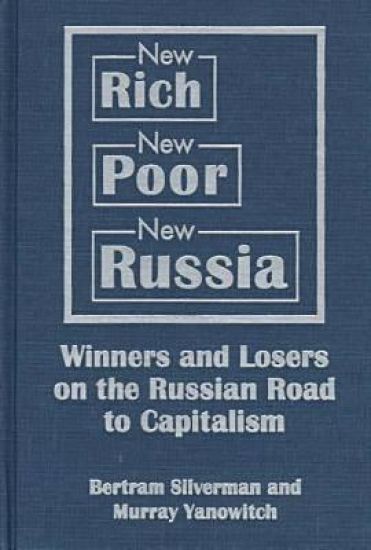
New Rich, New Poor, New Russia

New Rich, New Poor, New Russia

Bertram Silverman; Murray Yanowitch
Routledge
2000
sidottu
Now expanded to cover the consequences of Russia's 1998 financial collapse, this book focuses on the social consequences of a modern-day great depression. The text examines the unequal distribution of the costs and benefits of Russia's leap into capitalism. The topics covered include: the emergence of the "new poor"; the recruitment of a business elite; the changing social and economic status of women; and the impact of marketization on employment. The study draws on a range of statistics and survey research data to present a portrait of the lives and circumstances of comtemporary Russians.
New Rich, New Poor, New Russia

New Rich, New Poor, New Russia

Bertram Silverman; Murray Yanowitch
Routledge
1999
nidottu
Now expanded to cover the consequences of Russia's 1998 financial collapse, this book focuses on the social consequences of a modern-day great depression. The text examines the unequal distribution of the costs and benefits of Russia's leap into capitalism. The topics covered include: the emergence of the "new poor"; the recruitment of a business elite; the changing social and economic status of women; and the impact of marketization on employment. The study draws on a range of statistics and survey research data to present a portrait of the lives and circumstances of comtemporary Russians.
Double Shift

Double Shift

Bertram Silverman; Robert Vogt; Murray Yanowitch

M.E. Sharpe
1993
nidottu
Taken from a series of conferences, this collection of papers by leading labour experts from the United States and the former Soviet Union examines the profound changes in industrial systems and work organisation currently affecting both societies. The authors focus on the emergence of new labour market institutions, the evolution of managerial philosophy, changes in workers' values and attitudes toward economic security, economic inequality, and the legitimacy of worker participation in management and ownership. Comparison reveals both striking differences and similarities in the transformation of the two systems in the post-industrial age, and helps demystify some simplistic notions about the workings of market systems.
Double Shift

Double Shift

Bertram Silverman; Robert Vogt; Murray Yanowitch

M.E. Sharpe
1993
sidottu
Taken from a series of conferences, this collection of papers by leading labour experts from the United States and the former Soviet Union examines the profound changes in industrial systems and work organisation currently affecting both societies. The authors focus on the emergence of new labour market institutions, the evolution of managerial philosophy, changes in workers' values and attitudes toward economic security, economic inequality, and the legitimacy of worker participation in management and ownership. Comparison reveals both striking differences and similarities in the transformation of the two systems in the post-industrial age, and helps demystify some simplistic notions about the workings of market systems.
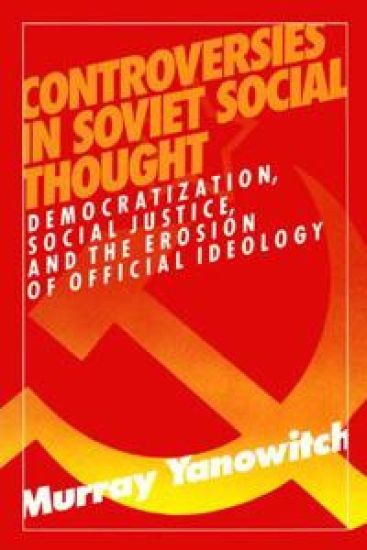
Controversies in Soviet Social Thought

Controversies in Soviet Social Thought

Murray Yanowitch

M.E. Sharpe
1991
sidottu
Over the past several years observers have become aware of what might be called the "expansionary logic" of the reform debate in the Soviet Union. Punctuated by periods of reaction and retreat, successive phases of reform momentum have brought to the fore ideas and proposals that only months before had been considered too radically unorthodox for prudent discussion. In this account, Murray Yanowitch traces the dynamic evolution of reform thinking and the emergence of liberal and social-democratic schools of thought on several pivotal issues. He shows how the contemporary debate over a recurrent theme - workplace democracy - escalated into demands for democratization of the society and political pluralism, and how similarly time-honoured discussions of the problem of economic inequality took unexpected turns, leading to reconsideration of notions of social justice, attacks on privilege, and, ultimately, demands for destatization and property reform. The cumulative impact of these developments, Yanowitch shows, has not only delegitimated the monopoly of the Communist party but has destroyed the sacral character of Marxism-Leninism itself.
Controversies in Soviet Social Thought

Controversies in Soviet Social Thought

Murray Yanowitch

M.E. Sharpe
1991
nidottu
Over the past several years observers have become aware of what might be called the "expansionary logic" of the reform debate in the Soviet Union. Punctuated by periods of reaction and retreat, successive phases of reform momentum have brought to the fore ideas and proposals that only months before had been considered too radically unorthodox for prudent discussion. In this account, Murray Yanowitch traces the dynamic evolution of reform thinking and the emergence of liberal and social-democratic schools of thought on several pivotal issues. He shows how the contemporary debate over a recurrent theme - workplace democracy - escalated into demands for democratization of the society and political pluralism, and how similarly time-honoured discussions of the problem of economic inequality took unexpected turns, leading to reconsideration of notions of social justice, attacks on privilege, and, ultimately, demands for destatization and property reform. The cumulative impact of these developments, Yanowitch shows, has not only delegitimated the monopoly of the Communist party but has destroyed the sacral character of Marxism-Leninism itself.
A Voice of Reform

A Voice of Reform

Tatiana I. Zaslavskaia; Murray Yanowitch; A. Schultz

M.E. Sharpe
1989
sidottu
First Published in 1989. It has become common, both in Soviet and in Western writings about the USSR, to characterize the early 1980s (the immediate pre-Gorbachev period) as years of stagnation or, at the very least, near stagnation in the Soviet system. Since the sudden outburst of reformist thinking since 1985 it is clear there is actually an elaboration and reinforcement of concepts and ideas that had already begun to emerge in the pre-Gorbachev years. The writings of Tat 'iana I. Zaslavskaia, trained as an economist and today one of the most influential and best known Soviet sociologists, provide an illustration of this proposition.
The Social Structure of the USSR

The Social Structure of the USSR

Murray Yanowitch

M.E. Sharpe
1987
nidottu
This is a study of "karayuki-san", impoverished Japanese women sent abroad to work as prostitutes from the 1860s to the 1920s. It follows the life of one prostitute, Osaki, who is persuaded as a child of ten to accept cleaning work in Borneo and then forced to work as a prostitute in a brothel.
The Social Structure of the USSR

The Social Structure of the USSR

Murray Yanowitch

M.E. Sharpe
1987
sidottu
This is a study of "karayuki-san", impoverished Japanese women sent abroad to work as prostitutes from the 1860s to the 1920s. It follows the life of one prostitute, Osaki, who is persuaded as a child of ten to accept cleaning work in Borneo and then forced to work as a prostitute in a brothel.