
Kirjojen hintavertailu – 12 903 725 kirjaa ja 27 kauppaa

Kirjailija

Mustak E Yalcin

Kirjat ja teokset yhdessä paikassa: 2 kirjaa, julkaisuja vuosilta 2005–2019, suosituimpiin kuuluu Reconfigurable Cellular Neural Networks and Their Applications. Vertaile teosten hintoja ja tarkista saatavuus suomalaisista kirjakaupoista.

Nimi esiintyy myös muodoissa: Müstak E. Yalçin

2 kirjaa

Kirjojen julkaisuvuodet: 2005–2019.

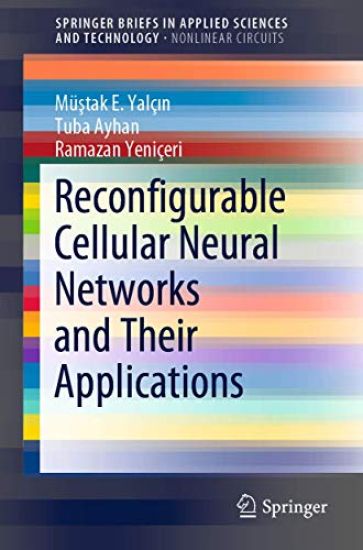
Reconfigurable Cellular Neural Networks and Their Applications

Reconfigurable Cellular Neural Networks and Their Applications

Müstak E. Yalçin; Tuba Ayhan; Ramazan Yeniçeri

Springer Nature Switzerland AG
2019
nidottu
This book explores how neural networks can be designed to analyze sensory data in a way that mimics natural systems. It introduces readers to the cellular neural network (CNN) and formulates it to match the behavior of the Wilson–Cowan model. In turn, two properties that are vital in nature are added to the CNN to help it more accurately deliver mimetic behavior: randomness of connection, and the presence of different dynamics (excitatory and inhibitory) within the same network. It uses an ID matrix to determine the location of excitatory and inhibitory neurons, and to reconfigure the network to optimize its topology. The book demonstrates that reconfiguring a single-layer CNN is an easier and more flexible solution than the procedure required in a multilayer CNN, in which excitatory and inhibitory neurons are separate, and that the key CNN criteria of a spatially invariant template and local coupling are fulfilled. In closing, the application of the authors’ neuron population model as a feature extractor is exemplified using odor and electroencephalogram classification.
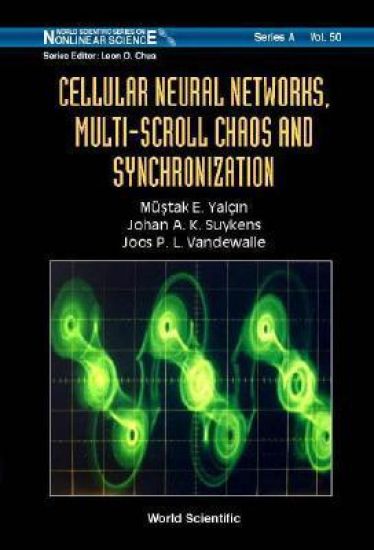
Cellular Neural Networks, Multi-scroll Chaos And Synchronization

Cellular Neural Networks, Multi-scroll Chaos And Synchronization

Johan A K Suykens; Mustak E Yalcin; Joos P L Vandewalle

World Scientific Publishing Co Pte Ltd
2005
sidottu
For engineering applications that are based on nonlinear phenomena, novel information processing systems require new methodologies and design principles. This perspective is the basis of the three cornerstones of this book: cellular neural networks, chaos and synchronization. Cellular neural networks and their universal machine implementations offer a well-established platform for processing spatial-temporal patterns and wave computing. Multi-scroll circuits are generalizations to the original Chua's circuit, leading to chip implementable circuits with increasingly complex attractors. Several applications make use of synchronization techniques for nonlinear systems. A systematic overview is given for Lur'e representable systems with global synchronization criteria for master-slave and mutual synchronization, robust synchronization, H8 synchronization, time-delayed systems and impulsive synchronization.