Kirjojen hintavertailu – 12 859 826 kirjaa ja 27 kauppaa

Kirjailija

Myron Hura

Kirjat ja teokset yhdessä paikassa: 12 kirjaa, julkaisuja vuosilta 2000–2022, suosituimpiin kuuluu Command and Control of U.S. Air Force Combat Support in a High-End Fight. Vertaile teosten hintoja ja tarkista saatavuus suomalaisista kirjakaupoista.

12 kirjaa

Kirjojen julkaisuvuodet: 2000–2022.

Command and Control of U.S. Air Force Combat Support in a High-End Fight

Command and Control of U.S. Air Force Combat Support in a High-End Fight

Don Snyder; Kristin F Lynch; Colby Peyton Steiner; John G Drew; Myron Hura; Miriam E Marlier; Theo Milonopoulos

RAND
2021
nidottu
A high-end fight places heavy demands on U. S. Air Force command and control of combat support. Policy has increasingly emphasized the need for new concepts, such as dynamic force employment, which stresses the need to maneuver and function in a communications degraded environment. The authors propose robust and resilient concepts for the command and control of logistics in such a situation.
Wing-Level Mission Assurance for a Cyber-Contested Environment

Wing-Level Mission Assurance for a Cyber-Contested Environment

Don Snyder; Lauren A Mayer; Jonathan Lee Brosmer; Elizabeth Bodine-Baron; Quentin E Hodgson; Myron Hura; Jonathan Fujiwara; Thomas Hamilton

RAND
2022
nidottu
Systems and operations have become more dependent on interconnected electronics and data. As that dependence grows, so does the need for mission assurance in the face of adversarial cyber operations. The authors offer ways to help wings assure their missions despite cyber attacks, focusing on how wings can maintain situational awareness, defend their systems, and respond to and recover from attacks to survive and operate when under cyber attack.
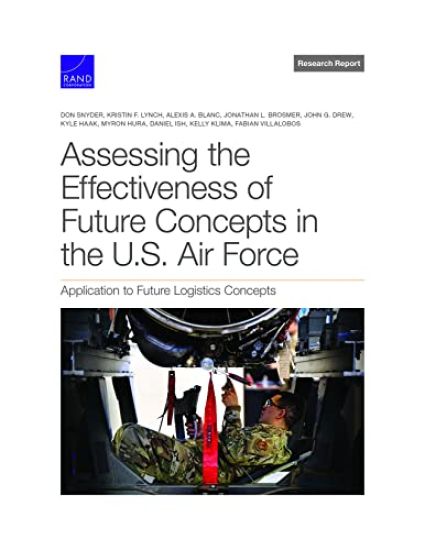
Assessing the Effectiveness of Future Concepts in the U.S. Air Force

Assessing the Effectiveness of Future Concepts in the U.S. Air Force

Don Snyder; Kristin F Lynch; Alexis A Blanc; Jonathan L Brosmer; John G Drew; Kyle Haak; Myron Hura; Daniel Ish; Kelly Klima; Fabian Villalobos

RAND Corporation
2022
nidottu
Researchers present a Future Logistics Concept Assessment Framework, which is a disciplined, systematic way to assess proposed future logistics concepts to meet the requirements of the National Defense Strategy. The idea is to reveal the most-promising concepts and prune the least promising before significant resources are invested. The goal is not to predict the future, but to show how a concept would fare across various potential futures.
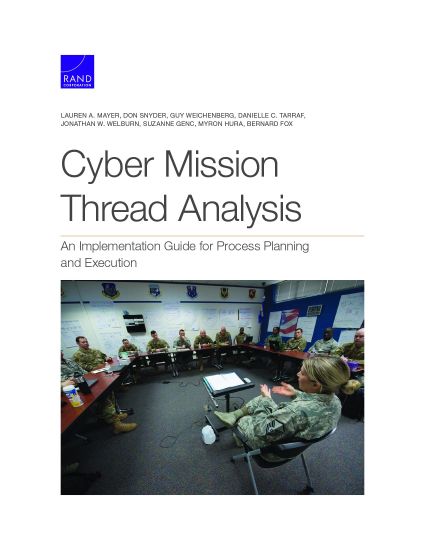
Cyber Mission Thread Analysis

Cyber Mission Thread Analysis

Lauren A Mayer; Don Snyder; Guy Weichenberg; Danielle C Tarraf; Jonathan W Welburn; Suzanne Genc; Myron Hura; Bernard Fox

RAND Corporation
2022
nidottu
Cyber mission thread analysis (CMTA), which identifies mission-critical systems in a cyber threat environment, requires a disciplined, well-planned process for its execution. This report provides a proposed planning and implementation guide (1) to perform CMTA expeditiously while still giving results good enough to make decisions about mission criticality, and (2) to analyze multiple missions concurrently.
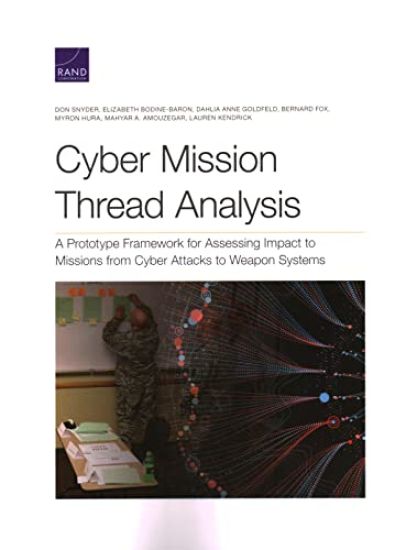
Cyber Mission Thread Analysis

Cyber Mission Thread Analysis

Don Snyder; Elizabeth Bodine-Baron; Dahlia Anne Goldfeld; Bernard Fox; Myron Hura; Mahyar A Amouzegar; Lauren Kendrick

RAND Corporation
2022
nidottu
An important consideration when deciding to mitigate or accept a risk from a cyber attack to a weapon system is how it affects operational missions. To analyze mission impact, the authors propose a methodology that aims to achieve two goals: to be comprehensive enough to be executed at the scale of each of the missions in the U. S. Air Force yet simple enough to be updated as needed to guide decisions to accept or to mitigate specific risks.
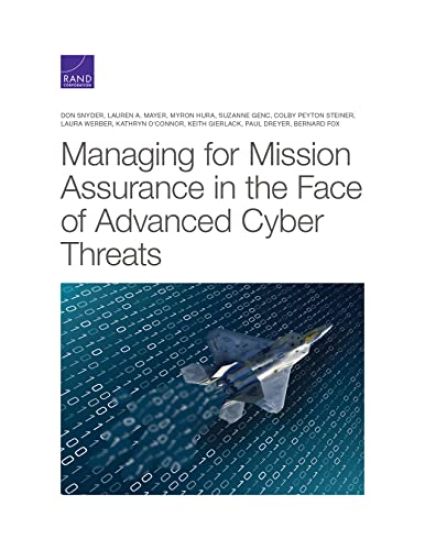
Managing for Mission Assurance in the Face of Advanced Cyber Threats

Managing for Mission Assurance in the Face of Advanced Cyber Threats

Don Snyder; Lauren A Mayer; Myron Hura; Suzanne Genc; Colby Peyton Steiner; Laura Werber; Kathryn O'Connor; Keith Gierlack; Paul Dreyer; Bernard Fox

RAND
2021
nidottu
Air Force activities to ensure resiliency to adversarial cyber operations are somewhat fractionated, with blurred lines of authority and no overall coordinating mechanisms to ensure that all related activities are identified, tasked, and implemented and act in concert to achieve enterprise objectives. The authors recommend better ways to manage, at the enterprise level, efforts to ensure resiliency of missions to adversarial cyber operations.
Measuring Cybersecurity and Cyber Resiliency

Measuring Cybersecurity and Cyber Resiliency

Don Snyder; Lauren A Mayer; Guy Weichenberg; Danielle C Tarraf; Bernard Fox; Myron Hura; Suzanne Genc; Jonathan William Welburn

RAND
2020
nidottu
This report presents a framework for the development of metrics--and a method for scoring them--that indicates how well a U. S. Air Force mission or system is expected to perform in a cyber-contested environment. There are two types of cyber metrics: working-level metrics to counter an adversary's cyber operations and institutional-level metrics to capture any cyber-related organizational deficiencies.
Enhancing Space Resilience Through Non-Materiel Means

Enhancing Space Resilience Through Non-Materiel Means

Gary McLeod; George Nacouzi; Paul Dreyer; Mel Eisman; Myron Hura; Krista S. Langeland; David Manheim; Geoffrey Torrington

RAND
2016
pokkari
Space is now a congested, contested, and competitive environment. Space systems must become more resilient to potential adversary actions and system failures, but changes to space systems are costly. To reduce costs, the Air Force asked RAND to identify non-materiel means doctrine, organization, training, leadership and education, personnel, facilities, and policy to enhance space resilience over the near and far terms."
The Effectiveness of Remotely Piloted Aircraft in a Permissive Hunter-Killer Scenario
The Air Force has begun to evaluate new concepts of operation for remotely piloted aircraft to meet future needs. This report analyzes the operational effectiveness of several such concepts in a specific, permissive hunter-killer mission, which illuminates trade-offs between platform size and number; sensor performance; and the complicating effects of darkness, fog, and cloud cover."
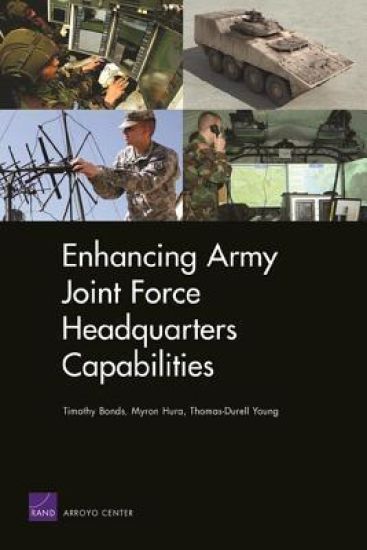
Enhancing Army Joint Force Headquarters Capabilities

Enhancing Army Joint Force Headquarters Capabilities

Timothy M. Bonds; Myron Hura; Thomas-Durell Young

RAND
2010
pokkari
The research in this document is aimed at helping the Army improve its ability to command and control joint, interagency, and multinational forces to accomplish diverse missions in a range of settings. A particular emphasis was placed on suggesting innovative ways to prepare Army headquarters, including Divisions, Corps, and Theater Armies, to perform as components of, or headquarters for, joint task forces.
Interoperability: a Continuing Challenge in Coalition Air Operations

Interoperability: a Continuing Challenge in Coalition Air Operations

Myron Hura; Gary McLeod; Eric R. Larson; William Little

RAND
2000
pokkari
The United States is incrcasingly participating in coalition military operations. Coalition support may be required for successful military operations and in most such operations the United States desires to share the burden. U. S. allies recognize the increased security that coalition operations can bring. Because interoperability is a key element in coalitions, RAND undertook research to help the Air Force identify potential interoperability problems that may arise in coalition air operations and to suggest nonmateriel and technology-based solutions. The research focus is on command, control, communications, intelligence, surveillance, and reconnaissance (C3ISR) systems in out-of-NATO-area operations. The authors' review of recent coalition air operations found that interoperability problems arose because of differences in doctrine, incompatible communications, different planning and execution systems, and different weapon system capabilities. For example, allies may lack sufficient all-weather, day and night precision-guided weapons. The authors suggest the following to increase interoperability in coalition operations: (1) common or harmonized doctrine for combined joint task force operations, from planning through assessment, (2) compatible or adaptable concepts of operation for airborne surveillance and control, (3) common information-sharing standards and compatible tactical communication systems, and (4) expert, experienced personnel who understand the capabilities of coalition partners. From a technology perspective and cost considerations, C3ISR initiatives appear to offer the best opportunities for interoperability enhancements.