Kirjojen hintavertailu – 12 903 725 kirjaa ja 27 kauppaa

Kirjailija

Mythili Ramchand

Kirjat ja teokset yhdessä paikassa: 4 kirjaa, julkaisuja vuosilta 2022–2025, suosituimpiin kuuluu Knowledge, Curriculum and Learning. Vertaile teosten hintoja ja tarkista saatavuus suomalaisista kirjakaupoista.

4 kirjaa

Kirjojen julkaisuvuodet: 2022–2025.

Knowledge, Curriculum and Learning

Knowledge, Curriculum and Learning

Mythili Ramchand; Sonia Sawhney; Poonam Sharma

TAYLOR FRANCIS LTD
2025
nidottu

Halvin toimitettuna 58,10 €

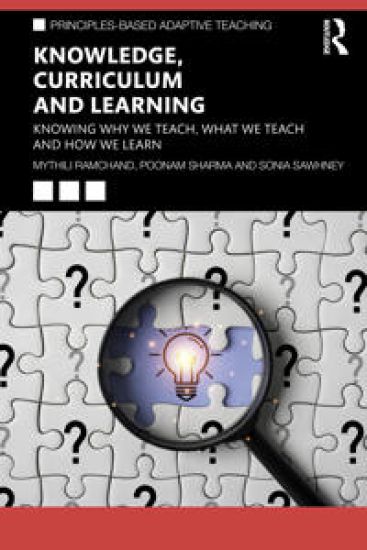
This book presents key epistemological ideas to enable teachers to understand different perspectives on knowledge, knowing and learning. It engages them to critically analyse various dimensions of knowledge and learning alongside their social and political implications. Drawing on theoretical perspectives in psychology, philosophy, sociology and anthropology, this book offers an opportunity for teachers to understand the multiple dimensions of learning. This encompasses values, beliefs and the cultivation of habits in various domains of learning such as the arts, languages, sciences, mathematics and sports. While engaging with questions of the know-that and know-how of knowledge, the book focuses on its different forms and their characterisation as school subjects. It critically examines the role of culture and politics in the formulation of the curriculum. With illustrative examples, it discusses the ideas shaping curriculum development and reforms such as child-centred education, inclusive education and integrated curriculum. This book will be of interest to students and teachers of education, BA, BEd and MEd courses, and epistemology. It will also be of interest to teachers of secondary and higher secondary schools, teacher educators, curriculum designers, developers of textbooks and other curriculum resources, non-governmental organisations (NGOs) and public and private sector bodies working in the area of education.
Knowledge, Curriculum and Learning

Knowledge, Curriculum and Learning

Mythili Ramchand; Sonia Sawhney; Poonam Sharma

TAYLOR FRANCIS LTD
2025
sidottu
This book presents key epistemological ideas to enable teachers to understand different perspectives on knowledge, knowing and learning. It engages them to critically analyse various dimensions of knowledge and learning alongside their social and political implications. Drawing on theoretical perspectives in psychology, philosophy, sociology and anthropology, this book offers an opportunity for teachers to understand the multiple dimensions of learning. This encompasses values, beliefs and the cultivation of habits in various domains of learning such as the arts, languages, sciences, mathematics and sports. While engaging with questions of the know-that and know-how of knowledge, the book focuses on its different forms and their characterisation as school subjects. It critically examines the role of culture and politics in the formulation of the curriculum. With illustrative examples, it discusses the ideas shaping curriculum development and reforms such as child-centred education, inclusive education and integrated curriculum. This book will be of interest to students and teachers of education, BA, BEd and MEd courses, and epistemology. It will also be of interest to teachers of secondary and higher secondary schools, teacher educators, curriculum designers, developers of textbooks and other curriculum resources, non-governmental organisations (NGOs) and public and private sector bodies working in the area of education.
Science Education

Science Education

Shamin Padalkar; Mythili Ramchand; Rafikh Shaikh; Indira Vijaysimha

TAYLOR FRANCIS LTD
2022
sidottu
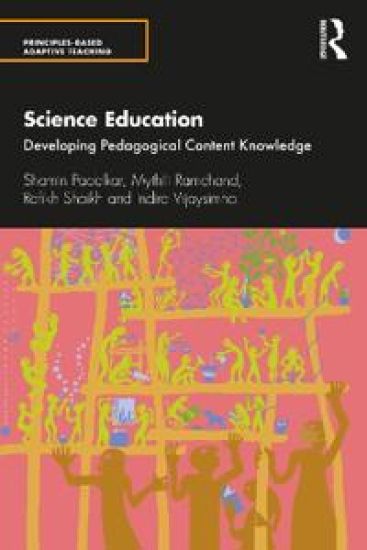
The book presents key perspectives on teaching and learning science in India. It offers adaptive expertise to teachers and educators through a pedagogic content knowledge (PCK) approach. Using cases and episodes from Indian science classrooms to contextualise ideas and practices, the volume discusses the nature of science, and aspects of assessments and evaluations for both process skills and conceptual understanding of the subject. It examines the significance of science education at school level and focuses on meaningful learning and development of scientific and technological aptitude. The chapters deal with topics from physics, chemistry and biology at the middle- and secondary-school levels, and are designed to equip student-teachers with theoretical and practical knowledge abilities about science, science learning and the abilities to teach these topics along with teaching. The book draws extensively from research on science education and teacher education and shifts away from knowledge transmission to the active process of constructivist teaching-learning practices. The authors use illustrative examples to highlight flexible planning for inclusive classrooms. Based on studies on cognitive and developmental psychology, pedagogical content knowledge of science, socio-cultural approaches to learning science, and the history and philosophy of science, the book promotes an understanding of science characterized by empirical criteria, logical arguments and sceptical reviews. With its accessible style, examples, exercises and additional references, it will be useful for students and teachers of science, science educators, BEd and MEd programmes for education, secondary and higher secondary school teachers, curriculum designers and developers of science. It will interest research institutes, non-governmental organisations, professionals and public and private sector bodies involved in science outreach, science education and teaching and learning practices.
Science Education

Science Education

Shamin Padalkar; Mythili Ramchand; Rafikh Shaikh; Indira Vijaysimha

TAYLOR FRANCIS LTD
2022
nidottu
The book presents key perspectives on teaching and learning science in India. It offers adaptive expertise to teachers and educators through a pedagogic content knowledge (PCK) approach. Using cases and episodes from Indian science classrooms to contextualise ideas and practices, the volume discusses the nature of science, and aspects of assessments and evaluations for both process skills and conceptual understanding of the subject. It examines the significance of science education at school level and focuses on meaningful learning and development of scientific and technological aptitude. The chapters deal with topics from physics, chemistry and biology at the middle- and secondary-school levels, and are designed to equip student-teachers with theoretical and practical knowledge abilities about science, science learning and the abilities to teach these topics along with teaching. The book draws extensively from research on science education and teacher education and shifts away from knowledge transmission to the active process of constructivist teaching-learning practices. The authors use illustrative examples to highlight flexible planning for inclusive classrooms. Based on studies on cognitive and developmental psychology, pedagogical content knowledge of science, socio-cultural approaches to learning science, and the history and philosophy of science, the book promotes an understanding of science characterized by empirical criteria, logical arguments and sceptical reviews. With its accessible style, examples, exercises and additional references, it will be useful for students and teachers of science, science educators, BEd and MEd programmes for education, secondary and higher secondary school teachers, curriculum designers and developers of science. It will interest research institutes, non-governmental organisations, professionals and public and private sector bodies involved in science outreach, science education and teaching and learning practices.