Kirjojen hintavertailu – 12 903 724 kirjaa ja 27 kauppaa
Kirjailija
N. V. Krylov
Kirjat ja teokset yhdessä paikassa: 12 kirjaa, julkaisuja vuosilta 1980–2018, suosituimpiin kuuluu Controlled Diffusion Processes. Vertaile teosten hintoja ja tarkista saatavuus suomalaisista kirjakaupoista.
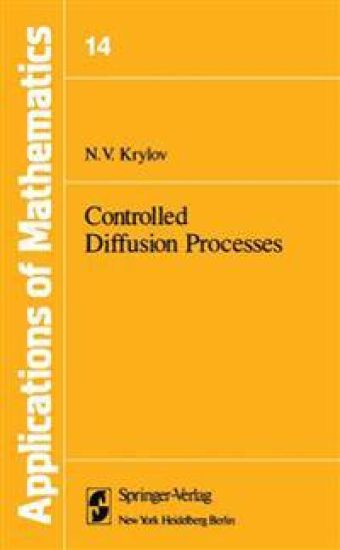
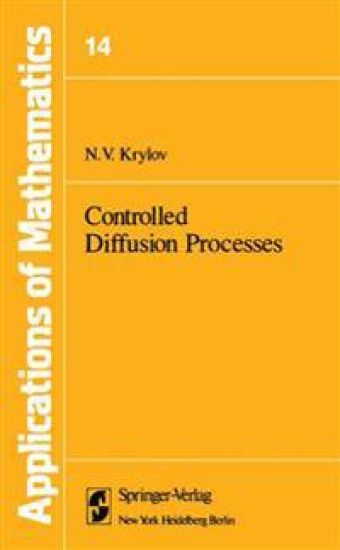
Stochastic control theory is a relatively young branch of mathematics. The beginning of its intensive development falls in the late 1950s and early 1960s. During that period an extensive literature appeared on optimal stochastic control using the quadratic performance criterion (see references in W onham [76J). At the same time, Girsanov [25J and Howard [26J made the first steps in constructing a general theory, based on Bellman's technique of dynamic programming, developed by him somewhat earlier [4J. Two types of engineering problems engendered two different parts of stochastic control theory. Problems of the first type are associated with multistep decision making in discrete time, and are treated in the theory of discrete stochastic dynamic programming. For more on this theory, we note in addition to the work of Howard and Bellman, mentioned above, the books by Derman [8J, Mine and Osaki [55J, and Dynkin and Yushkevich [12]. Another class of engineering problems which encouraged the development of the theory of stochastic control involves time continuous control of a dynamic system in the presence of random noise. The case where the system is described by a differential equation and the noise is modeled as a time continuous random process is the core of the optimal control theory of diffusion processes. This book deals with this latter theory.
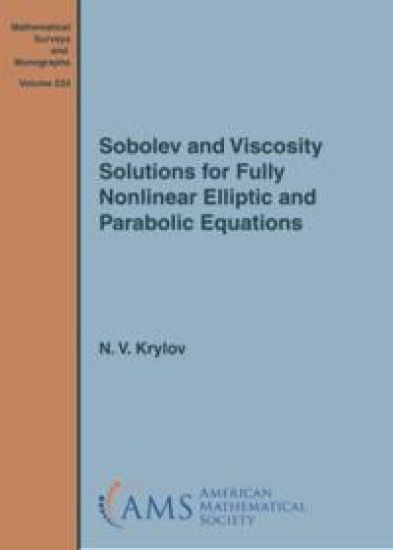
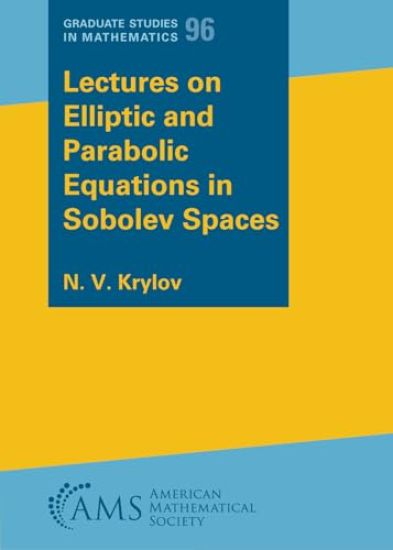
This book concentrates on the basic facts and ideas of the modern theory of linear elliptic and parabolic equations in Sobolev spaces. The main areas covered in this book are the first boundary-value problem for elliptic equations and the Cauchy problem for parabolic equations. In addition, other boundary-value problems such as the Neumann or oblique derivative problems are briefly covered. As is natural for a textbook, the main emphasis is on organizing well-known ideas in a self-contained exposition. Among the topics included that are not usually covered in a textbook are a relatively recent development concerning equations with $\mathsf{VMO}$ coefficients and the study of parabolic equations with coefficients measurable only with respect to the time variable. There are numerous exercises which help the reader better understand the material. After going through the book, the reader will have a good understanding of results available in the modern theory of partial differential equations and the technique used to obtain them. Prerequisites are basics of measure theory, the theory of $L_p$ spaces, and the Fourier transform.
Focuses on the basic facts and ideas of the modern theory of linear elliptic and parabolic equations in Sobolev spaces. This book covers the first boundary-value problem for elliptic equations and the Cauchy problem for parabolic equations. It also covers other boundary-value problems such as the Neumann or oblique derivative problems.
Stochastic control theory is a relatively young branch of mathematics. The beginning of its intensive development falls in the late 1950s and early 1960s. ~urin~ that period an extensive literature appeared on optimal stochastic control using the quadratic performance criterion (see references in Wonham [76]). At the same time, Girsanov [25] and Howard [26] made the first steps in constructing a general theory, based on Bellman's technique of dynamic programming, developed by him somewhat earlier [4]. Two types of engineering problems engendered two different parts of stochastic control theory. Problems of the first type are associated with multistep decision making in discrete time, and are treated in the theory of discrete stochastic dynamic programming. For more on this theory, we note in addition to the work of Howard and Bellman, mentioned above, the books by Derman [8], Mine and Osaki [55], and Dynkin and Yushkevich [12]. Another class of engineering problems which encouraged the development of the theory of stochastic control involves time continuous control of a dynamic system in the presence of random noise. The case where the system is described by a differential equation and the noise is modeled as a time continuous random process is the core of the optimal control theory of diffusion processes. This book deals with this latter theory.
Filtering and prediction is about observing moving objects when the observations are corrupted by random errors. The main focus is then on filtering out the errors and extracting from the observations the most precise information about the object, which itself may or may not be moving in a somewhat random fashion. Next comes the prediction step where, using information about the past behavior of the object, one tries to predict its future path. The first three chapters of the book deal with discrete probability spaces, random variables, conditioning, Markov chains, and filtering of discrete Markov chains. The next three chapters deal with the more sophisticated notions of conditioning in nondiscrete situations, filtering of continuous-space Markov chains, and of Wiener process. Filtering and prediction of stationary sequences is discussed in the last two chapters. The authors believe that they have succeeded in presenting necessary ideas in an elementary manner without sacrificing the rigor too much. Such rigorous treatment is lacking at this level in the literature. In the past few years the material in the book was offered as a one-semester undergraduate/beginning graduate course at the University of Minnesota. Some of the many problems suggested in the text were used in homework assignments.
This book concentrates on some general facts and ideas of the theory of stochastic processes. The topics include the Wiener process, stationary processes, infinitely divisible processes, and Ito stochastic equations. Basics of discrete time martingales are also presented and then used in one way or another throughout the book. Another common feature of the main body of the book is using stochastic integration with respect to random orthogonal measures. In particular, it is used for spectral representation of trajectories of stationary processes and for proving that Gaussian stationary processes with rational spectral densities are components of solutions to stochastic equations. In the case of infinitely divisible processes, stochastic integration allows for obtaining a representation of trajectories through jump measures. The Ito stochastic integral is also introduced as a particular case of stochastic integrals with respect to random orthogonal measures. Although it is not possible to cover even a noticeable portion of the topics listed above in a short book, it is hoped that after having followed the material presented here, the reader will have acquired a good understanding of what kind of results are available and what kind of techniques are used to obtain them. With more than 100 problems included, the book can serve as a text for an introductory course on stochastic processes or for independent study. Other works by this author published by the AMS include, "Lectures on Elliptic and Parabolic Equations in Holder Spaces" and "Introduction to the Theory of Diffusion Processes".
Approach your problems from the It isn't that they can't see the right end and begin with the solution. It is that they can't see answers. Then one day, perhaps the problem. you will find the final question. G. K. Chesterton. The Scandal of 'The Hermit Clad in Crane Father Brown 'The Point of a Pin'. Feathers' in R. van Gulik's The Chinese Maze Murders. Growing specialization and diversification have brought a host of mono graphs and textbooks on increasingly specialized topics. However, the "tree" of knowledge of mathematics and related fields does not grow only by putting forth new branches. It also happens, quite often in fact, that branches which were thought to be completely disparate are suddenly seen to be related. Further, the kind and level of sophistication of mathematics applied in various sciences has changed drastically in recent years: measure theory is used (non-trivially) in regional and theor.etical economics; algebraic geometry interacts with physics; the Minkowsky lemma, coding theory and the structure of water meet one another in packing and covering theory; quantum fields, crystal defects and mathematical programming profit from homotopy theory; Lie algebras are relevant to filtering; and prediction and electrical engineering can use Stein spaces.
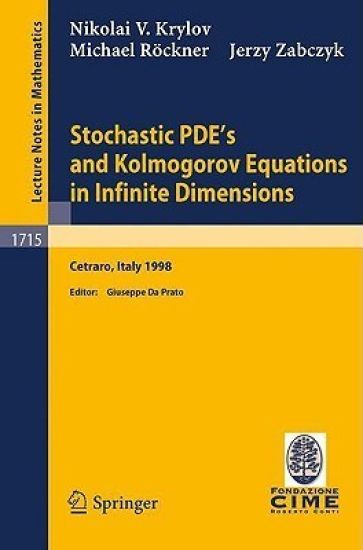
Kolmogorov equations are second order parabolic equations with a finite or an infinite number of variables. They are deeply connected with stochastic differential equations in finite or infinite dimensional spaces. They arise in many fields as Mathematical Physics, Chemistry and Mathematical Finance. These equations can be studied both by probabilistic and by analytic methods, using such tools as Gaussian measures, Dirichlet Forms, and stochastic calculus. The following courses have been delivered: N. V. Krylov presented Kolmogorov equations coming from finite-dimensional equations, giving existence, uniqueness and regularity results. M. Röckner has presented an approach to Kolmogorov equations in infinite dimensions, based on an LP-analysis of the corresponding diffusion operators with respect to suitably chosen measures. J. Zabczyk started from classical results of L. Gross, on the heat equation in infinite dimension, and discussed some recent results.
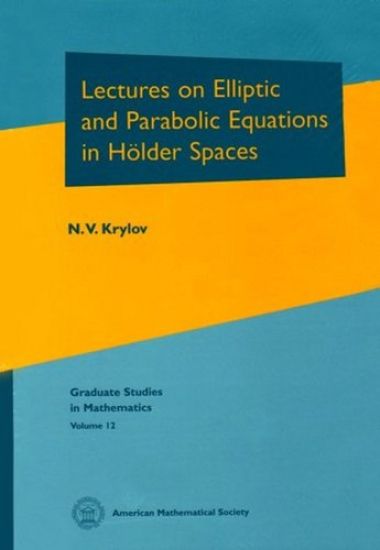
These lectures concentrate on fundamentals of the modern theory of linear elliptic and parabolic equations in Holder spaces. Krylov shows that this theory - including some issues of the theory of nonlinear equations - is based on some general and extremely powerful ideas and some simple computations. The main object of study is the first boundary-value problems for elliptic and parabolic equations, with some guidelines concerning other boundary-value problems such as the Neumann or oblique derivative problems or problems involving higher-order elliptic operators acting on the boundary. Numerical approximations are also discussed. This book, with nearly 200 exercises, will provide a good understanding of what kinds of results are available and what kinds of techniques are used to obtain them.
Stochastic control theory is a relatively young branch of mathematics. The beginning of its intensive development falls in the late 1950s and early 1960s. During that period an extensive literature appeared on optimal stochastic control using the quadratic performance criterion (see references in W onham [76J). At the same time, Girsanov [25J and Howard [26J made the first steps in constructing a general theory, based on Bellman's technique of dynamic programming, developed by him somewhat earlier [4J. Two types of engineering problems engendered two different parts of stochastic control theory. Problems of the first type are associated with multistep decision making in discrete time, and are treated in the theory of discrete stochastic dynamic programming. For more on this theory, we note in addition to the work of Howard and Bellman, mentioned above, the books by Derman [8J, Mine and Osaki [55J, and Dynkin and Yushkevich [12]. Another class of engineering problems which encouraged the development of the theory of stochastic control involves time continuous control of a dynamic system in the presence of random noise. The case where the system is described by a differential equation and the noise is modeled as a time continuous random process is the core of the optimal control theory of diffusion processes. This book deals with this latter theory.