

Kirjojen hintavertailu – 12 859 827 kirjaa ja 27 kauppaa

Kirjailija

Nadia Pocher

Kirjat ja teokset yhdessä paikassa: 2 kirjaa, julkaisuja vuosilta 2017–2025, suosituimpiin kuuluu Crypto-Asset Ecosystems and the EU Anti-Money Laundering Framework. Vertaile teosten hintoja ja tarkista saatavuus suomalaisista kirjakaupoista.

2 kirjaa

Kirjojen julkaisuvuodet: 2017–2025.

Crypto-Asset Ecosystems and the EU Anti-Money Laundering Framework

Crypto-Asset Ecosystems and the EU Anti-Money Laundering Framework

Nadia Pocher

Springer International Publishing AG
2025
sidottu
This interdisciplinary monograph investigates crypto-asset ecosystems and their interplay with the framework to prevent money laundering and the financing of terrorism and proliferation (AML/CFT). Positioned at the intersection of legal research and technical analysis, it conceptualises crypto-asset ecosystems as interconnected socio-technical systems. Building on this foundation, it examines how varying degrees of anonymity, transparency, (non)centralisation, and (dis)intermediation shape both challenges and opportunities for compliance and oversight. The book engages with the operational dynamics and terminological ambiguities that underpin current understandings and regulatory responses to crypto-asset-related risks. It unpacks the concepts of transaction obfuscation and traceability, and investigates the accountability implications of diverse tools and techniques – ranging from self-hosted wallets and decentralised exchanges to privacy-enhanced protocols and machine-learning-driven analytics. Through this lens, it explores the relevance of techno-legal trade-offs in system design, as exemplified in proposed central bank digital currency (CBDC) models. A contextualised assessment of international standards and the European Union’s evolving legal framework – including AML and AMLA Regulations, Crypto Travel Rule, and Markets in Crypto-Assets Regulation – serves as a foundation for a set of recommendations on how to holistically consider crypto-asset features in line with the AML/CFT risk-based approach. The methodology reflects the mutual interaction between regulation and technology within a co-regulatory setting, seen as a prerequisite to uphold compliance by (and through) design. Ultimately, the book advocates for a transposition model between AML/CFT risk indicators and techno-regulatory standards, informed by a risk-based taxonomy of crypto-asset ecosystems. Against the backdrop of rapidly evolving technologies, stakeholders, and risks, this monograph offers conceptual tools, terminological clarifications, and common discussion points across disciplines – including law, the social sciences, computer science and engineering, management and information systems. It provides a comprehensive foundation for scholars, practitioners, and policymakers engaged in shaping the future of crypto-asset regulation and compliance.
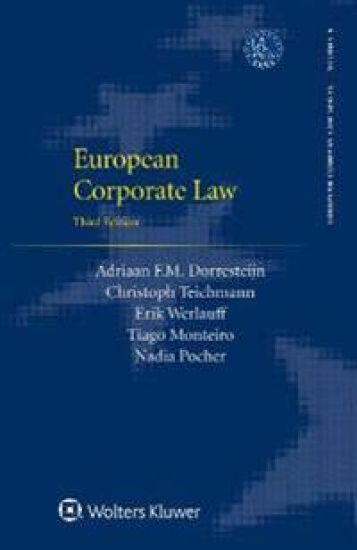
European Corporate Law

European Corporate Law

Adriaan F. M. Dorresteijn; Christoph Teichmann; Erik Werlauff; Tiago Monteiro; Nadia Pocher

Kluwer Law International
2017
sidottu
European Company Law Series Volume 5 European Corporate Law is the fully updated new edition providing the best-known practical overview of the law regarding companies, business activities, and capital markets in Europe, at the European Union (EU) and Member State levels. The characteristics of national company laws and political incentives remain, of course, a slackening combination to those who are convinced that acceleration of harmonization within the EU is the way to go. Seen from a distance, however, differences in national company laws are often related to details, the importance of which should not be overrated. The book incorporates analysis of recent developments, including the impact of global initiatives in such aspects of the corporate environment as regulation of financial institutions and non-financial reporting obligations with a view to sustainability and other social responsibility concerns. What's in this book: The authors, all leading experts in European corporate law, describe current and emerging trends in such areas of corporate law practice as the following: rules on cross-border mergers; employee involvement in business activities; the initiatives by the Organisation for Economic Co-operation and Development and the EU to curb tax avoidance; Member States' implementation of EU legislation; a company's freedom to incorporate in a jurisdiction not its own; competition among the legal forms of different Member States; and safeguarding of employee involvement in cross-border transactions. With respect to national law, the laws of Belgium, France, Germany, the Netherlands, Poland, Spain, and the United Kingdom (UK) are taken into account; Italy is now included in this new edition. The selection of countries may be debatable, but the book aims at including examples of continental European legal systems as well as the common law system of the UK. How this will help you: This Third Edition will continue to be of great value to practitioners and academics who wish to acquire a better understanding of European corporate law, in its supranational dimension as well as in the similarities and differences among the various national legal systems. It is also a springboard for further research on topics dealt with or mentioned briefly in the book such as liability of directors, corporate governance, cross-border acquisitions, digitalization of company law, cross-border insolvency, and pre-insolvency restructuring.