Kirjojen hintavertailu – 12 903 724 kirjaa ja 27 kauppaa

Kirjailija

Naim Kapucu

Kirjat ja teokset yhdessä paikassa: 11 kirjaa, julkaisuja vuosilta 2010–2026, suosituimpiin kuuluu Network Governance. Vertaile teosten hintoja ja tarkista saatavuus suomalaisista kirjakaupoista.

11 kirjaa

Kirjojen julkaisuvuodet: 2010–2026.

Network Governance

Network Governance

Naim Kapucu; Qian Hu

TAYLOR FRANCIS LTD
2026
sidottu
Although network governance has received greater attention within the fields of public administration and policy in recent years, few books are designed specifically to help students, researchers, and practitioners examine key concepts, synthesize the growing body of literature into reliable frameworks, and to bridge the theory-practice gap by exploring network applications. Network Governance: Concepts, Theories, and Applications, Second Edition fills this important gap, offering a systematic examination of existing knowledge, while also exploring the applications of networks in a variety of management and policy domains. Authors Naim Kapucu and Qian Hu begin with a thorough overview of the key concepts in networks and network analysis before moving into more advanced concepts including network leadership and management, network performance and evaluation, power and decision-making, and legitimacy and accountability issues. The authors then provide examples of network governance applications in diverse contexts, ranging from community and economic development to human and social services, virtual environments, and emergency and crisis management. This substantially revised second edition offers an integrated framework and methodologies to address contemporary challenges, as well as the growing demand for practical tools and actionable insights in the field, including advances in data analytics, artificial intelligence, and cross-sector collaboration. This new edition responds to these developments by integrating cutting-edge research, tools, practical applications, and innovative pedagogical approaches. An all-new chapter dedicated to network analysis and detailed steps for analyzing network data using R programming is included. PowerPoint slides and a sample syllabus are available for adopters on an accompanying website, making this second edition ideal for courses on network governance, collaborative public management, cross-sector governance, and collaboration and partnerships in programs of public administration, public affairs, and public policy.
Network Governance

Network Governance

Naim Kapucu; Qian Hu

TAYLOR FRANCIS LTD
2026
nidottu
Although network governance has received greater attention within the fields of public administration and policy in recent years, few books are designed specifically to help students, researchers, and practitioners examine key concepts, synthesize the growing body of literature into reliable frameworks, and to bridge the theory-practice gap by exploring network applications. Network Governance: Concepts, Theories, and Applications, Second Edition fills this important gap, offering a systematic examination of existing knowledge, while also exploring the applications of networks in a variety of management and policy domains. Authors Naim Kapucu and Qian Hu begin with a thorough overview of the key concepts in networks and network analysis before moving into more advanced concepts including network leadership and management, network performance and evaluation, power and decision-making, and legitimacy and accountability issues. The authors then provide examples of network governance applications in diverse contexts, ranging from community and economic development to human and social services, virtual environments, and emergency and crisis management. This substantially revised second edition offers an integrated framework and methodologies to address contemporary challenges, as well as the growing demand for practical tools and actionable insights in the field, including advances in data analytics, artificial intelligence, and cross-sector collaboration. This new edition responds to these developments by integrating cutting-edge research, tools, practical applications, and innovative pedagogical approaches. An all-new chapter dedicated to network analysis and detailed steps for analyzing network data using R programming is included. PowerPoint slides and a sample syllabus are available for adopters on an accompanying website, making this second edition ideal for courses on network governance, collaborative public management, cross-sector governance, and collaboration and partnerships in programs of public administration, public affairs, and public policy.
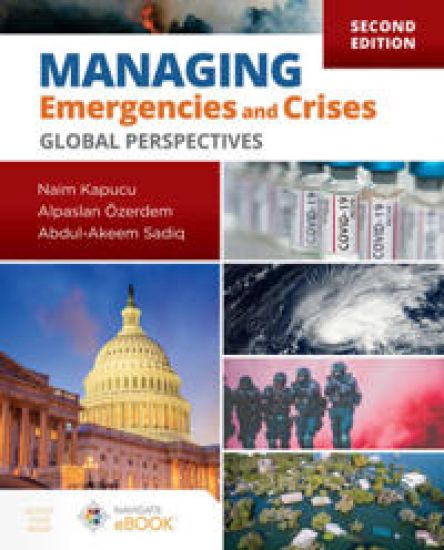
Managing Emergencies and Crises: Global Perspectives

Managing Emergencies and Crises: Global Perspectives

Naim Kapucu; Alpaslan Özerdem; Abdul-Akeem Sadiq

JONES AND BARTLETT PUBLISHERS, INC
2022
nidottu
As the scale, frequency, and intensity of crises faced by the world have dramatically increased over the last decade, there is a critical need for a careful stocktaking on the knowledge of managing disasters. Managing Emergencies and Crises: Global Perspectives clearly and comprehensively explores the most important concepts of emergency and crisis management (such as mitigation, protection, prevention, preparedness, response, recovery, vulnerability, and risk assessment) and illustrates them with cases involving disasters and emergencies worldwide. Substantially revised, the Second Edition has been reorganized and includes two new and timely chapters on terrorism and emergency management and public health emergencies and crises. It also provides an emphasis on management and leadership and cross-sector governance from interdisciplinary and global perspectives. Key Features:- Two new chapters: Terrorism and Emergency Management and Public Health Emergencies and Crises. - Diverse scholarly perspectives are presented to guide readers' understanding of various concepts in the emergency and crisis management field. - Rich and diverse case studies illustrate how various stakeholders, including emergency program managers, respond in crisis and emergency management situation. - Navigate eBook Access (included with the print text) provides online or offline access to the digital textbook
Network Governance

Network Governance

Naim Kapucu; Qian Hu

Routledge
2020
sidottu
Network governance has received much attention within the fields of public administration and policy in recent years, but surprisingly few books are designed specifically to help students, researchers, and practitioners examine key concepts, synthesize the growing body of literature into reliable frameworks, and to bridge the theory-practice gap by exploring network applications. Network Governance: Concepts, Theories, and Applications is the first textbook to focus on interorganizational networks and network governance from the perspective of public policy and administration, asking important questions such as: How are networks designed and developed? How are they governed, and what type of leadership do they require? To whom are networks accountable, and when are they effective? How can network governance contribute to effective delivery of public services and policy implementation? In this timely new book, authors Naim Kapucu and Qian Hu define and examine key concepts, propose exciting new theoretical frameworks to synthetize the fast-growing body of network research in public policy and administration, and provide detailed discussion of applications. Network Governance offers not only a much-needed systematic examination of existing knowledge, but it also goes much further than existing books by discussing the applications of networks in a wide range of management practice and policy domains—including natural resource management, environmental protection, public health, emergency and crisis management, law enforcement, transportation, and community and economic development. Chapters include understudied network research topics such as power and decision-making in interorganizational networks, virtual networks, global networks, and network analysis applications. What sets this book apart is the introduction of social network analysis and coverage of applications of social network analysis in the policy and management domains. PowerPoint slides and a sample syllabus are available for adopters on an accompanying website. Drawing on literature from sociology, policy sciences, organizational studies, and economics, this textbook will be required reading for courses on network governance, collaborative public management, cross-sector governance, and collaboration and partnerships in programs of public administration, public affairs, and public policy.
Network Governance

Network Governance

Naim Kapucu; Qian Hu

Routledge
2020
nidottu
Network governance has received much attention within the fields of public administration and policy in recent years, but surprisingly few books are designed specifically to help students, researchers, and practitioners examine key concepts, synthesize the growing body of literature into reliable frameworks, and to bridge the theory-practice gap by exploring network applications. Network Governance: Concepts, Theories, and Applications is the first textbook to focus on interorganizational networks and network governance from the perspective of public policy and administration, asking important questions such as: How are networks designed and developed? How are they governed, and what type of leadership do they require? To whom are networks accountable, and when are they effective? How can network governance contribute to effective delivery of public services and policy implementation? In this timely new book, authors Naim Kapucu and Qian Hu define and examine key concepts, propose exciting new theoretical frameworks to synthetize the fast-growing body of network research in public policy and administration, and provide detailed discussion of applications. Network Governance offers not only a much-needed systematic examination of existing knowledge, but it also goes much further than existing books by discussing the applications of networks in a wide range of management practice and policy domains—including natural resource management, environmental protection, public health, emergency and crisis management, law enforcement, transportation, and community and economic development. Chapters include understudied network research topics such as power and decision-making in interorganizational networks, virtual networks, global networks, and network analysis applications. What sets this book apart is the introduction of social network analysis and coverage of applications of social network analysis in the policy and management domains. PowerPoint slides and a sample syllabus are available for adopters on an accompanying website. Drawing on literature from sociology, policy sciences, organizational studies, and economics, this textbook will be required reading for courses on network governance, collaborative public management, cross-sector governance, and collaboration and partnerships in programs of public administration, public affairs, and public policy.
Disaster Vulnerability, Hazards and Resilience

Disaster Vulnerability, Hazards and Resilience

Fernando I. Rivera; Naim Kapucu

Springer International Publishing AG
2016
nidottu
This monograph provides valuable lessons in building disaster resilience for rural communities and beyond. With a focus on Florida, the authors present a comprehensive review of the current debates surrounding the study of resilience, from federal frameworks, state plans and local initiatives. They also review evaluation tools and feature first-hand accounts of county emergency managers as well as non-profit and community groups on key issues, including perspectives on vulnerable groups such as the elderly, children and farm workers. Readers will find insightful answers to such questions as: How can the concept of resilience be used as a framework to investigate the conditions that lead to stronger, more sustainable communities? What factors account for the variation across jurisdictions and geographic units in the ability to respond to and recover from a disaster? How does the recovery process impact the social, political and economic institutions of the stricken communities? How do communities, especially rural ones, collaborate with multiple stakeholders (local, regional, state, national) during the transition from recovery to resilience? Can the collaborative nature of disaster recovery help build resilient communities?. The primary audiences of this book are scholars in emergency and crisis management, planning and policy, disaster response and recovery, disaster sociology and environmental management and policy. This book can also be used as a textbook in graduate and advanced undergraduate programs / courses on disaster management, disaster studies, emergency and crisis management, environmental policy and management and public policy and administration.
Disaster Vulnerability, Hazards and Resilience

Disaster Vulnerability, Hazards and Resilience

Fernando I. Rivera; Naim Kapucu

Springer International Publishing AG
2015
sidottu
This monograph provides valuable lessons in building disaster resilience for rural communities and beyond. With a focus on Florida, the authors present a comprehensive review of the current debates surrounding the study of resilience, from federal frameworks, state plans and local initiatives. They also review evaluation tools and feature first-hand accounts of county emergency managers as well as non-profit and community groups on key issues, including perspectives on vulnerable groups such as the elderly, children and farm workers. Readers will find insightful answers to such questions as: How can the concept of resilience be used as a framework to investigate the conditions that lead to stronger, more sustainable communities? What factors account for the variation across jurisdictions and geographic units in the ability to respond to and recover from a disaster? How does the recovery process impact the social, political and economic institutions of the stricken communities? How do communities, especially rural ones, collaborate with multiple stakeholders (local, regional, state, national) during the transition from recovery to resilience? Can the collaborative nature of disaster recovery help build resilient communities?. The primary audiences of this book are scholars in emergency and crisis management, planning and policy, disaster response and recovery, disaster sociology and environmental management and policy. This book can also be used as a textbook in graduate and advanced undergraduate programs / courses on disaster management, disaster studies, emergency and crisis management, environmental policy and management and public policy and administration.
Network Governance in Response to Acts of Terrorism
High performance during catastrophic terrorist events require the ability to assess and adapt capacity rapidly, restore or enhance disrupted or inadequate communications, utilize flexible decision making swiftly, and expand coordination and trust between multiple emergency and crisis response agencies. These requirements are superimposed on conventional administrative systems that rely on relatively rigid plans, decision protocols, and formal relationships that assume smooth sailing and uninterrupted communications and coordination. Network Governance in Response to Acts of Terrorism focuses on the inter-organizational performance and coordinated response to recent terrorist incidents across different national, legal, and cultural contexts in New York, Bali, Istanbul, Madrid, London, and Mumbai. Effortlessly combining each case study with content analyses of news reports from local and national newspapers, situation reports from government emergency/crisis management agencies, and, interviews with public managers, community leaders, and nonprofit executives involved in response operations, Naim Kapucu presents an overview of how different countries tackle emergencies by employing various collaborative decision-making processes, thus, offering a global perspective with different approaches. These features make this book an important read for both scholars and practitioners eager to reconcile existing decision-making theories with practice.
Network Governance in Response to Acts of Terrorism
High performance during catastrophic terrorist events require the ability to assess and adapt capacity rapidly, restore or enhance disrupted or inadequate communications, utilize flexible decision making swiftly, and expand coordination and trust between multiple emergency and crisis response agencies. These requirements are superimposed on conventional administrative systems that rely on relatively rigid plans, decision protocols, and formal relationships that assume smooth sailing and uninterrupted communications and coordination. Network Governance in Response to Acts of Terrorism focuses on the inter-organizational performance and coordinated response to recent terrorist incidents across different national, legal, and cultural contexts in New York, Bali, Istanbul, Madrid, London, and Mumbai. Effortlessly combining each case study with content analyses of news reports from local and national newspapers, situation reports from government emergency/crisis management agencies, and, interviews with public managers, community leaders, and nonprofit executives involved in response operations, Naim Kapucu presents an overview of how different countries tackle emergencies by employing various collaborative decision-making processes, thus, offering a global perspective with different approaches. These features make this book an important read for both scholars and practitioners eager to reconcile existing decision-making theories with practice.
Managing Emergencies And Crises

Managing Emergencies And Crises

Naim Kapucu; Alpaslan ?zerdem

Jones and Bartlett Publishers, Inc
2011
nidottu
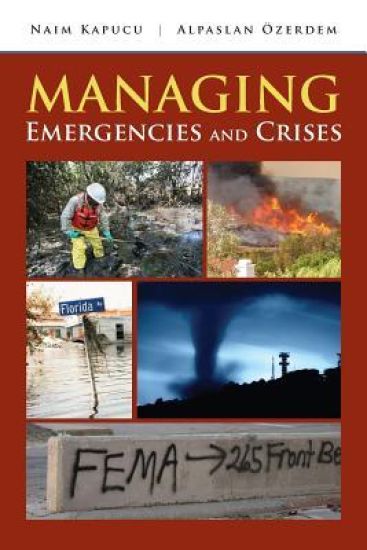
As the scale, frequency, and intensity of crises faced by the world have dramatically increased over the last decade, there is a critical need for a careful evaluation of knowledge of managing disasters. Managing Emergencies and Crises presents the experience of emergency management from a continental perspective by focusing on the emergency response systems, processes, and actors in the context of the United States and Europe. It explores the institutional, socio-cultural and political aspects of crisis response and management. Your students will examine questions such as: What does the experience of disaster response from Japan, Pakistan, Greece and Turkey to the UK and US tell us about the state-civil society cooperation in such environments? How effective are the existing prevention and preparedness mechanisms to protect societies against disasters? What specific roles are attributed to state, federal, international and private sector participants at a rhetorical level and how those actors actually carry out their `responsibilities’ and work with each other in the event of a crisis?