Kirjojen hintavertailu – 12 859 827 kirjaa ja 27 kauppaa

Kirjailija

Nan Chen

Kirjat ja teokset yhdessä paikassa: 7 kirjaa, julkaisuja vuosilta 2007–2026, suosituimpiin kuuluu Stochastic Methods for Modeling and Predicting Complex Dynamical Systems. Vertaile teosten hintoja ja tarkista saatavuus suomalaisista kirjakaupoista.

7 kirjaa

Kirjojen julkaisuvuodet: 2007–2026.

Stochastic Methods for Modeling and Predicting Complex Dynamical Systems
This second edition is an essential guide to understanding, modeling, and predicting complex dynamical systems using new methods with stochastic tools. Expanding upon the original book, the author covers a unique combination of qualitative and quantitative modeling skills, novel efficient computational methods, rigorous mathematical theory, as well as physical intuitions and thinking. The author presents mathematical tools for understanding, modeling, and predicting complex dynamical systems using various suitable stochastic tools. The book provides practical examples and motivations when introducing these tools, merging mathematics, statistics, information theory, computational science, and data science. The author emphasizes the balance between computational efficiency and modeling accuracy while equipping readers with the skills to choose and apply stochastic tools to a wide range of disciplines. This second edition includes updated discussion of combining stochastic models with machine learning and addresses several additional topics, including importance sampling, regression, and maximum likelihood estimate. The author also introduces a new chapter on optimal control.
Stochastic Methods for Modeling and Predicting Complex Dynamical Systems
This book enables readers to understand, model, and predict complex dynamical systems using new methods with stochastic tools. The author presents a unique combination of qualitative and quantitative modeling skills, novel efficient computational methods, rigorous mathematical theory, as well as physical intuitions and thinking. An emphasis is placed on the balance between computational efficiency and modeling accuracy, providing readers with ideas to build useful models in practice. Successful modeling of complex systems requires a comprehensive use of qualitative and quantitative modeling approaches, novel efficient computational methods, physical intuitions and thinking, as well as rigorous mathematical theories. As such, mathematical tools for understanding, modeling, and predicting complex dynamical systems using various suitable stochastic tools are presented. Both theoretical and numerical approaches are included, allowing readers to choose suitable methods in different practical situations. The author provides practical examples and motivations when introducing various mathematical and stochastic tools and merges mathematics, statistics, information theory, computational science, and data science. In addition, the author discusses how to choose and apply suitable mathematical tools to several disciplines including pure and applied mathematics, physics, engineering, neural science, material science, climate and atmosphere, ocean science, and many others. Readers will not only learn detailed techniques for stochastic modeling and prediction, but will develop their intuition as well. Important topics in modeling and prediction including extreme events, high-dimensional systems, and multiscale features are discussed.
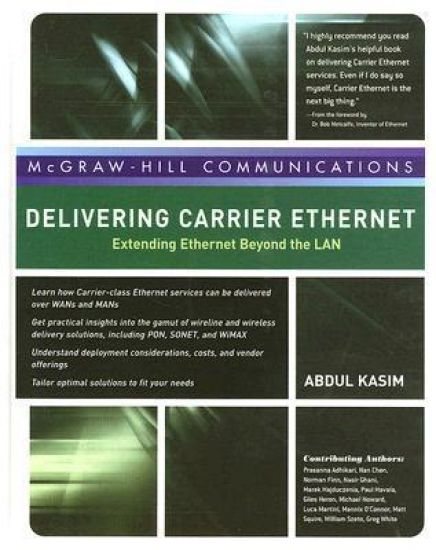
Delivering Carrier Ethernet: Extending Ethernet Beyond the LAN

Delivering Carrier Ethernet: Extending Ethernet Beyond the LAN

Abdul Kasim; Prasanna Adhikari; Nan Chen; Norman Finn; Nasir Ghani; Marek Hajduczenia; Paul Havala; Giles Heron; Michael Howard; Luca Martini; Bob Metcalfe; Mannix O'Connor; Matt Squire; William Szeto; Greg White

McGraw-Hill Professional
2007
sidottu
Publisher's Note: Products purchased from Third Party sellers are not guaranteed by the publisher for quality, authenticity, or access to any online entitlements included with the product. Understand and evaluate the delivery of Carrier Ethernet using different technologies Carrier Ethernet is rapidly becoming the de facto platform for offering the next generation of high-bandwidth multimedia applications. Delivering Carrier Ethernet: Extending Ethernet Beyond the LAN provides, for the very first time, an in-depth assessment of the various network solutions that can be used to deliver Carrier Ethernet services. The book is based on extensive real-world deployments and is written by globally renowned experts. A standard solution framework is used consistently throughout to address each underlying technology, its benefits and pitfalls, deployment approaches, ongoing developments, economic assessments, and key vendors promoting the solution. The potential evolution of Carrier Ethernet itself is also considered in detail. CopperHFC (Hybrid Fiber-Coax)PONs (Passive Optical Networks)TDM (Time Division Multiplexing)Fiber and WDM (Wavelength Division Multiplexing)Optical Wireless Mesh Network/Free Space OpticsSONET (Synchronous Optical NETworking)/MSPP (Multi-Service Provisioning Platform)RPR (Resilient Packet Ring)Bridging/SwitchingMPLS (MultiProtocol Label Switching)WiMAX/WiMAC
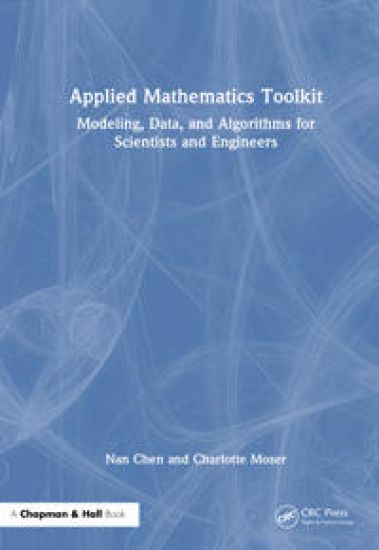
Applied Mathematics Toolkit

Applied Mathematics Toolkit

Nan Chen; Charlotte Moser

TAYLOR FRANCIS LTD
2026
sidottu
Modern scientific and engineering systems are increasingly defined by nonlinearity, high dimensionality, partial observability, and uncertainty. Addressing such complexity requires more than isolated techniques. It calls for an integrated applied mathematics perspective that connects modeling, data analysis, and computation within a coherent framework. This book develops such a unified toolkit. Rather than treating mathematical methods as separate disciplines, it emphasizes their complementary roles in understanding, analyzing, and predicting complex systems, with a focus on intuition, practical relevance, and transferability across scientific and engineering fields. Presents a broad collection of essential applied mathematics tools, organized to emphasize their interplay rather than treating them as isolated topics. Each method is introduced through simple yet illuminating examples that make advanced concepts accessible without sacrificing rigor. For every technique, the presentation highlights the underlying motivation, key assumptions, strengths, limitations, and the contexts in which it is most effective. Theory, data, and algorithms are consistently integrated to demonstrate how they work together in practical applications. Is accompanied by short ``one concept $\cdot$ one example'' videos, each 5-10 minutes long, focusing on a single idea and using deliberately simple examples to support initial exposure, intuition building, and efficient review. Example codes included to reinforce the concepts and facilitate hands-on learning. This book is intended for advanced undergraduate students, graduate students, and researchers in applied mathematics, science, and engineering who seek practical mastery of modern mathematical tools. It is well suited to topic courses and self-study, particularly for readers working at the intersection of modeling, data, and computation. By combining conceptual clarity with hands-on examples and an integrated methodology, the book provides a foundation for tackling real-world problems in a wide range of interdisciplinary settings.
Applied Mathematics Toolkit

Applied Mathematics Toolkit

Nan Chen; Charlotte Moser

TAYLOR FRANCIS LTD
2026
nidottu
Modern scientific and engineering systems are increasingly defined by nonlinearity, high dimensionality, partial observability, and uncertainty. Addressing such complexity requires more than isolated techniques. It calls for an integrated applied mathematics perspective that connects modeling, data analysis, and computation within a coherent framework. This book develops such a unified toolkit. Rather than treating mathematical methods as separate disciplines, it emphasizes their complementary roles in understanding, analyzing, and predicting complex systems, with a focus on intuition, practical relevance, and transferability across scientific and engineering fields. Presents a broad collection of essential applied mathematics tools, organized to emphasize their interplay rather than treating them as isolated topics. Each method is introduced through simple yet illuminating examples that make advanced concepts accessible without sacrificing rigor. For every technique, the presentation highlights the underlying motivation, key assumptions, strengths, limitations, and the contexts in which it is most effective. Theory, data, and algorithms are consistently integrated to demonstrate how they work together in practical applications. Is accompanied by short ``one concept $\cdot$ one example'' videos, each 5-10 minutes long, focusing on a single idea and using deliberately simple examples to support initial exposure, intuition building, and efficient review. Example codes included to reinforce the concepts and facilitate hands-on learning. This book is intended for advanced undergraduate students, graduate students, and researchers in applied mathematics, science, and engineering who seek practical mastery of modern mathematical tools. It is well suited to topic courses and self-study, particularly for readers working at the intersection of modeling, data, and computation. By combining conceptual clarity with hands-on examples and an integrated methodology, the book provides a foundation for tackling real-world problems in a wide range of interdisciplinary settings.