
Kirjailija
NASA
Kirjat ja teokset yhdessä paikassa: 79 kirjaa, julkaisuja vuosilta 1967–2021, suosituimpiin kuuluu NASA Apollo Spacecraft Lunar Excursion Module News Reference. Vertaile teosten hintoja ja tarkista saatavuus suomalaisista kirjakaupoista.
79 kirjaa
Kirjojen julkaisuvuodet: 1967–2021.
NASA Space Shuttle Transportation System Manual
NASA; Rockwell International
Periscope Film LLC
2011
pokkari
NASA Project Gemini Familiarization Manual Manned Satellite Spacecraft
NASA
Periscope Film LLC
2011
sidottu
NASA Project Gemini Familiarization Manual Manned Satellite Spacecraft
NASA
Periscope Film LLC
2011
pokkari
Project Mercury Familiarization Manual Manned Satellite Capsule
NASA
Periscope Film LLC
2011
pokkari
Project Mercury Familiarization Manual Manned Satellite Capsule
NASA
Periscope Film LLC
2011
sidottu
Celestial Mechanics and Space Flight Analysis
NASA; Clarence Gates
Literary Licensing, LLC
2011
sidottu
Celestial Mechanics and Space Flight Analysis is a comprehensive guide to the principles of celestial mechanics and their application to space flight analysis. Written by the experts at NASA, this book covers the fundamental concepts of celestial mechanics, including Kepler's laws, orbital mechanics, and the perturbation theory. It also covers the practical aspects of space flight analysis, such as trajectory optimization, orbital maneuvers, and attitude control. The book includes numerous examples and exercises to help readers apply the concepts to real-world problems. It is an essential resource for students, researchers, and professionals in the fields of aerospace engineering, astrodynamics, and space science. Includes Applications Of Numerical Analysis And Computer Techniques In Celestial Mechanics, By Paul R. Peabody; Analysis Of Satellite Orbits For Geophysical Effects, By William M. Kaula; Applications Of Celestial Mechanics To Spacecraft Flight, By Thomas W. Hamilton; Space Flight Optimization, By William G. Melbourne. This scarce antiquarian book is a facsimile reprint of the old original and may contain some imperfections such as library marks and notations. Because we believe this work is culturally important, we have made it available as part of our commitment for protecting, preserving, and promoting the world's literature in affordable, high quality, modern editions, that are true to their original work.
This is a FULL-COLOR (other variations are in grayscale) reproduction of the National Aeronautics and Space Administration (NASA) Systems Engineering Handbook (NASA/SP-2007-6105 Rev1). The FULL-COLOR versions can be found via these ISBN's: 9781680920499 Hardback 9781680920482 PaperbackThis handbook consists of six core chapters: (1) systems engineering fundamentals discussion, (2) the NASA program/project life cycles, (3) systems engineering processes to get from a concept to a design, (4) systems engineering processes to get from a design to a final product, (5) crosscutting management processes in systems engineering, and (6) special topics relative to systems engineering. These core chapters are supplemented by appendices that provide outlines, examples, and further information to illustrate topics in the core chapters. The handbook makes extensive use of boxes and figures to define, refine, illustrate, and extend concepts in the core chapters without diverting the reader from the main information. The handbook provides top-level guidelines for good systems engineering practices; it is not intended in any way to be a directive. NASA/SP-2007-6105 Rev1 supersedes SP-6105, dated June 1995.
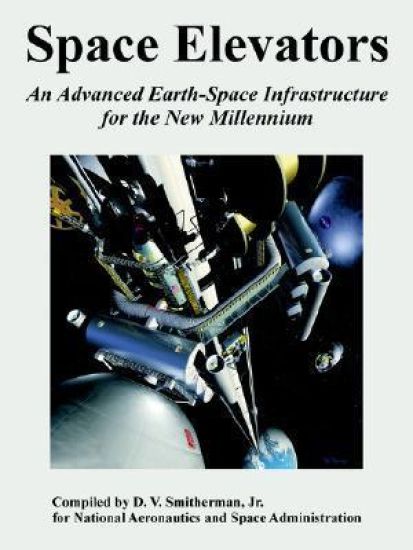
Space Elevators: An Advanced Earth-Space Infrastructure for the New Millennium
NASA
University Press of the Pacific
2006
nidottu
CONTENTS Foreword Introduction to Solar Physics Internal Rotation of the Sun A History of Solar Rotation Dynamics of the Outer Solar Atmosphere The Interplanetary Plasma Lower Atmospheres of the Planets The Composition of Planetary Atmospheres Interior Structure of Giant Planets Radar and Radio Exploration of the Planets Nature and Interpretation of the Apollo 11 Lunar Samples Origin of the Solar System Evolution of Planetary Atmospheres History of the Lunar Orbit
Foundations of Space Biology and Medicine is a collective scientific work which reviews the most important problems, achievements, and prospects for the development of space biology and medicine. Its purpose is to make available summarized and systematized data on the most important problems of space biology and medicine. The work was developed by a Joint Editorial Board established by the U. S. National Aeronautics and Space Administration and the Academy of Sciences of the U. S. S. R. Contents of Volume II - Book One Introduction Influence of an Artificial Gaseous Atmosphere of Spacecraft and Stations on the Organism Barometric Pressure and Gas Composition Toxicology of the Air in Closed Spaces Thermal Exchanges and Temperature Stress Effect of Dynamic Flight Factors on the Organism Principles of Gravitational Biology Prolonged Linear and Radial Accelerations Impact Accelerations Angular Velocities, Angular Accelerations, and Coriolis Accelerations Weightlessness Noise and Vibration
The Artemis Accords: Principles for Cooperation in the Civil Exploration, and Use of the Moon, Mars, Comets, and Astroids for Peaceful Purp
NASA
Cosimo Reports
1967
nidottu
"Artemis will be the broadest and most diverse international human space exploration program in history, and the Artemis Accords are the vehicle that will establish this singular global coalition." -Jim Bridenstine, NASA Administrator (2020) The Artemis Accords (2020), drafted by NASA and the US Department of State, is an arrangement between the US and other governments for cooperation in the civil exploration and peaceful use of the Moon, Mars, and other astronomical objects. Among The Artemis Accords' goals are the return of humans to the Moon by 2025 and eventually a human mission to Mars. It also describes its ten principles from "peaceful exploration" to "preserving heritage" and "deconfliction of activities", which are based upon the Outer Space Treaty of 1967 (included in this publication). This treaty is the foundation of international space law, which has been signed by over 110 countries, including all major spacefaring nations. This publication will appeal to students of space exploration, journalists and anyone interested in the future of humans in space.