Kirjojen hintavertailu – 12 903 725 kirjaa ja 27 kauppaa

Kirjailija

Natalia Ribas-Mateos

Kirjat ja teokset yhdessä paikassa: 5 kirjaa, julkaisuja vuosilta 2005–2025, suosituimpiin kuuluu A Message to You: A Cartography of Mobilities - Sexual Border Violence, Solidarities and Global Cities. Vertaile teosten hintoja ja tarkista saatavuus suomalaisista kirjakaupoista.

5 kirjaa

Kirjojen julkaisuvuodet: 2005–2025.

A Message to You: A Cartography of Mobilities - Sexual Border Violence, Solidarities and Global Cities
New analytical frameworks help us to shed light on global transformations regarding community responses and complex ways to think about gendered solidarities. Bringing together different ethnographic fieldworks, Ribas-Mateos provides lucid accounts of fundamental themes of the current times. This book involves a serious effort of visibilization of the hidden sexual violence in Mediterranean borders--particularly in Tangier and Oujda. Moreover, it brings such message of visibilization to diasporic cites--London and Paris--through the organization of video-debates and crowdfunding projects. This "Moving Cartography" consolidates the disparate strands of thought of mobilities in specific global sites, in order to provide a fundamental book for anybody who wishes to gain a deeper understanding of today's social solidarities regarding women s resistance, African migration, and BLM activism.
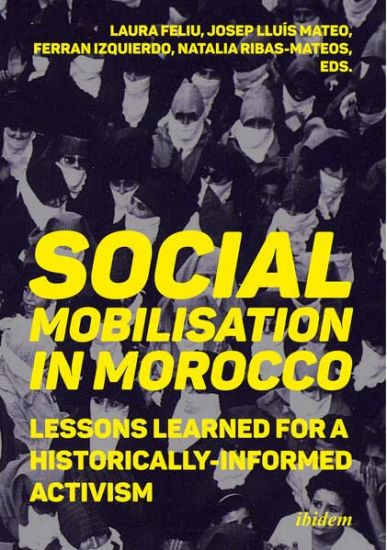
Social Mobilization in Morocco: Lessons Learned for a Historically Informed Activism

Social Mobilization in Morocco: Lessons Learned for a Historically Informed Activism

Saskia Sassen; Fadma Ait Mouss; Natalia Ribas-Mateos

ibidem-Verlag, Jessica Haunschild u Christian Schon
2022
nidottu
This collected volume investigates the ways in which historical training supports current activism and advocacy in global times by highlighting models of social activism and political representation in different parts of the world, with diverse social actions, strategies, and protest spaces. Morocco is a fascinating society to examine protest movements in an authoritarian regime. For the first time ever, the contributors reply in detail to questions, challenges and findings regarding the implications of historically informed activism in Morocco. The cooperative perspective is the key to a better understanding as it reinvigorates a conversation between social scientists--sociologists, anthropologists, and political scientists--and historians about how to analyse social and political activism. The main findings relate to the great structural transformations that have shaped the current power regimes in a longue dur e perspective. How are social movements born, how do they mature, and how do they die? Through the dynamics of social mobilisation, we discover the structure of the power regime, the responses (strategies), and its forms of survival (resources and capacities). How does history inform and empower current activism? The book covers 22 scenarios of popular revolts -urban, rural, and peripheral. Casablanca (1907, 1965, 2000), Fez (1907, 1990), the Eastern Rif (1909, 1921, 1958, 1984, 2004), Meknes (1937, 2011), Tangiers (1952, 2011, 2015), Sal , (1930, 2008), Taza (1915), and Imider (2011).
The Mediterranean in the Age of Globalization
The Mediterranean in the Age of Globalization is a welcome corrective to the tendency to present globalization as a homogenous concept, and the failure to describe how it operates in specific regions. Ribas-Mateos examines globalization and migration across the Mediterranean, using an innovative, integrated framework so as to map social places by describing how social, political, cultural, and economic forces are embedded within a globalizing environment. The author articulates an original and compelling narrative, mapping the Mediterranean as a global place where international and regional forces are intertwined in multiple threads. In doing so, she identifies two key components of globalization--affecting specifically forms of welfare and issues of mobility--in the context of a weakening European welfare state and the relocation and reinforcement of Mediterranean borders. Nine Mediterranean cities are investigated as "gateway" cities, which shape two major effects of globalization: welfare and mobility. The book challenges conventional North-South perspectives, and focuses and systematizes the way international migration should be conceptualized. The originality of the book results from the author's fieldwork, which is rich in descriptive detail, and from a theory centered around global perspectives. Seven case studies in Southern Europe--Algeciras, Athens, Barcelona, Lisbon, Naples, Turin, and Thrace--deal with issues related to migration and the welfare state. She also includes two ethnographies that represent two Mediterranean gateways in the North-South Mediterranean division: Tangiers (in Morocco) and Durres (in Albania), which are mapped as border-cities in the global Mediterranean context. Because of its intrinsically multidisciplinary nature, this superb volume will be of particular interest to academics and social science researchers as well as policymakers and international agencies.
The Mediterranean in the Age of Globalization

The Mediterranean in the Age of Globalization

Natalia Ribas-Mateos

Transaction Publishers
2005
sidottu
The Mediterranean in the Age of Globalization is a welcome corrective to the tendency to present globalization as a homogenous concept, and the failure to describe how it operates in specific regions. Ribas-Mateos examines globalization and migration across the Mediterranean, using an innovative, integrated framework so as to map social places by describing how social, political, cultural, and economic forces are embedded within a globalizing environment. The author articulates an original and compelling narrative, mapping the Mediterranean as a global place where international and regional forces are intertwined in multiple threads. In doing so, she identifies two key components of globalization--affecting specifically forms of welfare and issues of mobility--in the context of a weakening European welfare state and the relocation and reinforcement of Mediterranean borders. Nine Mediterranean cities are investigated as "gateway" cities, which shape two major effects of globalization: welfare and mobility. The book challenges conventional North-South perspectives, and focuses and systematizes the way international migration should be conceptualized. The originality of the book results from the author's fieldwork, which is rich in descriptive detail, and from a theory centered around global perspectives. Seven case studies in Southern Europe--Algeciras, Athens, Barcelona, Lisbon, Naples, Turin, and Thrace--deal with issues related to migration and the welfare state. She also includes two ethnographies that represent two Mediterranean gateways in the North-South Mediterranean division: Tangiers (in Morocco) and Durres (in Albania), which are mapped as border-cities in the global Mediterranean context. Because of its intrinsically multidisciplinary nature, this superb volume will be of particular interest to academics and social science researchers as well as policymakers and international agencies.