
Kirjojen hintavertailu – 12 859 827 kirjaa ja 27 kauppaa

Kirjailija

Nathan A. Fox

Kirjat ja teokset yhdessä paikassa: 2 kirjaa, julkaisuja vuosilta 2007–2014, suosituimpiin kuuluu Romania’s Abandoned Children. Vertaile teosten hintoja ja tarkista saatavuus suomalaisista kirjakaupoista.

2 kirjaa

Kirjojen julkaisuvuodet: 2007–2014.

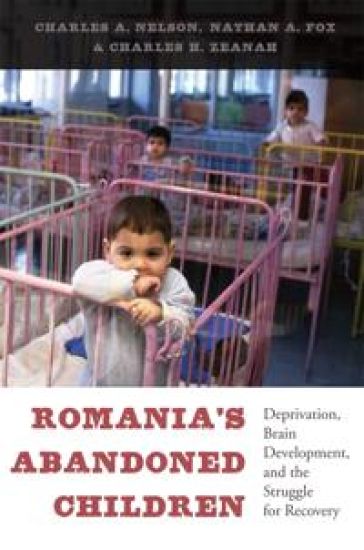
Romania’s Abandoned Children

Romania’s Abandoned Children

Charles A. Nelson; Nathan A. Fox; Charles H. Zeanah

Harvard University Press
2014
sidottu
The implications of early experience for children’s brain development, behavior, and psychological functioning have long absorbed caregivers, researchers, and clinicians. The 1989 fall of Romania’s Ceausescu regime left approximately 170,000 children in 700 overcrowded, impoverished institutions across Romania, and prompted the most comprehensive study to date on the effects of institutionalization on children’s wellbeing. Romania’s Abandoned Children, the authoritative account of this landmark study, documents the devastating toll paid by children who are deprived of responsive care, social interaction, stimulation, and psychological comfort. Launched in 2000, the Bucharest Early Intervention Project (BEIP) was a rigorously controlled investigation of foster care as an alternative to institutionalization. Researchers included 136 abandoned infants and toddlers in the study and randomly assigned half of them to foster care created specifically for the project. The other half stayed in Romanian institutions, where conditions remained substandard. Over a twelve-year span, both groups were assessed for physical growth, cognitive functioning, brain development, and social behavior. Data from a third group of children raised by their birth families were collected for comparison. The study found that the institutionalized children were severely impaired in IQ and manifested a variety of social and emotional disorders, as well as changes in brain development. However, the earlier an institutionalized child was placed into foster care, the better the recovery. Combining scientific, historical, and personal narratives in a gripping, often heartbreaking, account, Romania’s Abandoned Children highlights the urgency of efforts to help the millions of parentless children living in institutions throughout the world.
Preservation of Two Infant Temperaments into Adolescence

Preservation of Two Infant Temperaments into Adolescence

Nathan A. Fox; Laurence Steinberg; Jerome Kagan; Nancy Snidman; Sara Towsley; Vali Kahn

Wiley-Blackwell (an imprint of John Wiley Sons Ltd)
2007
nidottu
Temperament has been a central element of the on-going effort to describe the distinctiveness of persons at every stage of development. Many researchers have examined the relations of temperament to emotions, behavior, and adjustment generally. Fewer studies have focused primarily on the nature and structure of temperament, however, and even fewer have examined the developmental course of temperament. This Monograph reports a significant exception. The authors undertook theoretically relevant behavioral, biological, and self-report assessments of a sample of 14-to-17 year olds who had been classified into one of four temperamental groups at 4 months of age. Infant temperamental categories were based on observed behavior to a battery of unfamiliar stimuli. The infants classified as high reactive (20 percent of the sample) displayed vigorous motor activity and frequent crying. Those classified as low reactive (40 percent) displayed minimal motor activity and crying. About 25 percent of the infants, called distressed, showed minimal motor activity but cried frequently, and 10 percent, characterized by vigorous motoricity but little crying, were called aroused. Previous evaluations of these children at 14 and 21 months, and 4, 7, and 11 years had revealed that those children initially classified as high reactive were most likely to be avoidant of unfamiliar events at the early ages and emotionally subdued, cautious, and wary of new situations at the later ages. By contrast, initially low-reactive children had been the least avoidant of unfamiliarity in the second year and most emotionally spontaneous and sociable at the later ages. At age 11 years, assessments also had revealed that initially high-reactive children were more likely than the low-reactive participants to display right hemisphere activation in the EEG, a larger evoked potential from the inferior colliculus, larger event related waveforms to discrepant scenes, and greater sympathetic tone in the cardiovascular system. In the follow-up of these individuals reported here, adolescents (14-17 years of age) who had been classified as high reactive in infancy were more likely than initially low reactive participants to display sympathetic tone in the cardiovascular system, to combine a fast latency with a large magnitude of the evoked potential from the inferior colliculus, and to show shallower habituation of the event-related potential to discrepant visual events. Moreover, compared to their low-reactive agemates, initially high reactive adolescents more often reported being subdued in unfamiliar situations, experiencing a dour mood and anxiety over the future, and being religious. An important finding is that behavior and biology were more clearly dissociated in adolescence than at earlier ages. However, infant temperamental category at 4 months remained a powerful predictor of behavior in adolescence, suggesting that the features that characterize the two temperamental biases by initially high- and low-reactive are not completely malleable to the profound effects of brain growth and experience.