Kirjojen hintavertailu – 12 859 818 kirjaa ja 27 kauppaa

Kirjailija

Nathan Schneider

Kirjat ja teokset yhdessä paikassa: 7 kirjaa, julkaisuja vuosilta 2013–2024, suosituimpiin kuuluu Plough Quarterly No. 22 - Vocation. Vertaile teosten hintoja ja tarkista saatavuus suomalaisista kirjakaupoista.

7 kirjaa

Kirjojen julkaisuvuodet: 2013–2024.

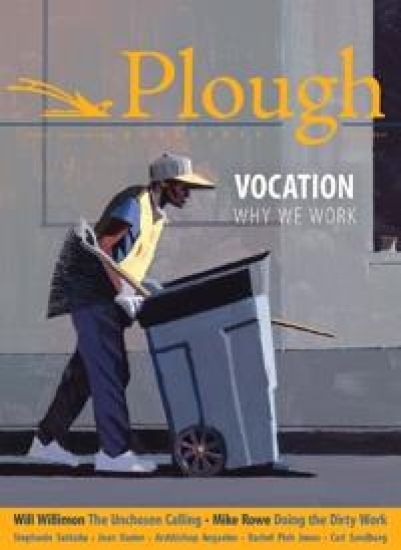
Plough Quarterly No. 22 - Vocation

Plough Quarterly No. 22 - Vocation

Will Willimon; Rachel Pieh Jones; Anne-Sophie Constant; Mike Rowe; Stephanie Saldaña; Scott Beauchamp; Nathan Schneider; Phil Christman; Michael Brendan Dougherty; Julian Peters

Plough Publishing House
2019
pokkari
Your job is not your vocation. Everyone hungers for work that has meaning and purpose. But what gives work meaning? Vocation, or “calling,” is the answer Protestant Christianity offers: each person is called by God to serve the common good in a particular line of work. Your vocation, evidently, might be almost anything: as a nurse, a wilderness guide, a calligrapher, a missionary, an activist, a venture capitalist, a politician, an executioner… Yet, as Will Willimon writes in this issue, the New Testament knows only one form of vocation: discipleship. And discipleship is far more likely to mean leaving father and mother, houses and land, than it is to mean embracing one’s identity as a fisherman or tax collector. This issue of Plough focuses on people who lived their lives with that sense of vocation. Such a life demands self-sacrifice and a willingness to recognize one’s own supposed strengths as weaknesses, as it did for the Canadian philosopher Jean Vanier. It involves a lifelong commitment to a flesh-and-blood church, as Coptic Archbishop Angaelos describes. It may even require a readiness to give up one’s life, as it did for Annalena Tonelli, an Italian humanitarian who pioneered the treatment of tuberculosis in the Horn of Africa. But as these stories also testify, it brings a gladness deeper than any self-chosen path. Also in this issue: - Scott Beauchamp on mercenaries - Nathan Schneider on cryptocurrencies - Stephanie Saldaña on Syrian refugee art - Peter Biles on loneliness at college - Phil Christman on Bible translation - Michael Brendan Dougherty on fatherhood - Insights on vocation from C. S. Lewis, Thérèse of Lisieux, Mother Teresa, Eberhard Arnold, Dorothy Sayers, Jean Vanier, and Gerard Manley Hopkins - poetry by Devon Balwit and Carl Sandburg - reviews of books by Robert Alter, Edwidge Danticat, Matthew D. Hockenos, Amy Waldman, and Jeremy Courtney - art and photography by Pola Rader, Dean Mitchell, Mark Freear, Timothy Jones, Pawel Filipczak, Mary Pal, Harley Manifold, Sami Lalu Jahola, Marc Chagall, and Russell Bain. Plough Quarterly features stories, ideas, and culture for people eager to put their faith into action. Each issue brings you in-depth articles, interviews, poetry, book reviews, and art to help you put Jesus’ message into practice and find common cause with others.

Governable Spaces

Governable Spaces

Nathan Schneider

University of California Press
2024
pokkari
A free ebook version of this title is available through Luminos, University of California Press's Open Access publishing program. Visit www.luminosoa.org to learn more. When was the last time you participated in an election for an online group chat or sat on a jury for a dispute about a controversial post? Platforms nudge users to tolerate nearly all-powerful admins, moderators, and "benevolent dictators for life." In Governable Spaces, Nathan Schneider argues that the internet has been plagued by a phenomenon he calls "implicit feudalism": a bias, both cultural and technical, for building communities as fiefdoms. The consequences of this arrangement matter far beyond online spaces themselves, as feudal defaults train us to give up on our communities' democratic potential, inclining us to be more tolerant of autocratic tech CEOs and authoritarian tendencies among politicians. But online spaces could be sites of a creative, radical, and democratic renaissance. Using media archaeology, political theory, and participant observation, Schneider shows how the internet can learn from governance legacies of the past to become a more democratic medium, responsive and inventive unlike anything that has come before.
Everything for Everyone

Everything for Everyone

Nathan Schneider

Bold Type Books
2018
sidottu

Halvin toimitettuna 28,00 €

Capitalism is in crisis mode. It is no longer serving ordinary people, while continuing to enrich the 1%. But as journalist Nathan Schneider shows, there is a democratic alternative to the robber-baron economy hiding in plain sight; we just need to know where to look. Cooperatives -- jointly-owned and democratically-controlled enterprises that advance the economic, social, and cultural needs of the members -- have provided that alternative for centuries. They often emerge during moments of capitalist crisis not unlike our own, putting people in charge of the credit unions, hardware stores, grocery stores, healthcare, and homes they depend on. After the economic crisis that began in 2008, the cooperative movement is coming back with renewed vigor. Based on years of reporting, Schneider chronicles this economic and social revolution -- from the taxi cooperatives in Colorado that are keeping Uber and Lyft at bay; to the mayoral administration in Jackson, Mississippi, that is giving citizens control over their economy; to the French hacker who is building a cooperative version of bitcoin; to the electricity coop members who are propelling an outdated system into the future. As these pioneers show, cooperative enterprise is poised to revolutionize our lives, put people like us in charge of our economy, and engender creativity and innovation that serves us all.
Sustainable Abundance for All

Sustainable Abundance for All

Ted Nunez; Nathan Schneider

Cascade Books
2018
sidottu
What constitutes the good life and authentic Christian leadership in a high-speed technological society geared to perpetual economic growth? In a world of rapid change and heightened risks, how do we move beyond the tyranny of emergency and polarization toward a politics of engagement and time oriented to the long-term common good? Taking up key themes in the social teaching of Popes Benedict XVI and Francis, Sustainable Abundance for All argues that life in a risky, runaway world requires new forms of Christian praxis that are both forward-looking and rooted in tradition. Among the issues addressed are pathways toward sustainable development in the Anthropocene, automation and the transition to post-jobs society, the proactionary-precautionary debate over new technologies, and the dangers of becoming ""people of the device."" Sustainable Abundance for All lays the groundwork for new kinds of Christian social action and prophetic witness in the twenty-first century. ""Sustainable Abundance for All is Christian social ethics at its best. At this anxious moment, accelerating technological achievements come with possibly catastrophic risks--to the natural world, social structures, and even the human spirit. Ted Nunez explores the evolving wisdom of the Catholic social tradition on these matters, then leads that tradition, and his readers, out onto the contemporary cultural dance floor in search of new partners, and ultimately, a more passionately loving dance with our world."" --Daniel Cowdin, Salve Regina University ""Keenly aware of past influences that prompted technological development, the present fast-paced growth of technologies that have put the Earth community at risk, and projected large-scale catastrophes in the future, Nunez superbly analyzes Catholic social teaching from 1891 onward for its adequacy in addressing technological development and insightfully crafts an innovative faith-based approach for assessing technological risks, embracing technologies that are socially, ecologically, and economically compatible, and launching the quest for sustaining an abundantly gifted but imperiled planetary home. His ethics of responsible care, case studies of current problems, and a cleverly articulated analogy of taking the lead in dancing the tango further enhance this splendid contribution to the scholarly literature."" --Jame Schaefer, Systematic Theology and Ethics Professor, Marquette University ""Ted Nunez roars through technologically accelerating American culture--where it's tough to tell progress from regress from destruction--with a smarter Catholic social thought in his soul and Laudato Si in his back pocket. Seeking 'sustainable abundance' where others see dystopia, he delivers a sharp analysis of our risky, runaway society and, with a tango-spiced ecosocial theology, distills new practices of Catholic social wisdom that should guide any serious discussion about the future of humanity and the planet."" --Anthony J. Godzieba, Villanova University ""Nunez offers us an informed, elegant, and prophetic vision for a future of sustainable abundance. Rooted in the tradition of Catholic social principles and aimed at the world-risking technocracy emerging around us today, this book evocatively invites us to the 'adjacent possible, ' a future we confront not with despair but along axes of grace, joy, realism, and hope. A wonderful read, this book is an essential prod to creatively reimagine our economic and ecological tomorrow."" --James Calvin Davis, author of Forbearance: A Theological Ethic for a Disagreeable Church Ted Nunez teaches in the Ethics Program at Villanova University and is an award-winning researcher in the area of Catholic social teaching and sustainable development. An Argentine tango dancer, Ted conducts interactive workshops on integral ecology and moral leadership for high school, college, and professional groups (www.closeembraces.com).
On Anarchism

On Anarchism

Noam Chomsky; Nathan Schneider

Penguin Books Ltd
2014
nidottu

Halvin toimitettuna 16,20 €

On Anarchism is an essential introduction to Noam Chomsky's political theory. On Anarchism sheds a much needed light on the foundations of Chomsky's thought, specifically his constant questioning of the legitimacy of entrenched power. The book gathers his essays and interviews to provide a short, accessible introduction to his distinctively optimistic brand of anarchism. Refuting the notion of anarchism as a fixed idea, and disputing the traditional fault lines between anarchism and socialism, this is a book sure to challenge, provoke and inspire. Profoundly relevant to our times, it is a touchstone for political activists and anyone interested in deepening their understanding of anarchism, or of Chomsky's thought.'Arguably the most important intellectual alive' New York Times
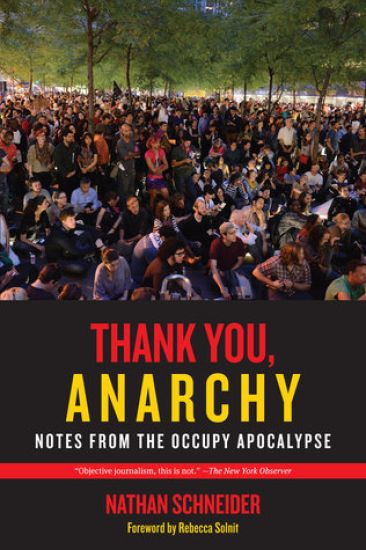
Thank You, Anarchy

Thank You, Anarchy

Nathan Schneider; Rebecca Solnit

University of California Press
2013
pokkari
Thank You, Anarchy is an up-close, inside account of Occupy Wall Street's first year in New York City, written by one of the first reporters to cover the phenomenon. Nathan Schneider chronicles the origins and explosive development of the Occupy movement through the eyes of the organizers who tried to give shape to an uprising always just beyond their control. Capturing the voices, encounters, and beliefs that powered the movement, Schneider brings to life the General Assembly meetings, the chaotic marches, the split-second decisions, and the moments of doubt as Occupy swelled from a hashtag online into a global phenomenon. A compelling study of the spirit that drove this watershed movement, Thank You, Anarchy vividly documents how the Occupy experience opened new social and political possibilities and registered a chilling indictment of the status quo. It was the movement's most radical impulses, this account shows, that shook millions out of a failed tedium and into imagining, and fighting for, a better kind of future.