Kirjojen hintavertailu – 12 903 725 kirjaa ja 27 kauppaa

Kirjailija

Nathan Sivin

Kirjat ja teokset yhdessä paikassa: 7 kirjaa, julkaisuja vuosilta 1968–2016, suosituimpiin kuuluu Health Care in Eleventh-Century China. Vertaile teosten hintoja ja tarkista saatavuus suomalaisista kirjakaupoista.

7 kirjaa

Kirjojen julkaisuvuodet: 1968–2016.

Health Care in Eleventh-Century China

Health Care in Eleventh-Century China

Nathan Sivin

Springer International Publishing AG
2016
nidottu
By examining all the prevalent varieties of therapy from self-care to religious ritual, this book explores health care practices in China, before modern times. In ancient China most people were unable to afford a doctor, even in the unlikely case that one lived near their village and was willing to treat peasants. What did they do when their children got sick? The answer is to be found in this book, which goes far beyond the history of medicine. The author uses methods of medical anthropology to explain the curative roles of popular religion, Daoism, Buddhism and the therapeutic rites performed by imperial officials. Readers will discover the steady interaction of religious healing and classical medicine in this culture. This highly readable book builds on over forty years of study and analysis of early liturgical and medical writings and a wide variety of other sources. Its focus on the eleventh century throws new light on a period of rapid transition in many aspects of therapy and itwill appeal to scholars and general readers alike.
Health Care in Eleventh-Century China

Health Care in Eleventh-Century China

Nathan Sivin

Springer International Publishing AG
2015
sidottu
By examining all the prevalent varieties of therapy from self-care to religious ritual, this book explores health care practices in China, before modern times. In ancient China most people were unable to afford a doctor, even in the unlikely case that one lived near their village and was willing to treat peasants. What did they do when their children got sick? The answer is to be found in this book, which goes far beyond the history of medicine. The author uses methods of medical anthropology to explain the curative roles of popular religion, Daoism, Buddhism and the therapeutic rites performed by imperial officials. Readers will discover the steady interaction of religious healing and classical medicine in this culture. This highly readable book builds on over forty years of study and analysis of early liturgical and medical writings and a wide variety of other sources. Its focus on the eleventh century throws new light on a period of rapid transition in many aspects of therapy and itwill appeal to scholars and general readers alike.
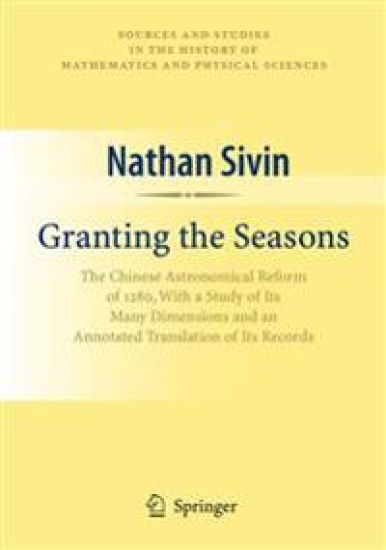
Granting the Seasons

Granting the Seasons

Nathan Sivin

Springer-Verlag New York Inc.
2010
nidottu
China’s most sophisticated system of computational astronomy was created for a Mongol emperor who could neither read nor write Chinese, to celebrate victory over China after forty years of devastating war. This book explains how and why, and reconstructs the observatory and the science that made it possible. For two thousand years, a fundamental ritual of government was the emperor’s “granting the seasons” to his people at the New Year by issuing an almanac containing an accurate lunisolar calendar. The high point of this tradition was the “Season-granting system” (Shou-shih li, 1280). Its treatise records detailed instructions for computing eclipses of the sun and moon and motions of the planets, based on a rich archive of observations, some ancient and some new. Sivin, the West’s leading scholar of the Chinese sciences, not only recreates the project’s cultural, political, bureaucratic, and personal dimensions, but translates the extensive treatise and explains every procedure in minimally technical language. The book contains many tables, illustrations, and aids to reference. It is clearly written for anyone who wants to understand the fundamental role of science in Chinese history. There is no comparable study of state science in any other early civilization.
Granting the Seasons

Granting the Seasons

Nathan Sivin

Springer-Verlag New York Inc.
2008
sidottu
China’s most sophisticated system of computational astronomy was created for a Mongol emperor who could neither read nor write Chinese, to celebrate victory over China after forty years of devastating war. This book explains how and why, and reconstructs the observatory and the science that made it possible. For two thousand years, a fundamental ritual of government was the emperor’s “granting the seasons” to his people at the New Year by issuing an almanac containing an accurate lunisolar calendar. The high point of this tradition was the “Season-granting system” (Shou-shih li, 1280). Its treatise records detailed instructions for computing eclipses of the sun and moon and motions of the planets, based on a rich archive of observations, some ancient and some new. Sivin, the West’s leading scholar of the Chinese sciences, not only recreates the project’s cultural, political, bureaucratic, and personal dimensions, but translates the extensive treatise and explains every procedure in minimally technical language. The book contains many tables, illustrations, and aids to reference. It is clearly written for anyone who wants to understand the fundamental role of science in Chinese history. There is no comparable study of state science in any other early civilization.
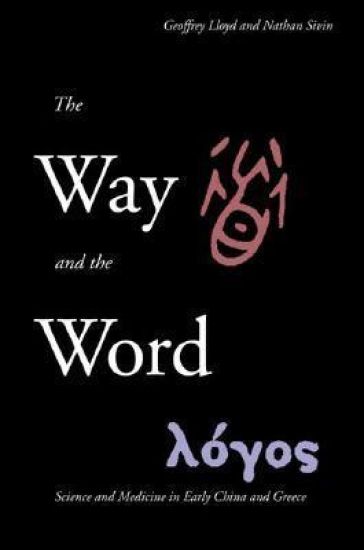
The Way and the Word

The Way and the Word

Geoffrey Lloyd; Nathan Sivin

Yale University Press
2003
pokkari
The rich civilizations of ancient China and Greece built sciences of comparable sophistication—each based on different foundations of concept, method, and organization. In this engrossing book, two world-renowned scholars compare the cosmology, science, and medicine of China and Greece between 400 B. C. and A. D. 200, casting new light not only on the two civilizations but also on the evolving character of science. Sir Geoffrey Lloyd and Nathan Sivin investigate the differences between the thinkers in the two civilizations: what motivated them, how they understood the cosmos and the human body, how they were educated, how they made a living, and whom they argued with and why. The authors’ new method integrally compares social, political, and intellectual patterns and connections, demonstrating how all affected and were affected by ideas about cosmology and the physical world. They relate conceptual differences in China and Greece to the diverse ways that intellectuals in the two civilizations earned their living, interacted with fellow inquirers, and were involved with structures of authority. By A. D. 200 the distinctive scientific strengths of both China and Greece showed equal potential for theory and practice. Lloyd and Sivin argue that modern science evolved not out of the Greek tradition alone but from the strengths of China, Greece, India, Islam, and other civilizations, which converged first in the Muslim world and then in Renaissance Europe.
Traditional Medicine in Contemporary China

Traditional Medicine in Contemporary China

Nathan Sivin

Centre for Chinese Studies Publications
1987
sidottu
Sivin devotes the first half of his book to an interpretive exploration of the history of classical Chinese medicine, outlining in detail the evolution of its essential concepts from ancient times through the present. The second half consists of translations from the Revised Outline of Chinese Medicine (1972), a textbook compiled in China for use by modern physicians.