Kirjojen hintavertailu – 12 903 725 kirjaa ja 27 kauppaa

Kirjailija

National Aeronauti Space Administration

Kirjat ja teokset yhdessä paikassa: 11 kirjaa, julkaisuja vuosilta 2014–2017, suosituimpiin kuuluu Walking to Olympus - An EVA Chronology, 1997-2011 - Volume 2 (NASA SP-2016-4550). Vertaile teosten hintoja ja tarkista saatavuus suomalaisista kirjakaupoista.

11 kirjaa

Kirjojen julkaisuvuodet: 2014–2017.

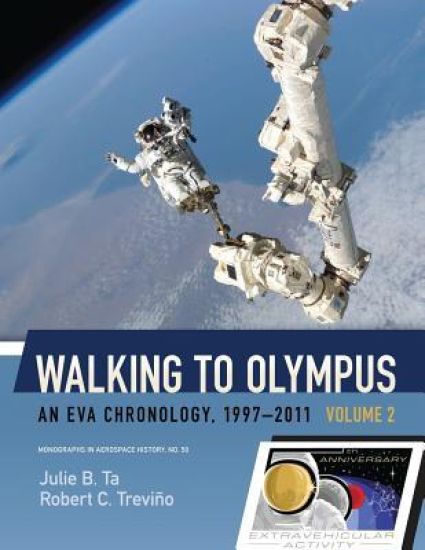
Walking to Olympus - An EVA Chronology, 1997-2011 - Volume 2 (NASA SP-2016-4550)

Walking to Olympus - An EVA Chronology, 1997-2011 - Volume 2 (NASA SP-2016-4550)

Julie B. Ta; Robert C. Trevino; National Aeronauti Space Administration

Createspace Independent Publishing Platform
2017
nidottu
The first edition of "Walking to Olympus: An EVA Chronology" (Monograph in Aerospace History #7, October 1997) spanned a period of space exploration of 32 years, from the first spacewalks in 1965 to the end of the Shuttle-Mir program in 1997. It included EVAs performed by both Soviet/Russian cosmonauts and American astronauts. The Soviet/Russian space programs that involved spacewalks were the Voskhod, Soyuz, Salyut, Mir, and Shuttle-Mir. During this same time period, the USA space programs that included spacewalks were Gemini, Apollo, Skylab, Space Shuttle, and the Shuttle-Mir. This second volume of Walking to Olympus continues from the end of the Shuttle-Mir pro-gram in 1997 to the end of the Space Shuttle Program in 2011. It includes not only spacewalks performed by American and European astronauts and the Russian/Soviet cosmonauts, but also those of the newest members of the EVA com-munity, the taikonauts of the People's Republic of China (Chinese taikonauts performed their first spacewalk on 27 September 2008). Space programs with EVAs that are included in this second volume are: the Mir and the International Space Station (ISS) programs (Russia), the Space Shuttle and the ISS programs (USA), and the Shenzhou space program (China).

Global Reach: A View of NASA's International Cooperation (NP-2014-03-969-HQ)

Global Reach: A View of NASA's International Cooperation (NP-2014-03-969-HQ)

National Aeronauti Space Administration

Createspace Independent Publishing Platform
2017
nidottu
When the National Aeronautics and Space Administration (NASA) was created in 1958, its founding legislation-the National Aeronautics and Space Act-directed the new Agency to pursue cooperation "with other nations and groups of nations." This principle of international cooperation has been a guiding philosophy for NASA, and it has never been more important than it is today. Such collaboration will be essential to addressing the inherently global and interrelated scientific challenges that will face us in the years ahead: expanding human exploration beyond the frontiers of low-Earth orbit; broadening human knowledge by answering profound questions about the Earth and the universe we live in; solving technical issues related to air traffic management, aviation safety, and the impact of aviation on climate and the environment; and leveraging technology investments to push the boundaries of innovation. Through the pages of this publication, learn more about NASA's continuing international partnerships. These examples will provide you with a sense of the breadth of NASA's cooperation with other nations, as well as the accompanying benefits that such cooperation has always yielded.
NASA Systems Engineering Handbook (NASA Sp-2016-6105 Rev2)

NASA Systems Engineering Handbook (NASA Sp-2016-6105 Rev2)

National Aeronauti Space Administration

Createspace Independent Publishing Platform
2017
nidottu
This handbook, "NASA Systems Engineering Handbook," is intended to provide general guidance and information on systems engineering that will be useful to the NASA community. It provides a generic description of Systems Engineering (SE) as it should be applied throughout NASA. A goal of the handbook is to increase awareness and consistency across the Agency and advance the practice of SE. This handbook provides perspectives relevant to NASA and data particular to NASA. This handbook describes systems engineering best practices that should be incorporated in the development and implementation of large and small NASA programs and projects. The engineering of NASA systems requires a systematic and disciplined set of processes that are applied recursively and iteratively for the design, development, operation, maintenance, and closeout of systems throughout the life cycle of the programs and projects. The scope of this handbook includes systems engineering functions regardless of whether they are performed by a manager or an engineer, in-house or by a contractor.