
Kirjailija
National Security Council
Kirjat ja teokset yhdessä paikassa: 8 kirjaa, julkaisuja vuosilta 1974–2025, suosituimpiin kuuluu National Strategy for Combating Terrorism, September 2006. Vertaile teosten hintoja ja tarkista saatavuus suomalaisista kirjakaupoista.
8 kirjaa
Kirjojen julkaisuvuodet: 1974–2025.
National Strategy for Combating Terrorism, September 2006
National Security Council
ALPHA EDITION
2022
pokkari

The Kissinger Report: Nssm-200 Implications of Worldwide Population Growth for U.S. Security Interests
Henry Kissinger; National Security Council
Cosimo Reports
2019
nidottu
"World population growth since World War II is quantitatively and qualitatively different from any previous epoch in human history... total growth rates are close to 2 percent a year, compared with about 1 percent before World War II, under 0.5 percent in 1750-1900, and far lower rates before 1750." -Executive Summary, The Kissinger ReportIn 1974, the United States National Security Council, led by Henry Kissinger, completed a classified report, National Security Study Memorandum 200 - Implications of Worldwide Population Growth for U. S. Security and Overseas Interests A. K. A. The Kissinger Report. Due to the sensitive nature of its content, it took another 15 years before this report was declassified in 1989. The Kissinger Report's purpose was to describe and analyze population growth, especially in the least developed countries ("LDCs"), and the implications for U. S. national security. This report forecasted world population to grow from 4 billion people in 1974 via 6.4 billion in 2000 to 12 billion in 2075. This kind of population growth was deemed unsustainable and would cause major problems: famines and ecological disasters; lack of economic development, civil unrest and mass foreign migration. This instability would be a threat to the countries involved, but also to the national interests of the U. S., since its import of minerals from those LDCs might be hampered. The report called for measures to limit the population to 6 billion by the mid-21st century and to an ultimate limit of 8 billion people, and for the promotion of contraception among 13 populous countries, including Pakistan, Nigeria, and Mexico. When this report was declassified in 1989, this proposed population control policy, including abortion and the targeting of LDCs, triggered controversy. However, today in 2017, with the world population at 7.4 billion, and daily news covering civil unrest and worse in the Middle East, record numbers of global refugees, heat waves and changing weather patterns, the bird flu and zika virus, it seems the The Kissinger Report had at least predictive value. Students of population studies, academics, journalists and anyone eager for a glimpse into the state of the world will find this essential reading.
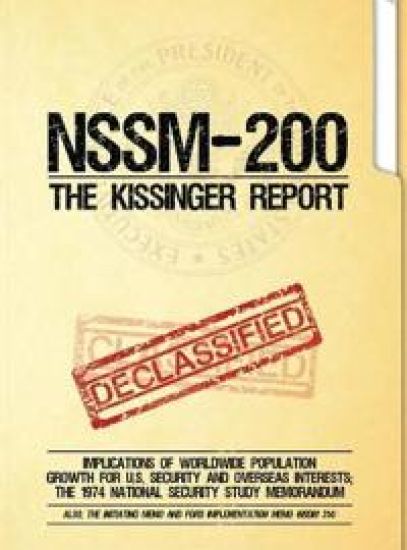
In 1974, President Richard Nixon ordered his national security council, under the direction of Henry Kissinger, to study the implications of population growth to the interests of the United States and propose action. This classified study was called NSSM-200. The study was concluded later that year, but Nixon was otherwise occupied, and did not act on the study. His replacement, Gerald Ford, would direct his administration to implement the memo. Upon its declassification a little over a decade later, a stunned world learned that the United States government had specifically targeted the world for de-population, with special emphasis on thirteen countries: India, Bangladesh, Pakistan, Nigeria, Mexico, Indonesia, Brazil, the Philippines, Thailand, Egypt, Turkey, Ethiopia and Columbia. The memo pointed out the importance of abortion as a population control measure and tied US foreign aid to a country's willingness to participate in population control programs. One section boldly calls for conditioning the world's citizens to desire small families through "Education and Indoctrination." To be clear, the authors of the memo insist that whatever measure is proposed to 'least developed countries' will be implemented in the United States, as well. This volume contains the complete and unabridged text of NSSM-200 exactly in its declassified form. It also contains the Initiating Memo and Ford's Implementation Memo (NSDM 314). The volume is free from any commentary, for or against the policies contained within it.
National Strategy for Countering Biological Threats
National Security Council; Executive Office of the P United States
Createspace Independent Publishing Platform
2012
nidottu
National Strategy for Countering Biological Threats
National Security Council
Createspace Independent Publishing Platform
2012
nidottu
National Strategy for Victory in Iraq
National Security Council
Createspace Independent Publishing Platform
2012
nidottu
The Kissinger Report: NSSM-200 Implications of Worldwide Population Growth for U.S. Security Interests
Henry Kissinger; National Security Council
Cosimo Reports
1974
sidottu
"World population growth since World War II is quantitatively and qualitatively different from any previous epoch in human history... total growth rates are close to 2 percent a year, compared with about 1 percent before World War II, under 0.5 percent in 1750-1900, and far lower rates before 1750." -Executive Summary, The Kissinger ReportIn 1974, the United States National Security Council, led by Henry Kissinger, completed a classified report, National Security Study Memorandum 200 - Implications of Worldwide Population Growth for U. S. Security and Overseas Interests A. K. A. The Kissinger Report. Due to the sensitive nature of its content, it took another 15 years before this report was declassified in 1989. The Kissinger Report's purpose was to describe and analyze population growth, especially in the least developed countries ("LDCs"), and the implications for U. S. national security. This report forecasted world population to grow from 4 billion people in 1974 via 6.4 billion in 2000 to 12 billion in 2075. This kind of population growth was deemed unsustainable and would cause major problems: famines and ecological disasters; lack of economic development, civil unrest and mass foreign migration. This instability would be a threat to the countries involved, but also to the national interests of the U. S., since its import of minerals from those LDCs might be hampered. The report called for measures to limit the population to 6 billion by the mid-21st century and to an ultimate limit of 8 billion people, and for the promotion of contraception among 13 populous countries, including Pakistan, Nigeria, and Mexico. When this report was declassified in 1989, this proposed population control policy, including abortion and the targeting of LDCs, triggered controversy. However, today in 2017, with the world population at 7.4 billion, and daily news covering civil unrest and worse in the Middle East, record numbers of global refugees, heat waves and changing weather patterns, the bird flu and zika virus, it seems the The Kissinger Report had at least predictive value. Students of population studies, academics, journalists and anyone eager for a glimpse into the state of the world will find this essential reading.