Kirjojen hintavertailu – 12 903 725 kirjaa ja 27 kauppaa

Kirjailija

Ned Rossiter

Kirjat ja teokset yhdessä paikassa: 3 kirjaa, julkaisuja vuosilta 2016–2019, suosituimpiin kuuluu Organize. Vertaile teosten hintoja ja tarkista saatavuus suomalaisista kirjakaupoista.

3 kirjaa

Kirjojen julkaisuvuodet: 2016–2019.

Organize

Organize

Timon Beyes; Lisa Conrad; Reinhold Martin; Geert Lovink; Ned Rossiter

University of Minnesota Press
2019
pokkari
A pioneering systematic inquiry into-and mapping of-the field of media and organization Media organize things into patterns and relations. As intermediaries among people and between people and worlds, media shape sociotechnical orders. At the same time, media are organized: while they condition different organizational forms and processes, they, too, are formed and can be re-formed. This intimate relation of media and organizing is timeless. Yet arguably, digital media technologies repose the question of organization-and thus of power and domination, control and surveillance, disruption and emancipation. Bringing together leading media thinkers and organization theorists, this book interrogates organization as an effect and condition of media. How can we understand the recursive relation between media and organization? How can we think, explore, critique, and perhaps alter the organizational bodies and scripts that shape contemporary life? Organize will be of interest to scholars and students of new and old media, social organization, and technology. Moreover, the dialogical form of these essays provides a concise and path-breaking view on the recursive relation between technological media and social organization. The book therefore establishes and maps “media and organization” as a highly relevant field of inquiry, appealing to those with a critical interest in the technological conditioning of the social.
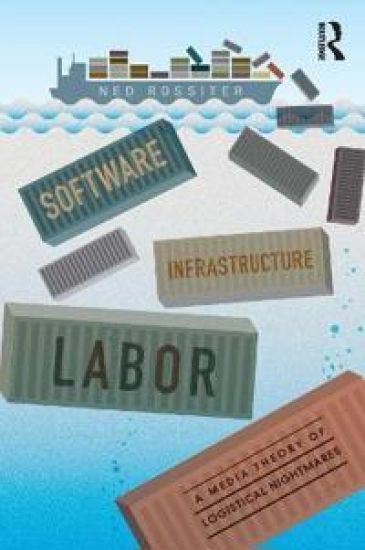
Software, Infrastructure, Labor

Software, Infrastructure, Labor

Ned Rossiter

Routledge
2016
nidottu
Infrastructure makes worlds. Software coordinates labor. Logistics governs movement. These pillars of contemporary capitalism correspond with the materiality of digital communication systems on a planetary scale. Ned Rossiter theorizes the force of logistical media to discern how subjectivity and labor, economy and society are tied to the logistical imaginary of seamless interoperability. Contingency haunts logistical power. Technologies of capture are prone to infrastructural breakdown, sabotage, and failure. Strategies of evasion, anonymity, and disruption unsettle regimes of calculation and containment. We live in a computational age where media, again, disappear into the background as infrastructure. Software, Infrastructure, Labor intercuts transdisciplinary theoretical reflection with empirical encounters ranging from the Cold War legacy of cybernetics, shipping ports in China and Greece, the territoriality of data centers, video game design, and scrap metal economies in the e-waste industry. Rossiter argues that infrastructural ruins serve as resources for the collective design of blueprints and prototypes demanded of radical politics today.
Software, Infrastructure, Labor

Software, Infrastructure, Labor

Ned Rossiter

Routledge
2016
sidottu
Infrastructure makes worlds. Software coordinates labor. Logistics governs movement. These pillars of contemporary capitalism correspond with the materiality of digital communication systems on a planetary scale. Ned Rossiter theorizes the force of logistical media to discern how subjectivity and labor, economy and society are tied to the logistical imaginary of seamless interoperability. Contingency haunts logistical power. Technologies of capture are prone to infrastructural breakdown, sabotage, and failure. Strategies of evasion, anonymity, and disruption unsettle regimes of calculation and containment. We live in a computational age where media, again, disappear into the background as infrastructure. Software, Infrastructure, Labor intercuts transdisciplinary theoretical reflection with empirical encounters ranging from the Cold War legacy of cybernetics, shipping ports in China and Greece, the territoriality of data centers, video game design, and scrap metal economies in the e-waste industry. Rossiter argues that infrastructural ruins serve as resources for the collective design of blueprints and prototypes demanded of radical politics today.