Kirjojen hintavertailu – 12 859 828 kirjaa ja 27 kauppaa

Kirjailija

Ngo Van Long

Kirjat ja teokset yhdessä paikassa: 5 kirjaa, julkaisuja vuosilta 1992–2010, suosituimpiin kuuluu Survey Of Dynamic Games In Economics, A. Vertaile teosten hintoja ja tarkista saatavuus suomalaisista kirjakaupoista.

5 kirjaa

Kirjojen julkaisuvuodet: 1992–2010.

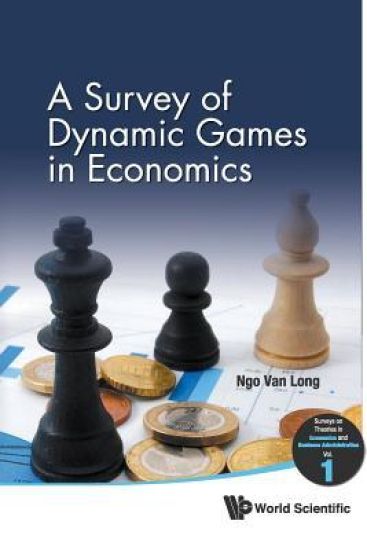
Survey Of Dynamic Games In Economics, A

Survey Of Dynamic Games In Economics, A

Ngo Van Long

WS Professional
2010
nidottu
This book provides readers with a comprehensive survey of models of dynamic games in economics, including an extensive coverage of numerous fields of applications. It will also discuss and explain main concepts and techniques used in dynamic games, and inform readers of its major developments while equipping them with tools and ideas that will aid in the formulation of solutions for problems. A Survey of Dynamic Games in Economics will interest those who wish to study more about the conceptions, approaches and models that are applied in the domain of dynamic games.
Survey Of Dynamic Games In Economics, A

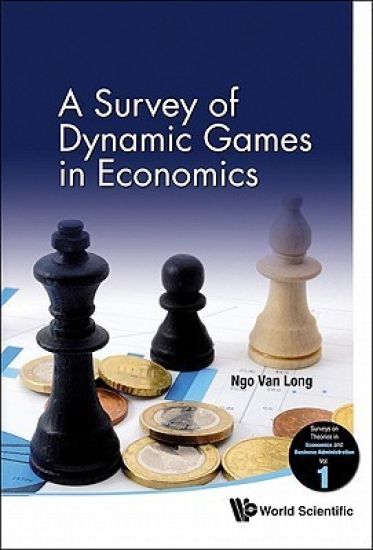
Survey Of Dynamic Games In Economics, A

Ngo Van Long

World Scientific Publishing Co Pte Ltd
2010
sidottu
This book provides readers with a comprehensive survey of models of dynamic games in economics, including an extensive coverage of numerous fields of applications. It will also discuss and explain main concepts and techniques used in dynamic games, and inform readers of its major developments while equipping them with tools and ideas that will aid in the formulation of solutions for problems. A Survey of Dynamic Games in Economics will interest those who wish to study more about the conceptions, approaches and models that are applied in the domain of dynamic games.
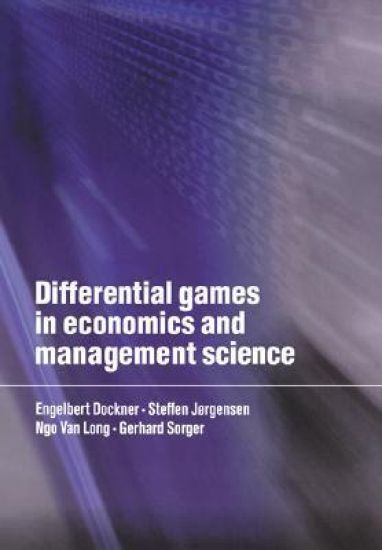
Differential Games in Economics and Management Science

Differential Games in Economics and Management Science

Engelbert J. Dockner; Steffen Jorgensen; Ngo Van Long; Gerhard Sorger

Cambridge University Press
2000
pokkari
A comprehensive, self-contained survey of the theory and applications of differential games, one of the most commonly used tools for modelling and analysing economics and management problems which are characterised by both multiperiod and strategic decision making. Although no prior knowledge of game theory is required, a basic knowledge of linear algebra, ordinary differential equations, mathematical programming and probability theory is necessary. Part One presents the theory of differential games, starting with the basic concepts of game theory and going on to cover control theoretic models, Markovian equilibria with simultaneous play, differential games with hierarchical play, trigger strategy equilibria, differential games with special structures, and stochastic differential games. Part Two offers applications to capital accumulation games, industrial organization and oligopoly games, marketing, resources and environmental economics.
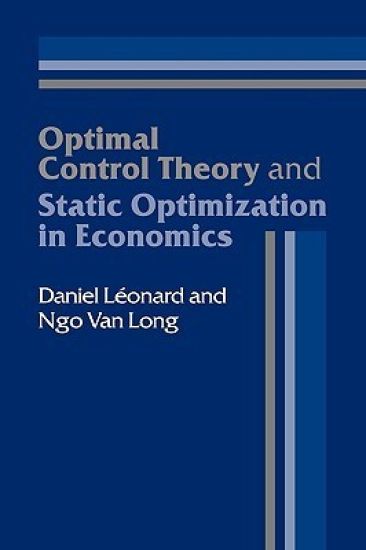
Optimal Control Theory and Static Optimization in Economics

Optimal Control Theory and Static Optimization in Economics

Daniel Léonard; Ngo van Long

Cambridge University Press
1992
pokkari
Optimal control theory is a technique being used increasingly by academic economists to study problems involving optimal decisions in a multi-period framework. This textbook is designed to make the difficult subject of optimal control theory easily accessible to economists while at the same time maintaining rigour. Economic intuitions are emphasized, and examples and problem sets covering a wide range of applications in economics are provided to assist in the learning process. Theorems are clearly stated and their proofs are carefully explained. The development of the text is gradual and fully integrated, beginning with simple formulations and progressing to advanced topics such as control parameters, jumps in state variables, and bounded state space. For greater economy and elegance, optimal control theory is introduced directly, without recourse to the calculus of variations. The connection with the latter and with dynamic programming is explained in a separate chapter. A second purpose of the book is to draw the parallel between optimal control theory and static optimization. Chapter 1 provides an extensive treatment of constrained and unconstrained maximization, with emphasis on economic insight and applications. Starting from basic concepts, it derives and explains important results, including the envelope theorem and the method of comparative statics. This chapter may be used for a course in static optimization. The book is largely self-contained. No previous knowledge of differential equations is required.
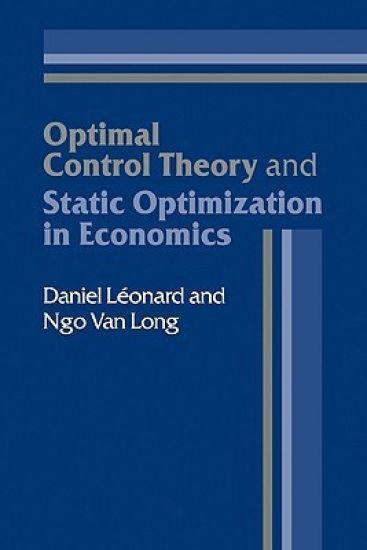
Optimal Control Theory and Static Optimization in Economics

Optimal Control Theory and Static Optimization in Economics

Daniel Léonard; Ngo van Long

Cambridge University Press
1992
sidottu
Optimal control theory is a technique being used increasingly by academic economists to study problems involving optimal decisions in a multi-period framework. This textbook is designed to make the difficult subject of optimal control theory easily accessible to economists while at the same time maintaining rigour. Economic intuitions are emphasized, and examples and problem sets covering a wide range of applications in economics are provided to assist in the learning process. Theorems are clearly stated and their proofs are carefully explained. The development of the text is gradual and fully integrated, beginning with simple formulations and progressing to advanced topics such as control parameters, jumps in state variables, and bounded state space. For greater economy and elegance, optimal control theory is introduced directly, without recourse to the calculus of variations. The connection with the latter and with dynamic programming is explained in a separate chapter. A second purpose of the book is to draw the parallel between optimal control theory and static optimization. Chapter 1 provides an extensive treatment of constrained and unconstrained maximization, with emphasis on economic insight and applications. Starting from basic concepts, it derives and explains important results, including the envelope theorem and the method of comparative statics. This chapter may be used for a course in static optimization. The book is largely self-contained. No previous knowledge of differential equations is required.