Kirjojen hintavertailu – 12 859 829 kirjaa ja 27 kauppaa

Kirjailija

Nicholas D. Smith

Kirjat ja teokset yhdessä paikassa: 14 kirjaa, julkaisuja vuosilta 1990–2023, suosituimpiin kuuluu Philosophy Through Science Fiction. Vertaile teosten hintoja ja tarkista saatavuus suomalaisista kirjakaupoista.

14 kirjaa

Kirjojen julkaisuvuodet: 1990–2023.

Philosophy Through Science Fiction

Philosophy Through Science Fiction

Ryan Nichols; Nicholas D. Smith; Fred Miller

Routledge
2008
sidottu
Philosophy Through Science Fiction offers a fun, challenging, and accessible way in to the issues of philosophy through the genre of science fiction. Tackling problems such as the possibility of time travel, or what makes someone the same person over time, the authors take a four-pronged approach to each issue, providing· a clear and concise introduction to each subject · a science fiction story that exemplifies a feature of the philosophical discussion· historical and contemporary philosophical texts that investigate the issue with rigor, and· glossary, plot profiles of pertinent science fiction stories and films, and questions for further reflection. Philosophy Through Science Fiction includes stories from contemporary science fiction writers including Greg Egan and Mike Resnick, as well as from classic authors like Philip K. Dick and Robert Heinlein. Philosophy readings include historical pieces by René Descartes and David Hume, and contemporary pieces by John Searle and Mary Midgley.
Socrates on Self-Improvement

Socrates on Self-Improvement

Nicholas D. Smith

Cambridge University Press
2023
pokkari
What model of knowledge does Plato's Socrates use? In this book, Nicholas D. Smith argues that it is akin to knowledge of a craft which is acquired by degrees, rather than straightforward knowledge of facts. He contends that a failure to recognize and identify this model, and attempts to ground ethical success in contemporary accounts of propositional or informational knowledge, have led to distortions of Socrates' philosophical mission to improve himself and others in the domain of practical ethics. He shows that the model of craft-knowledge makes sense of a number of issues scholars have struggled to understand, and makes a case for attributing to Socrates a very sophisticated and plausible view of the improvability of the human condition.
Socrates on Self-Improvement

Socrates on Self-Improvement

Nicholas D. Smith

Cambridge University Press
2021
sidottu
What model of knowledge does Plato's Socrates use? In this book, Nicholas D. Smith argues that it is akin to knowledge of a craft which is acquired by degrees, rather than straightforward knowledge of facts. He contends that a failure to recognize and identify this model, and attempts to ground ethical success in contemporary accounts of propositional or informational knowledge, have led to distortions of Socrates' philosophical mission to improve himself and others in the domain of practical ethics. He shows that the model of craft-knowledge makes sense of a number of issues scholars have struggled to understand, and makes a case for attributing to Socrates a very sophisticated and plausible view of the improvability of the human condition.
Summoning Knowledge in Plato's Republic

Summoning Knowledge in Plato's Republic

Nicholas D. Smith

Oxford University Press
2019
sidottu
Nicholas D. Smith presents an original interpretation of the Republic, considering it to be a book about knowledge and education. Over the course of Summoning Knowledge in Plato's Republic, he argues for four main theses. Firstly, the Republic is not just a work that has a lot to say about education; it is a book that depicts Socrates as attempting to engage his interlocutors in such a way as to help to educate them and also engages us, the readers, in a way that helps to educate us. Secondly, Plato does not suppose that education, properly understood, should have as its primary aim putting knowledge into souls that do not already have it. Instead, the education Plato discusses, represents occurring between Socrates and his interlocutors, and hopes to achieve in his readers is one that aims to arouse the power of knowledge in us and then to begin to train that power always to engage with what is more real, rather than what is less real. Thirdly, Plato's conception of knowledge is not the one typically presented in contemporary epistemology. It is, rather, the power of conceptualization by the use of exemplars. And finally, Plato engages this power of knowledge in the Republic in a way he represents as only a kind of second-best way to engage knowledge - and not as the best way, which would be dialectic. Instead, Plato uses images that summon the power of knowledge to begin the process by which the power may become fully realized.
Knowledge

Knowledge

Ian Evans; Nicholas D. Smith

Polity Press
2012
sidottu
Introductions to the theory of knowledge are plentiful, but none introduce students to the most recent debates that exercise contemporary philosophers. Ian Evans and Nicholas D. Smith aim to change that. Their book guides the reader through the standard theories of knowledge while simultaneously using these as a springboard to introduce current debates. Each chapter concludes with a “Current Trends” section pointing the reader to the best literature dominating current philosophical discussion. These include: the puzzle of reasonable disagreement; the so-called "problem of easy knowledge" the intellectual virtues; and new theories in the philosophy of language relating to knowledge. Chapters include discussions of skepticism, the truth condition, belief and acceptance, justification, internalism versus externalism, epistemic evaluation, and epistemic contextualism. Evans and Smith do not merely offer a review of existing theories and debates; they also offer a novel theory that takes seriously the claim that knowledge is not unique to humans. Surveying current scientific literature in animal ethology, they discover surprising sophistication and diversity in non-human cognition. In their final analysis the authors provide a unified account of knowledge that manages to respect and explain this diversity. They argue that animals know when they make appropriate use of the cognitive processes available to animals of that kind, in environments within which those processes are veridically well-adapted. Knowledge is a lively and accessible volume, ideal for undergraduate and post-graduate students. It is also set to spark debate among scholars for its novel approaches to traditional topics and its thoroughgoing commitment to naturalism.
Knowledge

Knowledge

Ian Evans; Nicholas D. Smith

Polity Press
2012
nidottu
Introductions to the theory of knowledge are plentiful, but none introduce students to the most recent debates that exercise contemporary philosophers. Ian Evans and Nicholas D. Smith aim to change that. Their book guides the reader through the standard theories of knowledge while simultaneously using these as a springboard to introduce current debates. Each chapter concludes with a “Current Trends” section pointing the reader to the best literature dominating current philosophical discussion. These include: the puzzle of reasonable disagreement; the so-called "problem of easy knowledge" the intellectual virtues; and new theories in the philosophy of language relating to knowledge. Chapters include discussions of skepticism, the truth condition, belief and acceptance, justification, internalism versus externalism, epistemic evaluation, and epistemic contextualism. Evans and Smith do not merely offer a review of existing theories and debates; they also offer a novel theory that takes seriously the claim that knowledge is not unique to humans. Surveying current scientific literature in animal ethology, they discover surprising sophistication and diversity in non-human cognition. In their final analysis the authors provide a unified account of knowledge that manages to respect and explain this diversity. They argue that animals know when they make appropriate use of the cognitive processes available to animals of that kind, in environments within which those processes are veridically well-adapted. Knowledge is a lively and accessible volume, ideal for undergraduate and post-graduate students. It is also set to spark debate among scholars for its novel approaches to traditional topics and its thoroughgoing commitment to naturalism.
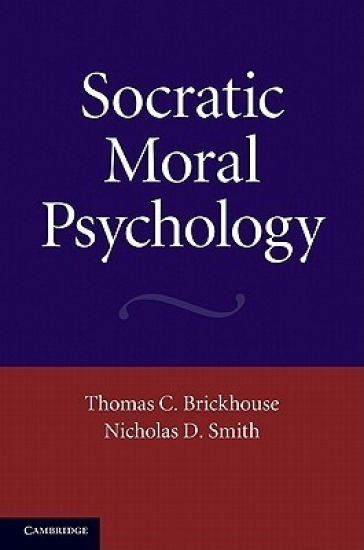
Socratic Moral Psychology

Socratic Moral Psychology

Thomas C. Brickhouse; Nicholas D. Smith

Cambridge University Press
2012
pokkari
Socrates' moral psychology is widely thought to be 'intellectualist' in the sense that, for Socrates, every ethical failure to do what is best is exclusively the result of some cognitive failure to apprehend what is best. Until publication of this book, the view that, for Socrates, emotions and desires have no role to play in causing such failure went unchallenged. This book argues against the orthodox view of Socratic intellectualism and offers in its place a comprehensive alternative account that explains why Socrates believed that emotions, desires and appetites can influence human motivation and lead to error. Thomas C. Brickhouse and Nicholas D. Smith defend the study of Socrates' philosophy and offer an alternative interpretation of Socratic moral psychology. Their novel account of Socrates' conception of virtue and how it is acquired shows that Socratic moral psychology is considerably more sophisticated than scholars have supposed.
Socratic Moral Psychology

Socratic Moral Psychology

Thomas C. Brickhouse; Nicholas D. Smith

Cambridge University Press
2010
sidottu
Socrates' moral psychology is widely thought to be 'intellectualist' in the sense that, for Socrates, every ethical failure to do what is best is exclusively the result of some cognitive failure to apprehend what is best. Until publication of this book, the view that, for Socrates, emotions and desires have no role to play in causing such failure went unchallenged. This book argues against the orthodox view of Socratic intellectualism and offers in its place a comprehensive alternative account that explains why Socrates believed that emotions, desires and appetites can influence human motivation and lead to error. Thomas C. Brickhouse and Nicholas D. Smith defend the study of Socrates' philosophy and offer an alternative interpretation of Socratic moral psychology. Their novel account of Socrates' conception of virtue and how it is acquired shows that Socratic moral psychology is considerably more sophisticated than scholars have supposed.
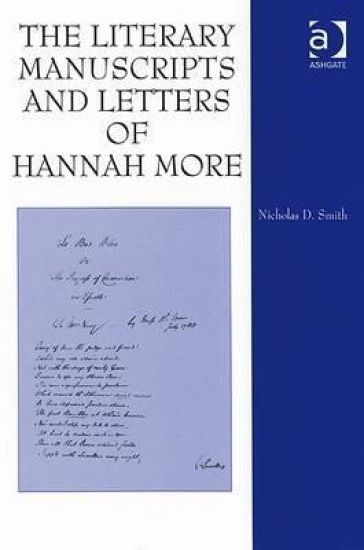
The Literary Manuscripts and Letters of Hannah More

The Literary Manuscripts and Letters of Hannah More

Nicholas D. Smith

Ashgate Publishing Limited
2008
sidottu
The result of extensive archival investigation, this meticulously researched book collects and describes for the first time the extant literary manuscripts and letters of the celebrated Bluestocking writer and Evangelical philanthropist Hannah More (1745-1833). Participating in the ongoing recovery of eighteenth-century women writers, Nicholas D. Smith's survey is an indispensable reference work not only for More scholars but for those researching the careers of many of her contemporaries. Features include an extended narrative analysis of the manuscripts that plots More's participation in the manuscript culture of the period and contextualizes the individual entries in the index; provenance details for the more substantial manuscript holdings in British and North American repositories; and identification of numerous autograph manuscripts and transcripts in public and private collections. More than 1,500 letters in 95 locations in Britain and North America have been inventoried and precise dates and internal locators are supplied when known. More's letters, the majority of which have never been published, are a largely untapped source of primary materials for scholars and students researching such diverse subjects as the literary activities and opinions of the Bluestocking circle, women's conduct and education, publishing and the book trade, the national debate over the abolition of the slave trade, the rise of the Evangelical movement, the conservative reaction to the American and French revolutions, and the Napoleonic wars.
Philosophy Through Science Fiction

Philosophy Through Science Fiction

Ryan Nichols; Nicholas D. Smith; Fred Miller

Routledge
2008
nidottu
Philosophy Through Science Fiction offers a fun, challenging, and accessible way in to the issues of philosophy through the genre of science fiction. Tackling problems such as the possibility of time travel, or what makes someone the same person over time, the authors take a four-pronged approach to each issue, providing· a clear and concise introduction to each subject · a science fiction story that exemplifies a feature of the philosophical discussion· historical and contemporary philosophical texts that investigate the issue with rigor, and· glossary, plot profiles of pertinent science fiction stories and films, and questions for further reflection. Philosophy Through Science Fiction includes stories from contemporary science fiction writers including Greg Egan and Mike Resnick, as well as from classic authors like Philip K. Dick and Robert Heinlein. Philosophy readings include historical pieces by René Descartes and David Hume, and contemporary pieces by John Searle and Mary Midgley.
Routledge Philosophy GuideBook to Plato and the Trial of Socrates

Routledge Philosophy GuideBook to Plato and the Trial of Socrates

Thomas C. Brickhouse; Nicholas D. Smith

Routledge
2004
sidottu
Socrates is one of the most influential philosophers in western civilisation, and Plato his most famous pupil. The Euthyphro, Apology of Socrates, Crito and the death scene from the Phaedo are Plato's account of Socrates' trial and execution, and together they provide the most important depiction of Socrates' ideas. In this GuideBook, Brickhouse and Smith provide clear explanations of these texts for students coming to them for the first time. Situating the works in their historical context, the authors carefully go through each text, exploring the philosophical issues raised in an accessible way. Plato and the Trial of Socrates is the ideal introduction to both the ideas of Socrates and the work of Plato.
Routledge Philosophy GuideBook to Plato and the Trial of Socrates

Routledge Philosophy GuideBook to Plato and the Trial of Socrates

Thomas C. Brickhouse; Nicholas D. Smith

Routledge
2004
nidottu
Socrates is one of the most influential philosophers in western civilisation, and Plato his most famous pupil. The Euthyphro, Apology of Socrates, Crito and the death scene from the Phaedo are Plato's account of Socrates' trial and execution, and together they provide the most important depiction of Socrates' ideas. In this GuideBook, Brickhouse and Smith provide clear explanations of these texts for students coming to them for the first time. Situating the works in their historical context, the authors carefully go through each text, exploring the philosophical issues raised in an accessible way. Plato and the Trial of Socrates is the ideal introduction to both the ideas of Socrates and the work of Plato.
Socrates on Trial

Socrates on Trial

Thomas C. Brickhouse; Nicholas D. Smith

Clarendon Press
1991
nidottu
Brickhouse and Smith argue, contrary to virtually every modern interpretation of Plato's Apology of Socrates, that Plato's Socrates offers a sincere defence against the charges he faces. In doing so the book offers an exhaustive historical and philosophical interpretation of and commentary on Plato's Apology. The authors demonstrate that Socrates' moral and religious principles prohibit him from needlessly risking a negative vote at his trial. By providing a complete commentary, they show that each specific claim Socrates makes in the Apology can be construed as a sincere attempt to inform the jury of the truth and convince the jurors of his blamelessness. The effect of these two strategies is a novel interpretation of the Apology which sheds new light on various aspects of Socrates' life and philosophy.
Socrates on Trial

Socrates on Trial

Thomas C. Brickhouse; Nicholas D. Smith

Princeton University Press
1990
pokkari
Thomas Brickhouse and Nicholas Smith offer a comprehensive historical and philosophical interpretation of, and commentary on, one of Plato's most widely read works, the Apology of Socrates. Virtually every modern interpretation characterizes some part of what Socrates says in the Apology as purposefully irrelevant or even antithetical to convincing the jury to acquit him at his trial. This book, by contrast, argues persuasively that Socrates offers a sincere and well-reasoned defense against the charges he faces. First, the authors establish a consensus of ancient reports about Socrates' moral and religious principles and show that these prohibit him from needlessly risking the condemnation of the jury. Second, they consider each specific claim made by Socrates in the Apology and show how each can be construed as an honest effort to inform the jurors of the truth and to convince them of his blamelessness. The arguments of this book are informed by a critical review of the scholarly literature and careful attention to the philosophy expressed in Plato's other early dialogues.