Kirjojen hintavertailu – 12 903 725 kirjaa ja 27 kauppaa

Kirjailija

Nicholas Lord

Kirjat ja teokset yhdessä paikassa: 6 kirjaa, julkaisuja vuosilta 2014–2026, suosituimpiin kuuluu Organising White-Collar and Corporate Crimes. Vertaile teosten hintoja ja tarkista saatavuus suomalaisista kirjakaupoista.

6 kirjaa

Kirjojen julkaisuvuodet: 2014–2026.

Organising White-Collar and Corporate Crimes

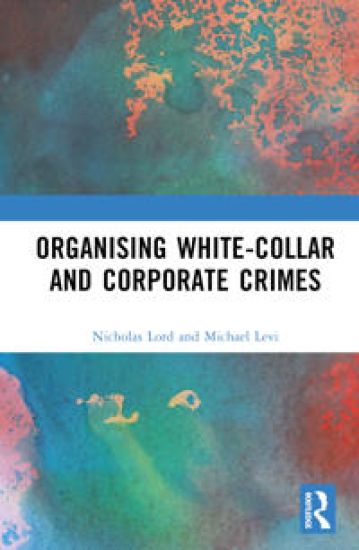
Organising White-Collar and Corporate Crimes

Nicholas Lord; Michael Levi

TAYLOR FRANCIS LTD
2026
nidottu
This book explores how we can re-constitute our approach to analysing and empirically investigating the organisation of white-collar and corporate crimes, with a view to building fuller theoretical and empirical accounts. The work demonstrates how knowledge can be produced and systematised within a conceptual and analytical framework concerned with understanding how such crimes are organised, why they are organised as they are, who gets involved in them as primary offenders and as facilitators, and the ‘real’ factors that shape these organisational dynamics over time in particular contexts and under varying conditions. In doing so, the book examines the distal (far-off) and proximal (close) social arrangements and relations that create and shape emergent white-collar crime opportunities and their structures. It also investigates the mechanisms, relationships, processes, and conditions that are necessary for the commission, or the unfolding, of white-collar crimes, or for their non-commission. How these are contingently connected to particular contexts is explored. The work also considers the people who collaborate, connect, and otherwise associate, whether ephemerally or for longer periods, in the pursuit of criminal goals and the actual or potential skills, expertise, and abilities of these people to accomplish or resist particular behaviours that are required of them. Finally, the book assesses the human, social, cultural, and material antecedents that enable white-collar crimes to flourish or fade. The work will be of particular interest to scholars theorising about and empirically investigating white-collar and corporate crimes, or seeking to understand empirical approaches to analysing such behaviours and other types of crime. It is primarily aimed at critical social scientists, including criminologists and sociologists, as well as socio-legal, business, economics, and political studies scholars. The work will also be of interest to practitioners and policymakers keen to learn more about how and why these crimes are organised as they are.

Urban Security in Europe

Urban Security in Europe

Adam Edwards; Gordon Hughes; Nicholas Lord

Routledge
2026
sidottu
What is the current state of urban security in Europe in the context of the increased freedom of movement of people, goods and services across national borders, an increasingly austere economic climate and consequent pressures on governing capacity in European cities? Crime prevention policy developed in Europe as a response to the perceived the perceived rise of transnational threats to the security of urban populations. This book examines the concept of ‘urban security’ in a European context, tracing the origins of the problem in public policy discourse through to the desire of the European Union to create an ‘area of freedom, security and justice’ amongst member states. Written by experts in the field and based on extensive research across Europe, this book argues that the social science has a major contribution to make to this policy discourse in corroborating, criticising and adapting its conception of the problems, responsibilities and expertise entailed in urban security and constituting its smarter governance in an age of austerity.
Organising White-Collar and Corporate Crimes

Organising White-Collar and Corporate Crimes

Nicholas Lord; Michael Levi

Routledge
2025
sidottu

Halvin toimitettuna 240,40 €

This book explores how we can re-constitute our approach to analysing and empirically investigating the organisation of white-collar and corporate crimes, with a view to building fuller theoretical and empirical accounts. The work demonstrates how knowledge can be produced and systematised within a conceptual and analytical framework concerned with understanding how such crimes are organised, why they are organised as they are, who gets involved in them as primary offenders and as facilitators, and the ‘real’ factors that shape these organisational dynamics over time in particular contexts and under varying conditions. In doing so, the book examines the distal (far-off) and proximal (close) social arrangements and relations that create and shape emergent white-collar crime opportunities and their structures. It also investigates the mechanisms, relationships, processes, and conditions that are necessary for the commission, or the unfolding, of white-collar crimes, or for their non-commission. How these are contingently connected to particular contexts is explored. The work also considers the people who collaborate, connect, and otherwise associate, whether ephemerally or for longer periods, in the pursuit of criminal goals and the actual or potential skills, expertise, and abilities of these people to accomplish or resist particular behaviours that are required of them. Finally, the book assesses the human, social, cultural, and material antecedents that enable white-collar crimes to flourish or fade. The work will be of particular interest to scholars theorising about and empirically investigating white-collar and corporate crimes, or seeking to understand empirical approaches to analysing such behaviours and other types of crime. It is primarily aimed at critical social scientists, including criminologists and sociologists, as well as socio-legal, business, economics, and political studies scholars. The work will also be of interest to practitioners and policymakers keen to learn more about how and why these crimes are organised as they are.
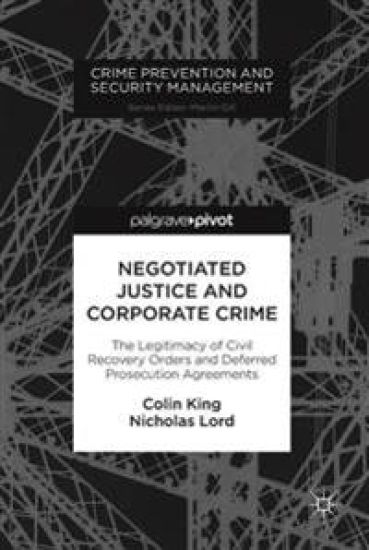
Negotiated Justice and Corporate Crime

Negotiated Justice and Corporate Crime

Colin King; Nicholas Lord

Birkhauser Verlag AG
2018
sidottu
This book argues that there is a strong normative argument for using the criminal law as a primary response to corporate crime. In practice, however, corporate crimes are rarely dealt with through criminal sanctioning mechanisms. Rather, the preference – for both prosecutors and corporates – appears to be on negotiating out of the criminal process. Reflecting this emphasis on negotiation, this book examines the use of Civil Recovery Orders and Deferred Prosecution Agreements as responses to corporate crime, and discusses a variety of UK case studies. Drawing upon legal and criminological backgrounds, and with an emphasis on the conceptual frameworks of ‘negotiated justice’ and ‘legitimacy’, the authors examine the law, policy and practice of these enforcement responses. They offer an original, theoretically-informed analysis which is accessible to practitioners and researchers.
Regulating Corporate Bribery in International Business
This book is about the regulation of corporations that use bribery in international commerce to win or maintain overseas business contracts and interests. Recent large-scale cases involving multinational corporations demonstrate how large commercial ’non-criminal’ enterprises are being implicated in substantive overseas bribery scandals and illustrate the difficulties faced by responsible enforcement authorities in the UK and Germany. The book imports concepts from regulation theory to aid our understanding of the emerging enforcement, self-regulatory and hybrid responses to transnational corporate bribery. Lord implements a qualitative, comparative research strategy involving semi-structured interviews, participant observation and document analysis to provide empirical insights into this relatively invisible area of criminological interest. Despite significant cultural differences between the jurisdictions, this book argues that UK and German anti-corruption authorities face procedural, evidential, legal, financial and structural difficulties that are leading to convergence in prosecution policies. Although self-regulatory and hybrid mechanisms are aiding the response and gaining some level of regulation, the default position is one of accommodation by state agencies, even where the will to enforce the law is high. This book is essential reading for academics and students researching corporate and white-collar crimes and the concept of regulation more generally, as well as law enforcement agencies and international and intergovernmental organisations concerned with anti-corruption.
Regulating Corporate Bribery in International Business

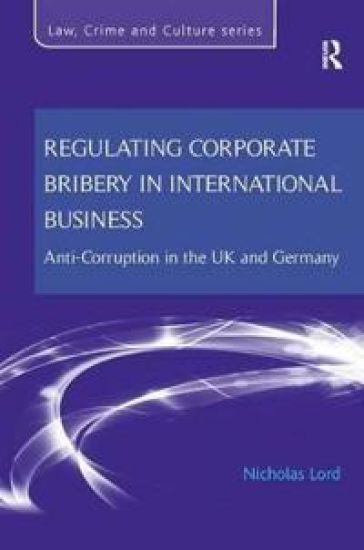
Regulating Corporate Bribery in International Business

Nicholas Lord

Ashgate Publishing Limited
2014
sidottu
This book is about the regulation of corporations that use bribery in international commerce to win or maintain overseas business contracts and interests. Recent large-scale cases involving multinational corporations demonstrate how large commercial ’non-criminal’ enterprises are being implicated in substantive overseas bribery scandals and illustrate the difficulties faced by responsible enforcement authorities in the UK and Germany. The book imports concepts from regulation theory to aid our understanding of the emerging enforcement, self-regulatory and hybrid responses to transnational corporate bribery. Lord implements a qualitative, comparative research strategy involving semi-structured interviews, participant observation and document analysis to provide empirical insights into this relatively invisible area of criminological interest. Despite significant cultural differences between the jurisdictions, this book argues that UK and German anti-corruption authorities face procedural, evidential, legal, financial and structural difficulties that are leading to convergence in prosecution policies. Although self-regulatory and hybrid mechanisms are aiding the response and gaining some level of regulation, the default position is one of accommodation by state agencies, even where the will to enforce the law is high. This book is essential reading for academics and students researching corporate and white-collar crimes and the concept of regulation more generally, as well as law enforcement agencies and international and intergovernmental organisations concerned with anti-corruption.