Kirjojen hintavertailu – 12 903 729 kirjaa ja 27 kauppaa

Kirjailija

Nicholas V. Riasanovsky

Kirjat ja teokset yhdessä paikassa: 6 kirjaa, julkaisuja vuosilta 1969–2021, suosituimpiin kuuluu To the Harbin Station. Vertaile teosten hintoja ja tarkista saatavuus suomalaisista kirjakaupoista.

6 kirjaa

Kirjojen julkaisuvuodet: 1969–2021.

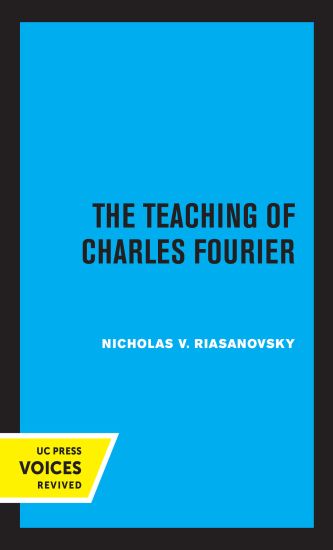
The Teaching of Charles Fourier

The Teaching of Charles Fourier

Nicholas V. Riasanovsky

University of California Press
2021
sidottu
Charles Fourier has generally been studied in relation to particular segments of his teaching. Consequently he is known only in one or another of the roles to which biographers or commentators have assigned him, such as that of a social critic, a precursor of Marx, a theoretician of the cooperative movement, or even a progenitor of today's worldwide revolutionary turmoil. Riasanovsky points out that two considerations make an adequate presentation of Fourier's ideas unusually difficult. For one thing, his thought was all of a piece, organically united in a multibranched universal formula so that it is virtually impossible to do justice to a period, a part, or a particular aspect of his teaching without dealing with the whole. For another, this formula was essentially mad and encompassed extremely bizarre and eccentric elements. Most writers have been unprepared to admit, let alone accept, the totality of his teaching. The primary purpose of this book is to state Fourier's system in its own terms, not in terms of its possible contribution to a different intellectual orientation. Riasanovsky succeeds admirably in this task, summarizing for the first time within one volume the essence of Fourier's ideas, which are of an almost overwhelming profusion in their original form. He also examines the relation of Fourier's views to the general currents of modern thought, and delineates his place on the intellectual map of the modern world. This title is part of UC Press's Voices Revived program, which commemorates University of California Press's mission to seek out and cultivate the brightest minds and give them voice, reach, and impact. Drawing on a backlist dating to 1893, Voices Revived makes high-quality, peer-reviewed scholarship accessible once again using print-on-demand technology. This title was originally published in 1969.
The Teaching of Charles Fourier

The Teaching of Charles Fourier

Nicholas V. Riasanovsky

University of California Press
2020
pokkari
Charles Fourier has generally been studied in relation to particular segments of his teaching. Consequently he is known only in one or another of the roles to which biographers or commentators have assigned him, such as that of a social critic, a precursor of Marx, a theoretician of the cooperative movement, or even a progenitor of today's worldwide revolutionary turmoil. Riasanovsky points out that two considerations make an adequate presentation of Fourier's ideas unusually difficult. For one thing, his thought was all of a piece, organically united in a multibranched universal formula so that it is virtually impossible to do justice to a period, a part, or a particular aspect of his teaching without dealing with the whole. For another, this formula was essentially mad and encompassed extremely bizarre and eccentric elements. Most writers have been unprepared to admit, let alone accept, the totality of his teaching. The primary purpose of this book is to state Fourier's system in its own terms, not in terms of its possible contribution to a different intellectual orientation. Riasanovsky succeeds admirably in this task, summarizing for the first time within one volume the essence of Fourier's ideas, which are of an almost overwhelming profusion in their original form. He also examines the relation of Fourier's views to the general currents of modern thought, and delineates his place on the intellectual map of the modern world. This title is part of UC Press's Voices Revived program, which commemorates University of California Press's mission to seek out and cultivate the brightest minds and give them voice, reach, and impact. Drawing on a backlist dating to 1893, Voices Revived makes high-quality, peer-reviewed scholarship accessible once again using print-on-demand technology. This title was originally published in 1969.
Russian Identities

Russian Identities

Nicholas V. Riasanovsky

Oxford University Press Inc
2005
sidottu
This book investigates the question of Russian identity, looking at changes and continues over a huge territory, many centuries, and a variety of political, social, and economic structures. Its main emphases are on the struggle against the steppe peoples, Orthodox Christianity, autocratic monarchy, and Westernization.
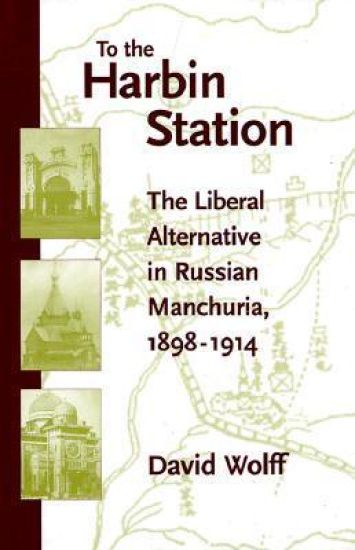
To the Harbin Station

To the Harbin Station

David Wolff; Nicholas V. Riasanovsky

Stanford University Press
1999
sidottu
In 1898, near the projected intersection of the Chinese Eastern Railroad (the last leg of the Trans-Siberian) and China's Sungari River, Russian engineers founded the city of Harbin. Between the survey of the site and the profound dislocations of the 1917 revolution, Harbin grew into a bustling multiethnic urban center with over 100,000 inhabitants. In this area of great natural wealth, Russian, Chinese, Japanese, Korean, and American ambitions competed and converged, and sometimes precipitated vicious hostilities. Drawing on the archives, both central and local, of seven countries, this history of Harbin presents multiple perspectives on Imperial Russia's only colony. The Russian authorities at Harbin and their superiors in St. Petersburg intentionally created an urban environment that was tolerant not only toward their Chinese host, but also toward different kinds of "Russians." For example, in no other city of the Russian Empire were Jews and Poles, who were numerous in Harbin, encouraged to participate in municipal government. The book reveals how this liberal Russian policy changed the face and fate of Harbin. As the history of Harbin unfolds, the narrative covers a wide range of historiographic concerns from several national histories. These include: the role of the Russian finance minister Witte, the building of the Trans-Siberian Railroad, the origins of Stolypin's reforms, the development of Siberia and the Russian Far East, the 1905 Revolution, the use of ethnicity as a tool of empire, civil-military conflict, strategic area studies, Chinese nationalism, the Japanese decision for war against the Russians, Korean nationalism in exile, and the rise of the soybean as an international commodity. In all these concerns, Harbin was a vibrant source of creative, unorthodox policy and turbulent economic and political claims.
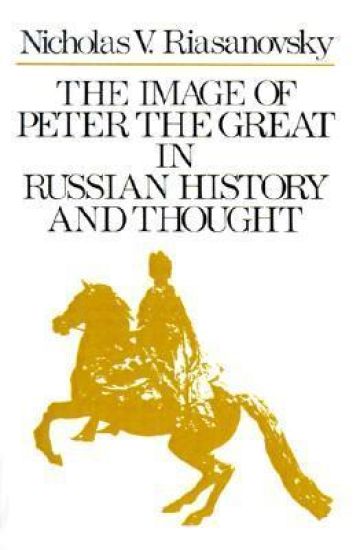
The Image of Peter the Great in Russian History and Thought

The Image of Peter the Great in Russian History and Thought

Nicholas V. Riasanovsky

Oxford University Press Inc
1992
nidottu
The image of Peter the Great casts a long shadow in modern Russian thought and culture. As important to modern Russia as the French Revolution is to France and the Reformation is to Germany, the image of this militaristic ruler, founder of St Petersburg, and czar of all Russia from 1689-1725 has been central to Russian history, literature, and art since the early 1700s. Riasanovsky, one of the foremost historians of Russia, traces the development of this image from 1700 to the present. Drawing examples from Russian historical accounts, literature, folklore, and the arts, he shows how the use of the image of Peter has reflected the changing cultural and political values of the Russian people.
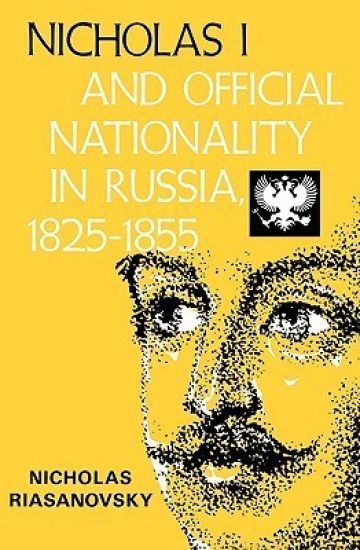
Nicholas I and Official Nationality in Russia 1825 - 1855

Nicholas I and Official Nationality in Russia 1825 - 1855

Nicholas V. Riasanovsky

University of California Press
1969
pokkari
Nicholas I and Official Nationality in Russia, 1825 - 1855 developed from a much more modest interest in Uvarov's doctrine of "Orthodoxy, autocracy, and nationality." During the author's study of the Slavophiles in particular, he became increasing aware of the paucity of our knowledge of this so-called Official Nationality frequently combined with a deprecating attitude toward it. Unable to find a satisfactory analysis of the subject, the author proceeded to write his own. This book largely organized itself: an exposition and discussion of the ideology naturally occupied the central position, preceded by a brief treatment of its proponents. But Official Nationality reached beyond intellectual circles, lectures and books; indeed, for thirty years it ruled Russia. Therefore, the author found it necessary to write a chapter on the emperor who, in effect, personally dominated and governed the country throughout his reign; to add a section on the imperial family, the ministers, and some other high officials to an account of the intellectuals who supported the state; and to sketch the application of Official Nationalty both in home affairs and in foreign policy. In this manner this title is able to bring the state doctrine and its role in Russian history into proper focus.