Kirjojen hintavertailu – 12 903 735 kirjaa ja 27 kauppaa

Kirjailija

Nick Dyer-Witheford

Kirjat ja teokset yhdessä paikassa: 9 kirjaa, julkaisuja vuosilta 1999–2025, suosituimpiin kuuluu Cyberwar and Revolution. Vertaile teosten hintoja ja tarkista saatavuus suomalaisista kirjakaupoista.

9 kirjaa

Kirjojen julkaisuvuodet: 1999–2025.

Cybernetic Circulation Complex

Cybernetic Circulation Complex

Nick Dyer-Witheford; Alessandra Mularoni

Verso Books
2025
nidottu

Halvin toimitettuna 24,90 €

Big Tech firms dominate the global economy. But what value do they actually produce? In this brilliant survey of global tech economy, Nick Dyer-Witheford and Alessandra Mularoni argue that the role of firms like Amazon and Google, Palantir and Uber, is in the automation of circulation. By applying digital technologies to processes of market exchange-everything from advertising and shopping, to logistics and financial services-Big Tech aims to subject these activities to the level of control and predictability that capital has secured in industrial production. But there is a way out of the multiple crises that Big Tech has helped precipitate. If we are to break their grip on the global economy then it'll take more than just antitrust legislation or reducing individual time online. By understanding the central role Big Tech plays in contemporary capitalism, Dyer-Witheford and Mularoni argue that what is required instead is a new, ambitious and comprehensive program of democratic collective planning that can move us beyond capitalism. Cybernetic Circulation Complex offers not only a compelling analysis of the power of Big Tech and their role in our current global crises, but a roadmap for a new form of life: biocommunism, a digital degrowth that can help us steer between the double boundaries of ecological sustainability and equitable social development.

Inhuman Power

Inhuman Power

Nick Dyer-Witheford; Atle Mikkola Kjøsen; James Steinhoff

Pluto Press
2019
pokkari

Halvin toimitettuna 32,90 €

Artificial Intelligence (AI) has seen major advances in recent years. While machines were always central to the Marxist analysis of capitalism, AI is a new kind of machine that Marx could not have anticipated. Contemporary machine-learning AI allows machines to increasingly approach human capacities for perception and reasoning in narrow domains. This book explores the relationship between Marxist theory and AI through the lenses of different theoretical concepts, including surplus-value, labour, the general conditions of production, class composition and surplus population. It argues against left accelerationism and post-Operaismo thinkers, asserting that a deeper analysis of AI produces a more complex and disturbing picture of capitalism's future than has previously been identified. Inhuman Power argues that on its current trajectory, AI represents an ultimate weapon for capital. It will render humanity obsolete or turn it into a species of transhumans working for a wage until the heat death of the universe; a fate that is only avoidable by communist revolution.
Inhuman Power

Inhuman Power

Nick Dyer-Witheford; Atle Mikkola Kjøsen; James Steinhoff

Pluto Press
2019
sidottu
Artificial Intelligence (AI) has seen major advances in recent years. While machines were always central to the Marxist analysis of capitalism, AI is a new kind of machine that Marx could not have anticipated. Contemporary machine-learning AI allows machines to increasingly approach human capacities for perception and reasoning in narrow domains. This book explores the relationship between Marxist theory and AI through the lenses of different theoretical concepts, including surplus-value, labour, the general conditions of production, class composition and surplus population. It argues against left accelerationism and post-Operaismo thinkers, asserting that a deeper analysis of AI produces a more complex and disturbing picture of capitalism's future than has previously been identified. Inhuman Power argues that on its current trajectory, AI represents an ultimate weapon for capital. It will render humanity obsolete or turn it into a species of transhumans working for a wage until the heat death of the universe; a fate that is only avoidable by communist revolution.
Cyberwar and Revolution

Cyberwar and Revolution

Nick Dyer-Witheford; Svitlana Matviyenko

University of Minnesota Press
2019
pokkari
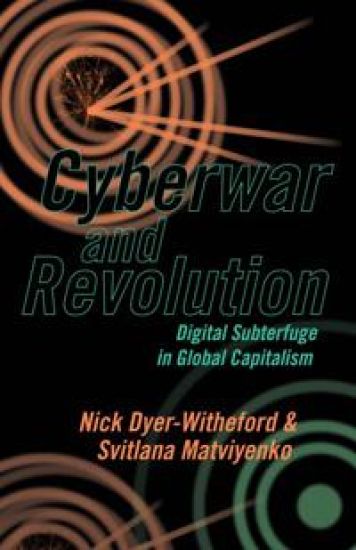
Uncovering the class conflicts, geopolitical dynamics, and aggressive capitalism propelling the militarization of the internet Global surveillance, computational propaganda, online espionage, virtual recruiting, massive data breaches, hacked nuclear centrifuges and power grids-concerns about cyberwar have been mounting, rising to a fever pitch after the alleged Russian hacking of the U. S. presidential election and the Cambridge Analytica scandal. Although cyberwar is widely discussed, few accounts undertake a deep, critical view of its roots and consequences. Analyzing the new militarization of the internet, Cyberwar and Revolution argues that digital warfare is not a bug in the logic of global capitalism but rather a feature of its chaotic, disorderly unconscious. Urgently confronting the concept of cyberwar through the lens of both Marxist critical theory and psychoanalysis, Nick Dyer-Witheford and Svitlana Matviyenko provide a wide-ranging examination of the class conflicts and geopolitical dynamics propelling war across digital networks. Investigating the subjectivities that cyberwar mobilizes, exploits, and bewilders, and revealing how it permeates the fabric of everyday life and implicates us all in its design, this book also highlights the critical importance of the emergent resistance to this digital militarism-hacktivism, digital worker dissent, and off-the-grid activism-for effecting different, better futures.
Cyberwar and Revolution

Cyberwar and Revolution

Nick Dyer-Witheford; Svitlana Matviyenko

University of Minnesota Press
2019
sidottu
Uncovering the class conflicts, geopolitical dynamics, and aggressive capitalism propelling the militarization of the internet Global surveillance, computational propaganda, online espionage, virtual recruiting, massive data breaches, hacked nuclear centrifuges and power grids-concerns about cyberwar have been mounting, rising to a fever pitch after the alleged Russian hacking of the U. S. presidential election and the Cambridge Analytica scandal. Although cyberwar is widely discussed, few accounts undertake a deep, critical view of its roots and consequences. Analyzing the new militarization of the internet, Cyberwar and Revolution argues that digital warfare is not a bug in the logic of global capitalism but rather a feature of its chaotic, disorderly unconscious. Urgently confronting the concept of cyberwar through the lens of both Marxist critical theory and psychoanalysis, Nick Dyer-Witheford and Svitlana Matviyenko provide a wide-ranging examination of the class conflicts and geopolitical dynamics propelling war across digital networks. Investigating the subjectivities that cyberwar mobilizes, exploits, and bewilders, and revealing how it permeates the fabric of everyday life and implicates us all in its design, this book also highlights the critical importance of the emergent resistance to this digital militarism-hacktivism, digital worker dissent, and off-the-grid activism-for effecting different, better futures.
Cyber-Proletariat

Cyber-Proletariat

Nick Dyer-Witheford

Pluto Press
2015
pokkari
An unsparing analysis of class power and computerisation, Cyber-Proletariat shows us the dark-side of the information revolution. From Coltan mines in the Congo; electronics factories in China and devastated neighbourhoods in Detroit, this book reveals how technology facilitates growing polarisation between wealthy elites and precarious workers. Nick Dyer-Witheford reveals the class domination behind everything from expanding online surveillance to intensifying robotisation. At the same time, he looks at possibilities for information technology within radical movements; contemporary struggles are cast in the blue glow of the computer screen. This book brings heterodox Marxist analysis to bear on modern technological developments. This is essential reading for anyone who wants to understand how Silicon Valley shapes the way we live today.
Games of Empire

Games of Empire

Nick Dyer-Witheford; Greig de Peuter

University of Minnesota Press
2009
nidottu
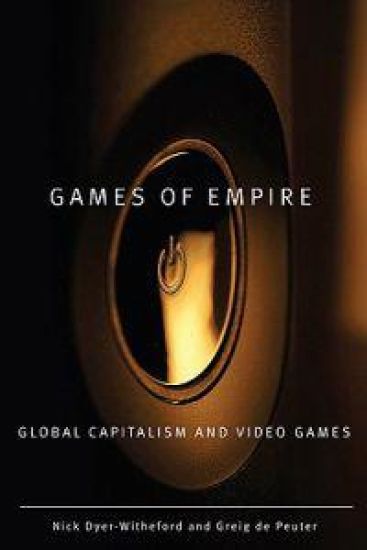
In the first decade of the twenty-first century, video games are an integral part of global media culture, rivaling Hollywood in revenue and influence. No longer confined to a subculture of adolescent males, video games today are played by adults around the world. At the same time, video games have become major sites of corporate exploitation and military recruitment. In Games of Empire, Nick Dyer-Witheford and Greig de Peuter offer a radical political critique of such video games and virtual environments as Second Life, World of Warcraft, and Grand Theft Auto, analyzing them as the exemplary media of Empire, the twenty-first-century hypercapitalist complex theorized by Michael Hardt and Antonio Negri. The authors trace the ascent of virtual gaming, assess its impact on creators and players alike, and delineate the relationships between games and reality, body and avatar, screen and street. Games of Empire forcefully connects video games to real-world concerns about globalization, militarism, and exploitation, from the horrors of African mines and Indian e-waste sites that underlie the entire industry, the role of labor in commercial game development, and the synergy between military simulation software and the battlefields of Iraq and Afghanistan exemplified by Full Spectrum Warrior to the substantial virtual economies surrounding World of Warcraft, the urban neoliberalism made playable in Grand Theft Auto, and the emergence of an alternative game culture through activist games and open-source game development. Rejecting both moral panic and glib enthusiasm, Games of Empire demonstrates how virtual games crystallize the cultural, political, and economic forces of global capital, while also providing a means of resisting them.
Digital Play

Digital Play

Stephen Kline; Nick Dyer-Witheford; Greig de Peuter

McGill-Queen's University Press
2003
nidottu
A uniquely critical study of video gaming that blends perspectives from political economy, cultural studies, and communications theory.
Cyber-Marx

Cyber-Marx

Nick Dyer-Witheford

University of Illinois Press
1999
nidottu
In this highly readable and thought-provoking work, Nick Dyer-Witheford assesses the relevance of Marxism in our time and demonstrates how the information age, far from transcending the historic conflict between capital and its laboring subjects, constitutes the latest battleground in their encounter. Dyer-Witheford maps the dynamics of modern capitalism, showing how capital depends for its operations not just on exploitation in the immediate workplace, but on the continuous integration of a whole series of social sites and activities, from public health and maternity to natural resource allocation and the geographical reorganization of labor power. He also shows how these sites and activities may become focal points of subversion and insurgency, as new means of communication vital for the smooth flow of capital also permit otherwise isolated and dispersed points of resistance to connect and combine with one another. Cutting through the smokescreen of high-tech propaganda, Dyer-Witheford predicts the advent of a reinvented, "autonomist" Marxism that will rediscover the possibility of a collective, communist transformation of society. Refuting the utopian promises of the information revolution, he discloses the real potentialities for a new social order in the form of a twenty-first-century communism based on the common sharing of wealth.