Kirjojen hintavertailu – 12 903 725 kirjaa ja 27 kauppaa
Kirjailija
Nico Cloete
Kirjat ja teokset yhdessä paikassa: 7 kirjaa, julkaisuja vuosilta 2004–2020, suosituimpiin kuuluu Universities and Economic Development in Africa. Vertaile teosten hintoja ja tarkista saatavuus suomalaisista kirjakaupoista.
Worldwide, in Africa and in South Africa, the importance of the doctorate has increased disproportionately in relation to its share of the overall graduate output over the past decade. This heightened attention has not only been concerned with the traditional role of the PhD, namely the provision of future academics; rather, it has focused on the increasingly important role that higher education - and, particularly, high-level skills - is perceived to play in national development and the knowledge economy. This book is unique in the area of research into doctoral studies because it draws on a large number of studies conducted by the Centre of Higher Education Trust (CHET) and the Centre for Research on Evaluation, Science and Technology (CREST), as well as on studies from the rest of Africa and the world. In addition to the historical studies, new quantitative and qualitative research was undertaken to produce the evidence base for the analyses presented in the book. The findings presented in Doctoral Education in South Africa pose anew at least six tough policy questions that the country has struggled with since 1994, and continues to struggle with, if it wishes to gear up the system to meet the target of 5 000 new doctorates a year by 2030. Discourses framed around the single imperatives of growth, efficiency, transformation or quality will not, however, generate the kind of policy discourses required to resolve these tough policy questions effectively. What is needed is a change in approach that accommodates multiple imperatives and allows for these to be addressed simultaneously.
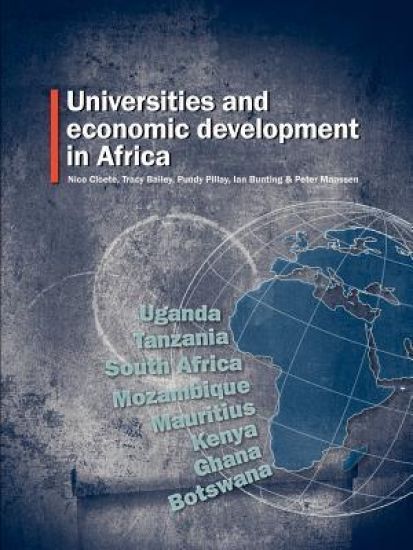
A previous edition of Universities and Economic Development in Africa studied eight African countries and their flagship universities. In addition to minor updates, this edition includes a new section on the key findings in each of the eight countries and universities. In each case, this new section provides more detailed data and analysis which will prove invaluable for researchers and policy-makers on higher education in Africa. The eight countries included in the study are Uganda, Botswana, Ghana, Kenya, Mauritius, South Africa, Mozambique and Tanzania.
Universities and economic development in Africa: Pact, academic core and coordination draws together evidence and synthesises the findings from eight African case studies. The three key findings presented in this report are as follows: 1. There is a lack of clarity and agreement (pact) about a development model and the role of higher education in development, at both national and institutional levels. There is, however, an increasing awareness, particularly at government level, of the importance of universities in the global context of the knowledge economy. 2. Research production at the eight African universities is not strong enough to enable them to build on their traditional undergraduate teaching roles and make a sustained contribution to development via new knowledge production. A number of universities have manageable student-staff ratios and adequately qualifi ed staff, but inadequate funds for staff to engage in research. In addition, the incentive regimes do not support knowledge production. 3. In none of the countries in the sample is there a coordinated effort between government, external stakeholders and the university to systematically strengthen the contribution that the university can make to development. While at each of the universities there are exemplary development projects that connect strongly to external stakeholders and strengthen the academic core, the challenge is how to increase the number of these projects. The project on which this report is based forms part of a larger study on Higher Education and Economic Development in Africa, undertaken by the Higher Education Research and Advocacy Network in Africa (HERANA). HERANA is coordinated by the Centre for Higher Education Transformation in South Africa.
A study of the progress of reform in higher education institutions in the Eastern Cape of South Africa since the end of apartheid in 1994. The Partnership for Higher Education in Africa commissioned case studies of higher education provision in Tanzania, Uganda, Kenya, Mozambique, Nigeria, Ghana and South Africa, as part of its effort to stimulate enlightened, equitable, and knowledge-based national development, and to provide guides to understanding. A radical reform of South African higher education started after the first democratic elections of 1994: higher education was confronted with social, political and economic demands, of a kind not encountered during the apartheid era. In association with Partnership for Higher Education in Africa