Kirjojen hintavertailu – 12 859 829 kirjaa ja 27 kauppaa

Kirjailija

Nicola Lacey

Kirjat ja teokset yhdessä paikassa: 11 kirjaa, julkaisuja vuosilta 1994–2019, suosituimpiin kuuluu Introduction to Jurisprudence and Legal Theory. Vertaile teosten hintoja ja tarkista saatavuus suomalaisista kirjakaupoista.

11 kirjaa

Kirjojen julkaisuvuodet: 1994–2019.

Introduction to Jurisprudence and Legal Theory

Introduction to Jurisprudence and Legal Theory

Anne Barron; Hugh Collins; Emily Jackson; Nicola Lacey; Robert Reiner; Hamish Ross; Gunther Teubner; James Penner

LexisNexis UK
2002
nidottu
This text lays out a course of study combining the traditional subject matter of jurisprudence with a series of introductions to a variety of other theoretical perspectives. It is designed for those taking jurisprudence/legal theory courses, and political science, philosophy and sociology students.
A Woman in Law

A Woman in Law

Celia Wells; Nicola Lacey

Waterside Press
2019
nidottu
Celia Wells always felt like an outsider. Her unconventional early life was shaped by her Communist Party parents, she grew up as `town' not `gown' in Oxford, surrounded by books but living in a council house. She has uncovered an intriguing backstory with a bigamous grandmother, a convicted forger cousin transported to Australia in the 1840s, and the rise and fall of landed gentry. The author describes her parents' bohemian friends and their coded language and uses their original wartime correspondence to produce a picture of a fascinating heritage which ran against the grain and shaped an inquiring mind. A Woman in Law shows how the post-war political landscape provided opportunities for women yet failed to shift many entrenched advantages of gender and class. Tracing the rocky path to becoming Cardiff University's first female law professor, the author shows how her distinctive academic research led to different approaches to teaching criminal law as well as contributing to key reforms described in the book. As she asserts, `I wanted to write about my rather confused political and cultural background, and to relate it to my professional and personal life, to my academic writing, to my relationships, and my beliefs, my experiences of suicide and addiction in my close family.'
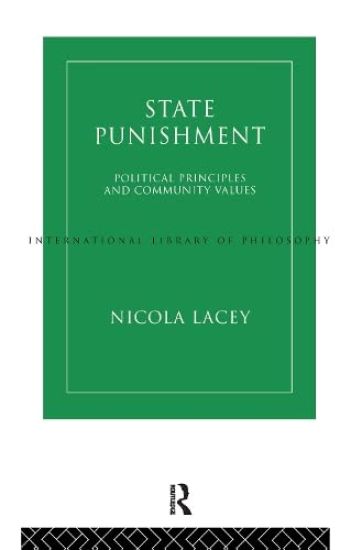
State Punishment

State Punishment

Nicola Lacey

Routledge
2016
sidottu
Nicola Lacey presents a new approach to the question of the moral justification of punishment by the State. She focuses on the theory of punishments in context of other political questions, such as the nature of political obligation and the function and scope of criminal law. Arguing that no convincing set of justifying reasons has so far been produced, she puts forward a theory of punishments which places the values of the community at its centre.
In Search of Criminal Responsibility

In Search of Criminal Responsibility

Nicola Lacey

Oxford University Press
2016
sidottu
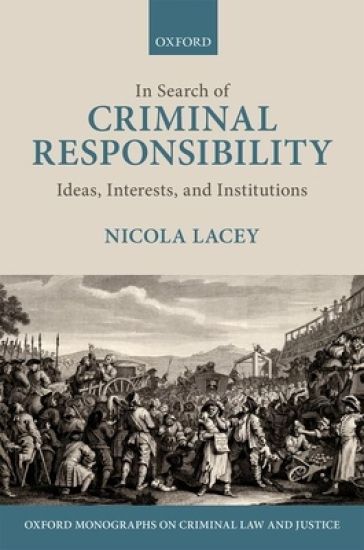
What makes someone responsible for a crime and therefore liable to punishment under the criminal law? Modern lawyers will quickly and easily point to the criminal law's requirement of concurrent actus reus and mens rea, doctrines of the criminal law which ensure that someone will only be found criminally responsible if they have committed criminal conduct while possessing capacities of understanding, awareness, and self-control at the time of offense. Any notion of criminal responsibility based on the character of the offender, meaning an implication of criminality based on reputation or the assumed disposition of the person, would seem to today's criminal lawyer a relic of the 18th Century. In this volume, Nicola Lacey demonstrates that the practice of character-based patterns of attribution was not laid to rest in 18th Century criminal law, but is alive and well in contemporary English criminal responsibility-attribution. Building upon the analysis of criminal responsibility in her previous book, Women, Crime, and Character, Lacey investigates the changing nature of criminal responsibility in English law from the mid-18th Century to the early 21st Century. Through a combined philosophical, historical, and socio-legal approach, this volume evidences how the theory behind criminal responsibility has shifted over time. The character and outcome responsibility which dominated criminal law in the 18th Century diminished in ideological importance in the following two centuries, when the idea of responsibility as founded in capacity was gradually established as the core of criminal law. Lacey traces the historical trajectory of responsibility into the 21st Century, arguing that ideas of character responsibility and the discourse of responsibility as founded in risk are enjoying a renaissance in the modern criminal law. These ideas of criminal responsibility are explored through an examination of the institutions through which they are produced, interpreted and executed; the interests which have shaped both doctrines and institutions; and the substantive social functions which criminal law and punishment have been expected to perform at different points in history.
In Search of Criminal Responsibility

In Search of Criminal Responsibility

Nicola Lacey

Oxford University Press
2016
nidottu
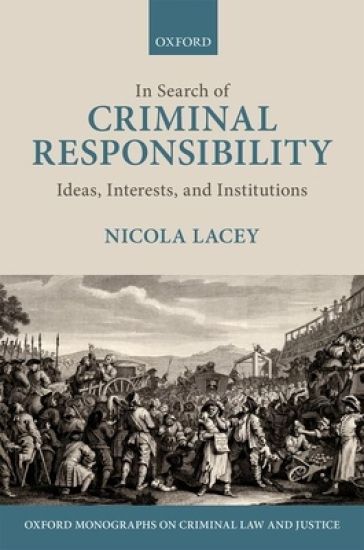
What makes someone responsible for a crime and therefore liable to punishment under the criminal law? Modern lawyers will quickly and easily point to the criminal law's requirement of concurrent actus reus and mens rea, doctrines of the criminal law which ensure that someone will only be found criminally responsible if they have committed criminal conduct while possessing capacities of understanding, awareness, and self-control at the time of offense. Any notion of criminal responsibility based on the character of the offender, meaning an implication of criminality based on reputation or the assumed disposition of the person, would seem to today's criminal lawyer a relic of the 18th Century. In this volume, Nicola Lacey demonstrates that the practice of character-based patterns of attribution was not laid to rest in 18th Century criminal law, but is alive and well in contemporary English criminal responsibility-attribution. Building upon the analysis of criminal responsibility in her previous book, Women, Crime, and Character, Lacey investigates the changing nature of criminal responsibility in English law from the mid-18th Century to the early 21st Century. Through a combined philosophical, historical, and socio-legal approach, this volume evidences how the theory behind criminal responsibility has shifted over time. The character and outcome responsibility which dominated criminal law in the 18th Century diminished in ideological importance in the following two centuries, when the idea of responsibility as founded in capacity was gradually established as the core of criminal law. Lacey traces the historical trajectory of responsibility into the 21st Century, arguing that ideas of character responsibility and the discourse of responsibility as founded in risk are enjoying a renaissance in the modern criminal law. These ideas of criminal responsibility are explored through an examination of the institutions through which they are produced, interpreted and executed; the interests which have shaped both doctrines and institutions; and the substantive social functions which criminal law and punishment have been expected to perform at different points in history.
The Prisoners' Dilemma

The Prisoners' Dilemma

Nicola Lacey

Cambridge University Press
2008
pokkari
Over the last two decades, and in the wake of increases in recorded crime and other social changes, British criminal justice policy has become increasingly politicised as an index of governments' competence. New and worrying developments, such as the inexorable rise of the US prison population and the rising force of penal severity, seem unstoppable in the face of popular anxiety about crime. But is this inevitable? Nicola Lacey argues that harsh 'penal populism' is not the inevitable fate of all contemporary democracies. Notwithstanding a degree of convergence, globalisation has left many of the key institutional differences between national systems intact, and these help to explain the striking differences in the capacity for penal tolerance in otherwise relatively similar societies. Only by understanding the institutional preconditions for a tolerant criminal justice system can we think clearly about the possible options for reform within particular systems.
A Life of H.L.A. Hart

A Life of H.L.A. Hart

Nicola Lacey

Oxford University Press
2006
nidottu
Shortlisted for the 2005 British Academy Book prize, Nicola Lacey's entrancing biography recounts the life of H. L. A. Hart, the pre-eminent legal philosopher of the twentieth century. Following Hart's life from modest origins as the son of Jewish tailor parents in Yorkshire to worldwide fame as the most influential English-speaking legal theorist of the post-War era, the book traces his successive metamorphoses; from Yorkshire schoolboy to Oxford scholar, from government intelligence officer to Professor of Jurisprudence, from awkward batchelor to family figurehead. In the tradition of Ray Monk's biography of Wittgenstein, Nicola Lacey paints an absorbing picture of intellectual and psychological development, of a mind struggling to cope with intellectual self-doubt, uncertain sexuality, a difficult marriage and an anti-semitic society. In depicting the evolution of Hart's life and mind, Lacey provides a vivid recreation of both the intellectual and social climate of Oxford in the post-War era.
A Life of H. L. A. Hart

A Life of H. L. A. Hart

Nicola Lacey

Oxford University Press
2004
sidottu
Herbert Lionel Adolphus Hart was born in Yorkshire in 1907 to second generation Jewish immigrants. Having won a scholarship to Oxford University, he went on to become the most famous legal philosopher of the twentieth century. From 1932-40 H. L. A Hart practised as a barrister in London. He was pronounced physically unfit for military service in 1940, and was recruited by MI5, where he worked until 1945. During his time at the Bar he had continued to study philosophy and at M15 his interest was further stimulated by his philosopher colleagues in M16, Stuart Hampshire and Gilbert Ryle. After the war, Hart returned to Oxford to take up a philosophy fellowship, later to become Professor of Jurisprudence. H. L. A Hart single-handedly reinvented the philosophy of law and influenced the nation's thinking in the 1960s on abortion, the legalization of homosexuality, and on capital punishment. Hart's approach to legal philosophy was at once disarmingly simple and breathtakingly ambitious, combining as it did the insights of Austin and Bentham and the new linguistic philosophy of J. L. Austin and Ludwig Wittgenstein. He sought to elucidate a concept of law which would be of relevance to all forms of law, wherever or whenever they arose: his bestselling book, The Concept of Law, has sold tens of thousands of copies worldwide. In 1941, he married Jenifer Williams (a high-ranking civil servant, later an Oxford academic) with whom he had four children. Their relationship was an enduring if unconventional one. In the early 1950s, Jenifer was rumoured to be having a long-standing affair with Isaiah Berlin, one of Hart's closest friends. She was also, falsely, accused by the Sunday Times of having been a Russian spy, an allegation which was all the more scandalous given Hart's position at MI5 during the War. Nicola Lacey draws on Hart's previously unpublished diaries and letters to reveal a complex inner life. Outwardly successful, Hart was in fact tormented by doubts about his intellectual abilities, his sexual identity and his capacity to form close relationships. Her biography also sheds fascinating light on the origins of his ideas, and assesses his overall contribution. Above all, it chronicles of a life which had a depth ands impact far greater than many of Hart's readers have realized.

Unspeakable Subjects

Unspeakable Subjects

Nicola Lacey

Hart Publishing
1998
sidottu
Nicola Lacey's book presents a feminist critique of law based on an analysis of the ways in which the very structure or method of modern law is gendered. All of the essays in the book therefore engage at some level with the question of whether there are things of a general nature to be said about what might be called the sex or gender of law. Ranging across fields including criminal law,public law and anti-discrimination law, the essays examine the conceptual framework of modern legal practices: the legal conception of the subject as an individual; the concepts of equality, freedom, justice and rights; and the legal construction of public and private realms and of the relations between individual, state and community. They also reflect upon the deployment of law as a means of furthering feminist ethical and political values. At a more general level, the essays contemplate the relationship between feminist and other critical approaches to legal theory; the relationship between the ideas underlying feminist legal theory and those informing contemporary developments in social and political theory; and the nature of the relationship between feminist legal theories and feminist legal politics. The essays in this book tell the story of an intellectual journey which has led the author to question some of the central assumptions of traditional legal education and scholarship. They also set out a distinctive vision of jurisprudence as a form of critical social theory.
Unspeakable Subjects

Unspeakable Subjects

Nicola Lacey

Hart Publishing
1998
nidottu
Nicola Lacey's book presents a feminist critique of law based on an analysis of the ways in which the very structure or method of modern law is gendered. All of the essays in the book therefore engage at some level with the question of whether there are things of a general nature to be said about what might be called the sex or gender of law. Ranging across fields including criminal law,public law and anti-discrimination law, the essays examine the conceptual framework of modern legal practices: the legal conception of the subject as an individual; the concepts of equality, freedom, justice and rights; and the legal construction of public and private realms and of the relations between individual, state and community. They also reflect upon the deployment of law as a means of furthering feminist ethical and political values. At a more general level, the essays contemplate the relationship between feminist and other critical approaches to legal theory; the relationship between the ideas underlying feminist legal theory and those informing contemporary developments in social and political theory; and the nature of the relationship between feminist legal theories and feminist legal politics. The essays in this book tell the story of an intellectual journey which has led the author to question some of the central assumptions of traditional legal education and scholarship. They also set out a distinctive vision of jurisprudence as a form of critical social theory.
State Punishment

State Punishment

Nicola Lacey

Routledge
1994
nidottu
Nicola Lacey presents a new approach to the question of the moral justification of punishment by the State. She focuses on the theory of punishments in context of other political questions, such as the nature of political obligation and the function and scope of criminal law. Arguing that no convincing set of justifying reasons has so far been produced, she puts forward a theory of punishments which places the values of the community at its centre.