Kirjojen hintavertailu – 12 903 725 kirjaa ja 27 kauppaa

Kirjailija

Nicolai J. Foss

Kirjat ja teokset yhdessä paikassa: 14 kirjaa, julkaisuja vuosilta 2005–2024, suosituimpiin kuuluu Strategy, Economic Organization, and the Knowledge Economy. Vertaile teosten hintoja ja tarkista saatavuus suomalaisista kirjakaupoista.

Nimi esiintyy myös muodoissa: Nicolai J Foss

14 kirjaa

Kirjojen julkaisuvuodet: 2005–2024.

Behavioral Strategy

Behavioral Strategy

Nicolai J Foss; Ambra Mazzelli; Libby Weber

Cambridge University Press
2024
pokkari
Behavioral strategy has emerged as one of the most important currents in contemporary strategic management. But, what is it? Where does it come from? Why is it important? This Element provides a review of key streams in behavioral, interpreting behavioral strategy as a consistently microfoundational approach to strategy that is grounded in evidence-based insight in behaviors and interaction. We show that there is considerable room for furthering the microfoundations of behavioral strategy and point to research opportunities and methods that may realize this aim. The Element is of interest to strategy scholars in general, and to Ph. D. students in strategy research in particular.

Behavioral Strategy

Behavioral Strategy

Nicolai J Foss; Ambra Mazzelli; Libby Weber

Cambridge University Press
2024
sidottu
Behavioral strategy has emerged as one of the most important currents in contemporary strategic management. But, what is it? Where does it come from? Why is it important? This Element provides a review of key streams in behavioral, interpreting behavioral strategy as a consistently microfoundational approach to strategy that is grounded in evidence-based insight in behaviors and interaction. We show that there is considerable room for furthering the microfoundations of behavioral strategy and point to research opportunities and methods that may realize this aim. The Element is of interest to strategy scholars in general, and to Ph. D. students in strategy research in particular.

Economic Microfoundations of Strategic Management

Economic Microfoundations of Strategic Management

Kirsten Foss; Nicolai J. Foss

Springer International Publishing AG
2023
nidottu

Halvin toimitettuna 148,00 €

This book develops a property rights approach to firm strategy and demonstrates how it helps address key challenges in strategic management research. It shows that the property rights approach holds important implications both for entrepreneurship and organizational learning theory. Property rights have direct implications for strategic management, as control over assets has an immediate link to the creation and appropriation of economic value. For a firm to execute a competitive strategy, it must hold rights to appropriate resources. This book will appeal to scholars working in the fields of strategic management, organizational theory and resource allocation. It is an invaluable summary of two decades of groundbreaking research.
Economic Microfoundations of Strategic Management

Economic Microfoundations of Strategic Management

Kirsten Foss; Nicolai J. Foss

Springer International Publishing AG
2022
sidottu
This book develops a property rights approach to firm strategy and demonstrates how it helps address key challenges in strategic management research. It shows that the property rights approach holds important implications both for entrepreneurship and organizational learning theory. Property rights have direct implications for strategic management, as control over assets has an immediate link to the creation and appropriation of economic value. For a firm to execute a competitive strategy, it must hold rights to appropriate resources. This book will appeal to scholars working in the fields of strategic management, organizational theory and resource allocation. It is an invaluable summary of two decades of groundbreaking research.
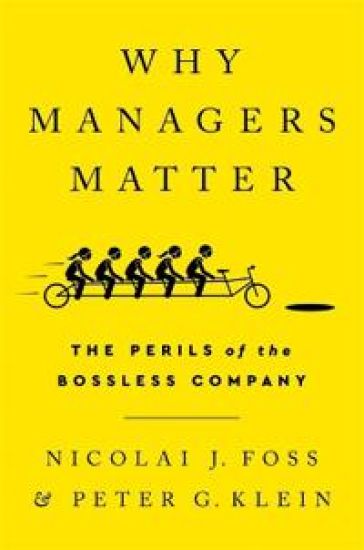
Why Managers Matter

Why Managers Matter

Nicolai J Foss; Peter G Klein

PUBLICAFFAIRS,U.S.
2022
sidottu
As business struggles to adapt to a rapidly changing world, managers are bombarded with a bewildering array of schemes for how to be a boss and make an organization tick. It's tempting to be seduced by futurist fantasies where every company has the culture of a startup, and where employees in wacky, whimsical office settings, liberated from hierarchies and bosses that oppress them, are the foundation for breakthrough performance." Get real," warn Nicolai J. Foss and Peter G. Klein. These fads ironically lead to micromanaging and, often, to disaster. Companies and societies, they show, need authority and hierarchy to coordinate work, including creative work. And, counterintuitively, Foss and Klein illustrate how the creative use of authority and hierarchy helps companies to be more agile and flexible, enabling educated, motivated people and teams to thrive. And not a moment too soon: Foss and Klein provide evidence that global challenges such as the proliferation of artificial intelligence, economic disruption, empowered knowledge workers, and black swan events such as the pandemic actually make hierarchy and the job of the manager more important than ever.
Microfoundations

Microfoundations

Nicolai J. Foss; Stefan Linder

Cambridge University Press
2019
pokkari
'Microfoundations' has become prominent in the discourse of management scholars. But what is it and how does it matter? This Element provides a characterization of microfoundations based on classical work on the methodology of social science and documents and discusses its manifestations in management research over the last one and a half decades. It also covers the relation of microfoundations to multilevel research, criticisms of microfoundations, and empirical research strategies for microfoundations.
Austrian Perspectives on Entrepreneurship, Strategy, and Organization

Austrian Perspectives on Entrepreneurship, Strategy, and Organization

Nicolai J. Foss; Peter G. Klein; Matthew McCaffrey

Cambridge University Press
2019
pokkari
The 'Austrian' tradition is well-known for its definitive contributions to economics in the twentieth century. However, Austrian economics also offers an exciting research agenda outside the traditional boundaries of economics, especially in the management disciplines. This Element examines how Austrian ideas play a key role in expanding the understanding of fields like entrepreneurship, strategy, and organization. It focuses especially on the vital role that entrepreneurs play in guiding economic progress by shaping firms and their strategic behavior. In doing so, it explains a wide range of contributions that Austrian economics makes to the understanding of key problems in management, while also highlighting many directions for future work in this inspiring tradition.
Organizing Entrepreneurial Judgment

Organizing Entrepreneurial Judgment

Nicolai J. Foss; Peter G. Klein

Cambridge University Press
2012
pokkari
Entrepreneurship, long neglected by economists and management scholars, has made a dramatic comeback in the last two decades, not only among academic economists and management scholars, but also among policymakers, educators and practitioners. Likewise, the economic theory of the firm, building on Ronald Coase's (1937) seminal analysis, has become an increasingly important field in economics and management. Despite this resurgence, there is still little connection between the entrepreneurship literature and the literature on the firm, both in academia and in management practice. This book fills this gap by proposing and developing an entrepreneurial theory of the firm that focuses on the connections between entrepreneurship and management. Drawing on insights from Austrian economics, it describes entrepreneurship as judgmental decision made under uncertainty, showing how judgment is the driving force of the market economy and the key to understanding firm performance and organization.
Organizing Entrepreneurial Judgment

Organizing Entrepreneurial Judgment

Nicolai J. Foss; Peter G. Klein

Cambridge University Press
2012
sidottu
Entrepreneurship, long neglected by economists and management scholars, has made a dramatic comeback in the last two decades, not only among academic economists and management scholars, but also among policymakers, educators and practitioners. Likewise, the economic theory of the firm, building on Ronald Coase's (1937) seminal analysis, has become an increasingly important field in economics and management. Despite this resurgence, there is still little connection between the entrepreneurship literature and the literature on the firm, both in academia and in management practice. This book fills this gap by proposing and developing an entrepreneurial theory of the firm that focuses on the connections between entrepreneurship and management. Drawing on insights from Austrian economics, it describes entrepreneurship as judgmental decision made under uncertainty, showing how judgment is the driving force of the market economy and the key to understanding firm performance and organization.
Innovating Organization and Management

Innovating Organization and Management

Nicolai J. Foss; Torben Pedersen; Jacob Pyndt; Majken Schultz

Cambridge University Press
2012
sidottu
The search for competitive advantage serves as the basis for organizational strategy. This book argues that there are four key sources of competitive advantage and financial success that have not been given the attention they deserve. Firstly, that organizational design and management processes may be strategic resources in their own right. Secondly, that organizational design and management processes can be deployed to create new strategic resources. Thirdly, that managers have begun to think of organizational design and management processes in a proactive way rather than seeing them more passively as necessary facilitators of success. Fourthly, that this new way of looking at organization and management requires a search for new ways of structuring organizational design and managerial processes. These points are driven home through case studies of the Danish firms LEGO Group, Vestas Wind Systems, Coloplast, Chr. Hansen, IC Companys and NKT Flexibles.
Innovating Organization and Management

Innovating Organization and Management

Nicolai J. Foss; Torben Pedersen; Jacob Pyndt; Majken Schultz

Cambridge University Press
2012
pokkari
The search for competitive advantage serves as the basis for organizational strategy. This book argues that there are four key sources of competitive advantage and financial success that have not been given the attention they deserve. Firstly, that organizational design and management processes may be strategic resources in their own right. Secondly, that organizational design and management processes can be deployed to create new strategic resources. Thirdly, that managers have begun to think of organizational design and management processes in a proactive way rather than seeing them more passively as necessary facilitators of success. Fourthly, that this new way of looking at organization and management requires a search for new ways of structuring organizational design and managerial processes. These points are driven home through case studies of the Danish firms LEGO Group, Vestas Wind Systems, Coloplast, Chr. Hansen, IC Companys and NKT Flexibles.
Knowledge, Economic Organization and Property Rights

Knowledge, Economic Organization and Property Rights

Nicolai J. Foss

Edward Elgar Publishing Ltd
2009
sidottu
Nicolai Foss, the influential European management scholar presents, in this essential book, sixteen of his most prominent papers. Written from a new institutional and Austrian economics perspective, this book focuses on the knowledge-based view of the firm, economic organization and property rights economics. The author critically examines notions of routines and capabilities and calls for the use of micro-foundations in management research. He illustrates the need for more emphasis to be placed upon managerial opportunism and other organizational costs, and highlights how concepts of property rights can inform strategic management. Accompanied by a lively and accessible introduction, this informative volume will invigorate strategic management, organization and international business students and scholars, as well as economists concerned with organization.
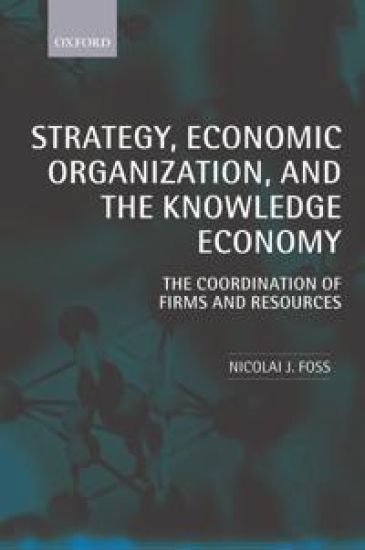
Strategy, Economic Organization, and the Knowledge Economy

Strategy, Economic Organization, and the Knowledge Economy

Nicolai J. Foss

Oxford University Press
2006
nidottu
The rise of the knowledge economy has far-reaching implications for the nature of economic organization as well as firm strategy. Not surprisingly, thinking in management studies as well as in economics has been profoundly affected by these changes. Thus, management thinking in particular has been increasingly characterized by a schism between those who advocate 'knowledge' or 'capabilities-based' approaches in the strategy and organization fields and those who adopt more economics-influenced approaches, notably the economics of organization. This book is a sustained attempt to overcome this schism. Its basic argument is that knowledge-based and organizational economics approaches are not substitutes but complements. In particular, organizational economics has much to contribute with respect to furthering the understanding of efficient organization and strategy in the emerging knowledge economy. This theme is taken through several theoretical as well as empirical variations. Themes such as the incentive liabilities of flat, 'knowledge-based' organizations, the role of complementary HRM practices for fostering knowledge sharing and creation, and the role of organizational instruments in the knowledge management activities of the multinational corporate are extensively treated. The book thus contains important implications for knowledge management, organizational design, and international management. The book encompasses nine chapters which critically examine current thinking on strategy, and organization. The reasoning is non-technical. While primarily aimed at a management studies audience, economists and other social scientists will also benefit from it, including Advanced Students, Academics, and Researchers.
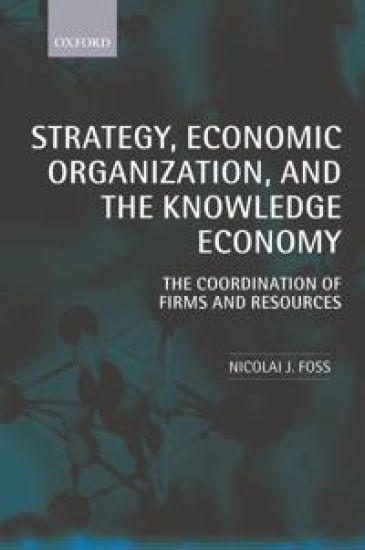
Strategy, Economic Organization, and the Knowledge Economy

Strategy, Economic Organization, and the Knowledge Economy

Nicolai J. Foss

Oxford University Press
2005
sidottu
The rise of the knowledge economy has far-reaching implications for the nature of economic organization as well as firm strategy. Not surprisingly, thinking in management studies as well as in economics has been profoundly affected by these changes. Thus, management thinking in particular has been increasingly characterized by a schism between those who advocate 'knowledge' or 'capabilities-based' approaches in the strategy and organization fields and those who adopt more economics-influenced approaches, notably the economics of organization. This book is a sustained attempt to overcome this schism. Its basic argument is that knowledge-based and organizational economics approaches are not substitutes but complements. In particular, organizational economics has much to contribute with respect to furthering the understanding of efficient organization and strategy in the emerging knowledge economy. This theme is taken through several theoretical as well as empirical variations. Themes such as the incentive liabilities of flat, 'knowledge-based' organizations and the role of complementary HRM practices for fostering knowledge sharing and creation are extensively treated. The book thus contains important implications for knowledge management, organizational design, and firm strategy." The book encompasses nine chapters which critically examine current thinking on strategy, and organization. The reasoning is non-technical. While primarily aimed at a management studies audience, economists and other social scientists will also benefit from it, including Advanced Students, Academics, and Researchers.