
Kirjailija
Nicolas Malebranche
Kirjat ja teokset yhdessä paikassa: 39 kirjaa, julkaisuja vuosilta 1968–2026, suosituimpiin kuuluu De la recherche de la verite. Vertaile teosten hintoja ja tarkista saatavuus suomalaisista kirjakaupoista.
Nimi esiintyy myös muodoissa: Nicolas. Malebranche, Nicolás Malebranche
39 kirjaa
Kirjojen julkaisuvuodet: 1968–2026.
Reponse De L'Auteur De La Recherche De La Verite
Nicolas Malebranche
KESSINGER PUBLISHING, LLC
2009
pokkari

Reponse Du Pere Malebranche Pretre De L'Oratoire, A La Troisieme Lettre De M. Arnauld (1704)
Nicolas Malebranche; Antoine Arnauld
KESSINGER PUBLISHING, LLC
2009
pokkari

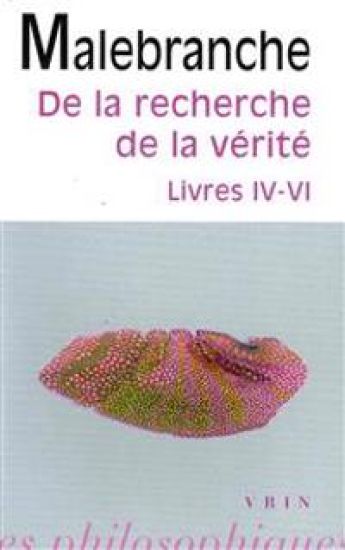
De la recherche de la verite
Nicolas Malebranche; Jean-Christophe Bardout; M. Bore; Th. Machefert; J. Roger
Librairie Philosophique J Vrin
2006
Nidottu
Livres IV-VI
First published in 2002. This is Volume XI of seventeen in the Library of Philosophy series on Metaphysics. Written in 1923, this study of Malebranche’s philosophical system, translated from ‘Entretiens sur la Metaphysique’, dialogues on metaphysics and religion.
Malebranche: Dialogues on Metaphysics and on Religion
Nicolas Malebranche
Cambridge University Press
1997
pokkari
Malebranche’s Dialogues on Metaphysics and on Religion is in many ways the best introduction to his thought, and provides the most systematic exposition of his philosophy as a whole. In it, he presents clear and comprehensive statements of his two best-known contributions to metaphysics and epistemology, namely, the doctrines of occasionalism and vision in God; he also states his views on such central issues as self-knowledge, the existence of the external world and the problem of theodicy. His skilful handling of the dialogue form enables the reader to see how he responds to objections made to his earlier work The Search after Truth. This edition presents a translation of the text which is clear, readable and more accurate than any of its predecessors, together with an introduction that analyses Malebranche’s central teachings and explains the importance of the Dialogues in the context of seventeenth-century philosophy.
Nicolas Malebranche is now recognised as a major figure in the history of philosophy, occupying a crucial place in the Rationalist tradition of Descartes, Spinoza and Leibniz. The Search after Truth is his first, longest and most important work; this volume also presents the Elucidations which accompanied its third edition, the result of comments that Malebranche solicited on the original work and an important repository of his theories of ideas and causation. Together, the two texts constitute the complete expression of his mature thought, and are written in his subtle, argumentative and thoroughly readable style. They are presented in the distinguished translations by Thomas M. Lennon and Paul J. Olscamp, together with a historical introduction, a chronology of Malebranche’s life, and useful notes on further reading.
Nicolas Malebranche is now recognised as a major figure in the history of philosophy, occupying a crucial place in the Rationalist tradition of Descartes, Spinoza and Leibniz. The Search after Truth is his first, longest and most important work; this volume also presents the Elucidations which accompanied its third edition, the result of comments that Malebranche solicited on the original work and an important repository of his theories of ideas and causation. Together, the two texts constitute the complete expression of his mature thought, and are written in his subtle, argumentative and thoroughly readable style. They are presented in the distinguished translations by Thomas M. Lennon and Paul J. Olscamp, together with a historical introduction, a chronology of Malebranche's life, and useful notes on further reading.
Written seven years after publication of his "Search after Truth", Malebranche's "Treatise on Ethics" develops a detailed, "experimental" science of ethics in two parts - the ethics of virtue and the ethics of duty. Part One distinguishes six sources of motivation: sense perceptions, passions, imagination and "inner feelings" of love as-respect, as-goodwill, and as-esteem. It examines how each is to be evaluated. This is interwoven with an Aristotelian analysis of act and habit, and voluntary vs involuntary acts, and practical reasoning. This part concludes with two basic virtues - "the strength of the mind" and "the freedom of the mind". In part Two, Malebranche explores our duties to ourselves, to others, to our sovereign and to God. The translator's introduction discusses the place of Malebranche's ethics within his larger system, his borrowings and innovations and his impact on later philosophers.
Features the selections that provide the student of modern philosophy with both a view of Malebranche's philosophical system and a picture of his most important doctrines. This title presents Malebranche's occasionalism, his theory of knowledge and the 'vision in God', and his writings on theodicy and freedom.
Treatise on Nature and Grace by Nicolas Malebranche (1638-1715), first published in 1680, is one of the most celebrated and controversial works of seventeenth-century philosophical theology. This major text, last translated into English in 1695, is here made available to a new generation of readers in an entirely new translation, with a substantial scholarly introduction. The central argument, that God governs the realms of nature and of grace by simple, constant, and uniform `general wills', not through `particular providence', had fundamental repercussions within the contemporary debates on the nature of divine grace and of salvation, contradicting the claims of the Calvinists and Jansenists that God wills the individual salvation of an elected few. Hailed as a work of genius by Bayle and Leibniz, the Treatise was to have a profound and far-reaching influence on the development of eighteenth-century thought through the theory of the just and justifiable `general will', which re-emerged in secular form in the work of Rousseau.
Von der Erforschung der Wahrheit / Von der Erforschung der Wahrheit
Nicolas Malebranche
Felix Meiner
1968
sidottu