

Kirjojen hintavertailu – 12 903 725 kirjaa ja 27 kauppaa

Kirjailija

Nicolas Wittstock

Kirjat ja teokset yhdessä paikassa: 2 kirjaa, julkaisuja vuodelta 2025, suosituimpiin kuuluu U.S. Innovation Inequality and Trumpism. Vertaile teosten hintoja ja tarkista saatavuus suomalaisista kirjakaupoista.

2 kirjaa

U.S. Innovation Inequality and Trumpism

U.S. Innovation Inequality and Trumpism

Victor Menaldo; Nicolas Wittstock

Cambridge University Press
2025
sidottu
President Trump embraced economic populism centered on trade protectionism, restrictions on international capital and technology flows, and subsidies for American raw material providers and domestic manufacturers. More innovative US counties roundly rejected this economic paradigm: Voters in innovation clusters of all sizes and across the country repudiated Trumpism in both 2016 and 2020. Trump's tariffs and attacks on global supply chains, restrictions on visas for skilled foreign workers, and his overall hostility toward high-tech sectors threatened the innovative firms that motor these places' economies. Trump was different in degree but not kind from previous American populists such as Jennings Bryan and Perot: they too exploited innovation inequality, but were less successful because, before the digital revolution, the industrial organization of American technological progress was not rooted in vertically disintegrated global supply chains. Thus, populism may not only be about resentment toward elites and experts but threaten innovation.
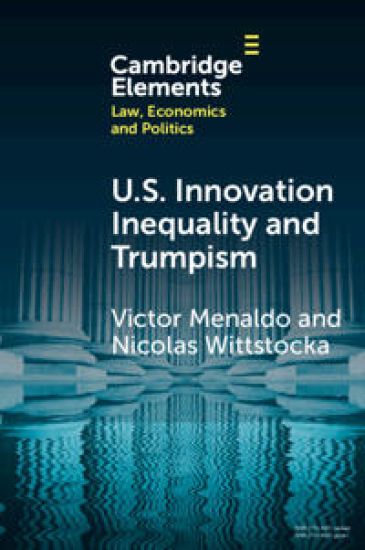
U.S. Innovation Inequality and Trumpism

U.S. Innovation Inequality and Trumpism

Victor Menaldo; Nicolas Wittstock

Cambridge University Press
2025
pokkari
President Trump embraced economic populism centered on trade protectionism, restrictions on international capital and technology flows, and subsidies for American raw material providers and domestic manufacturers. More innovative US counties roundly rejected this economic paradigm: Voters in innovation clusters of all sizes and across the country repudiated Trumpism in both 2016 and 2020. Trump's tariffs and attacks on global supply chains, restrictions on visas for skilled foreign workers, and his overall hostility toward high-tech sectors threatened the innovative firms that motor these places' economies. Trump was different in degree but not kind from previous American populists such as Jennings Bryan and Perot: they too exploited innovation inequality, but were less successful because, before the digital revolution, the industrial organization of American technological progress was not rooted in vertically disintegrated global supply chains. Thus, populism may not only be about resentment toward elites and experts but threaten innovation.