Kirjojen hintavertailu – 12 903 735 kirjaa ja 27 kauppaa

Kirjailija

Nik Cornish

Kirjat ja teokset yhdessä paikassa: 9 kirjaa, julkaisuja vuosilta 2001–2025, suosituimpiin kuuluu Red Army into the Reich. Vertaile teosten hintoja ja tarkista saatavuus suomalaisista kirjakaupoista.

9 kirjaa

Kirjojen julkaisuvuodet: 2001–2025.

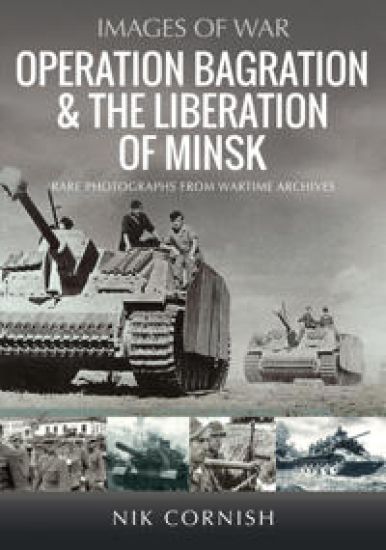
Operation Bagration & the Liberation of Minsk

Operation Bagration & the Liberation of Minsk

Nik Cornish

PEN SWORD BOOKS LTD
2025
nidottu

Halvin toimitettuna 29,90 €

Often overshadowed by D-Day Operation Bagration, the code name for the Red Army's summer offensive of 1944, broke the back of the Axis on the Eastern Front. Coincidentally beginning on the third anniversary of Hitler's invasion of the Soviet Union, Bagration demonstrated that the Red Army had learnt the lessons of mobile warfare and was capable of putting them into ruthless practice. A series of well-coordinated attacks combined with major partisan strikes struck the defence lines of Army Group Centre in Belarus. Weak in armour and air support AGC had not been the target Hitler had anticipated that the Soviets would chose for this operation. It was only when the Red Army had almost outrun its supply lines and panzer formations had be relocated from elsewhere on the Eastern Front in early July that the Germans managed to defend effectively. However, this book only covers the fighting until the liberation of Minsk in early July. The Soviet's summer offensive would not officially end until the last week of August by which time Finland had sued for an armistice, Romania had switched sides and the German forces had been savaged, holding a line hundreds of kilometres to the west of its original positions outside the gates of Warsaw
Red Army into the Reich

Red Army into the Reich

Simon Forty; Nik Cornish

Casemate Publishers
2021
sidottu
The last year of the war saw Russian offensives that cleared the Germans out of their final strongholds in Finland and the Baltic states, before advancing into Finnmark in Norway and the east European states that bordered Germany: Poland, Czechoslovakia and Hungary. By spring 1945 the Red Army had reached to Vienna and the Balkans, and had thrust deep into Germany where they met American, French and British troops advancing from the west. The final days of the Third Reich were at hand. Berlin was first surrounded, then attacked and taken. Hitler's suicide and his successors' unconditional surrender ended the war. For writers and historians who concentrate on the Western Allies and the battles in France and the Low Countries, the Eastern Front comes as a shock. The sheer size of both the territories and the forces involved; the savagery of both weather and the fighting; the appalling suffering of the civilian populations of all countries and the wreckage of towns and cities - it's no wonder that words like armageddon are used to describe the annihilation. Red Army into the Reich combines a narrative history, contemporary photographs and maps with images of memorials, battlefield survivors and then & now views. It may come as a surprise to the western reader to see how many memorials there are to Russia's Great Patriotic War and those to the losses suffered by the countries who spent so long under the murderous Nazi regime.
Hitler versus Stalin: The Eastern Front 1944-1945: Warsaw to Berlin
In the fourth and final volume of Nik Cornish's photographic history of the Second World�War on the Eastern Front the defeat of the German army, the destruction and occupation�of the cities in eastern Germany and the humiliation of the German people are shown in�over 150 mostly unpublished wartime photographs. The extent of the fighting, from the�Baltic in the north to the Balkans in the south, is recorded in a selection of graphic images,�as is the tenacity and desperation of the German resistance and the unstoppable force of�the Red Army as offensive after offensive crushed the Third Reich. While most of the�photographs show the Red Army, its troops, equipment and the conditions in which it�fought, the shattered cities of Germany and eastern Europe and the suffering and�destitution of the civilians are recorded in graphic detail.
Hitler versus Stalin: The Eastern Front 1943 - 1944
The third volume in Nik Cornish's photographic history of the Second World War on the Eastern Front records in vivid visual detail the sequence of Red Army offensives that pushed the Wehrmacht back across Russia after the failure of the Operation Citadel, the German attack at Kursk. Previously unpublished images show the epic scale of the build-up to the Kursk battle and the enormous cost in terms of lives and material of the battle itself. They also show that the military initiative was now firmly in Soviet hands, for the balance of power on the Eastern Front had shifted and the Germans were on the defensive and in retreat. Subsequent chapters chronicle the hard-fought and bloody German withdrawal across western Russia and the Ukraine, recording the Red Army's liberation of occupied Soviet territory. Not only do the photographs track the sequence of events on the ground, they also show the equipment and the weapons used by both sides, the living conditions experienced by the troops and the devastation the war left in its wake.
Soviet Partisan 1941–44

Soviet Partisan 1941–44

Nik Cornish

Osprey Publishing
2014
nidottu
The partisan war in the Soviet Union from 1941 to 1944 has been the subject of considerable political manipulation in the decades following 1945. In great part this was due to the need to project the image of a country united behind Joseph Stalin and the Communist regime when the truth was much more complex than that. The opening weeks of Operation Barbarossa had exposed the lack of unity in the Soviet Empire as nationalist and anti-Communist groups emerged in the western provinces such as Belo Russia, Galicia, Bukovina, Ukraine and the Baltic states of Latvia, Lithuania and Estonia. Consequently it was vital for the survival of the Soviet Union that such groups were countered in situ and that the authority of Moscow was maintained in what were known as the Occupied Territories. During the summer of 1941 plans, dormant since the 1930s, for the conduct of partisan warfare behind the lines of an invading force were resurrected. The plans were intended to make life for the invaders as problematic as possible by acts of sabotage, but most important of all to maintain the physical presence of Soviet authority.
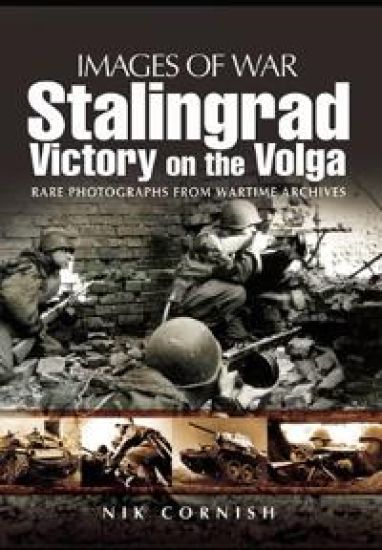
Stalingrad: Victory on the Volga

Stalingrad: Victory on the Volga

Nik Cornish

Pen Sword Military
2009
nidottu
The Soviet victory over the Germans at Stalingrad was decisive for the war on the Eastern Front and for the Second World War as a whole, and the story of the long, bitter battle on the banks of the Volga has fascinated historians ever since. While it has been the subject of countless histories, memoirs and eyewitness accounts, the gruelling reality of the battle on the ground, in the shattered streets and buildings of the city, has rarely been recorded photographically. And this is the great strength of Nik Cornish's selection of unforgettable images. He documents every aspect of the fighting - the dreadful conditions endured by the soldiers, the jagged outline of the ruined city, the harrowing daily routine of street fighting and close-quarter combat, the casualties and the dead, and the battle behind the lines - the tremendous effort made by the Germans and the Soviets to sustain their men in what had become a fight to the death. But perhaps most memorable of all, the photographs give us glimpses of the lives and deaths of soldiers on both sides who participated in one of the most terrible battles in history.
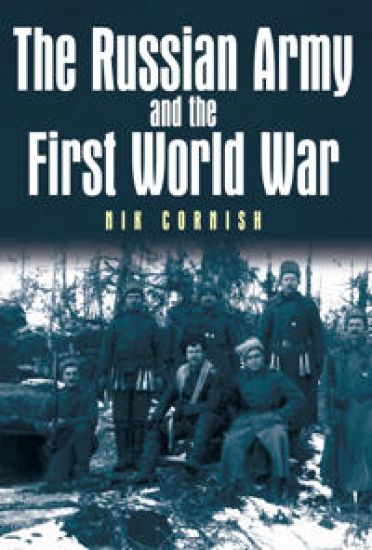
The Russian Army and the First World War

The Russian Army and the First World War

Nik Cornish

Spellmount Publishers Ltd
2006
sidottu
This book covers not only the three major events on the Eastern Front, the battle of Tannenburg and the March and October Revolutions, it also dispels some of the myths that have grown up around the Tsar's army: their often-cited inability to adapt to 'modern' warfare being one. The nationalist formations and the Revolutionary units of the Provisional Goverment are also described, something difficult if not impossible to find in other publications. 140 photographs and six maps bring the Eastern Front into sharp focus.
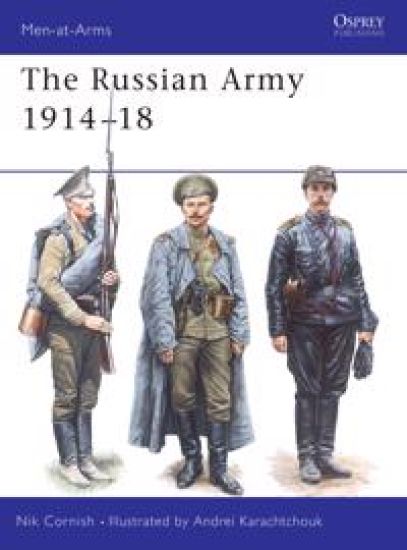
The Russian Army 1914–18

The Russian Army 1914–18

Nik Cornish

Osprey Publishing
2001
nidottu
Imperial Russia's massive, if finally fatal contribution to the Allied war effort of 1914-17 involved huge numbers of men and some of the greatest battles of the war. The defeat at Tannenburg in 1914, and Brusilov's successful 1916 offensive against the Austro-Hungarians, were major events which had far-reaching effects on the Western fronts; and the attempts to keep the war effort going after the fall of the Tsar greatly influenced the course of the Bolshevik Revolution. This volume provides illustrated detail on the range of varied and colourful uniforms worn by the troops who played central roles in these events, many of which appear exotic to western eyes.