Kirjojen hintavertailu – 12 903 725 kirjaa ja 27 kauppaa
Kirjailija
Nilmini Wickramasinghe
Kirjat ja teokset yhdessä paikassa: 15 kirjaa, julkaisuja vuosilta 2009–2025, suosituimpiin kuuluu Creating Responsible Inquiring Digital Health Organizations. Vertaile teosten hintoja ja tarkista saatavuus suomalaisista kirjakaupoista.
This book centres on the topic of digital twins for superior healthcare decision support, as access is enabled to large volumes of multi-dimensional data such as patient’s electronic medical records, medical scans, and data. The reader learns about the possibility of a digital representation of analogous clinical cases built from data-driven models to represent and present relevant information and germane knowledge in context. Together with cutting-edge technologies, authors share the ability of data-driven models to offer more efficient clinical decision support. The authors take a three-prong approach in the study of digital twins, the positive contributions made in other industries, the different types of applications, and the numerous benefits offered. Artificial Intelligence (AI) techniques, such as Machine Learning (ML) and Deep Learning (DL) algorithms are discussed in the context of digital twins in healthcare applications. By looking at how digital twins reduce workflow challenges, provide fast and precise diagnosis, therefore support superior clinical decision making. Importantly, the editors identify critical success issues including co-design and research, for the design, development, and deployment of suitable digital twins. This book is written for the healthcare audience, professionals, physicians, medical administrators, managers, and the IT practitioner. It would also serve as a useful reference for the senior level undergraduate students and graduate students in health informatics and public health.
This book centres on the topic of digital twins for superior healthcare decision support, as access is enabled to large volumes of multi-dimensional data such as patient’s electronic medical records, medical scans, and data. The reader learns about the possibility of a digital representation of analogous clinical cases built from data-driven models to represent and present relevant information and germane knowledge in context. Together with cutting-edge technologies, authors share the ability of data-driven models to offer more efficient clinical decision support. The authors take a three-prong approach in the study of digital twins, the positive contributions made in other industries, the different types of applications, and the numerous benefits offered. Artificial Intelligence (AI) techniques, such as Machine Learning (ML) and Deep Learning (DL) algorithms are discussed in the context of digital twins in healthcare applications. By looking at how digital twins reduce workflow challenges, provide fast and precise diagnosis, therefore support superior clinical decision making. Importantly, the editors identify critical success issues including co-design and research, for the design, development, and deployment of suitable digital twins. This book is written for the healthcare audience, professionals, physicians, medical administrators, managers, and the IT practitioner. It would also serve as a useful reference for the senior level undergraduate students and graduate students in health informatics and public health.
Healthcare systems globally are grappling with how best to implement effective and efficient patient-centred care while simultaneously trying to contain runaway costs and provide high quality. This book explores the essential enabling role of digital health, taking a socio-technical perspective and looking at the key facets of technology, people and process in turn. This book examines the opportunities of key digital health components, demystifying digital health and demonstrating how to use its key precepts effectively. The book presents evidence and anecdotes from stakeholders around the world, demonstrating the global relevance and the ability of digital health to uplift and upskill care delivery as it is applied commercially. Bridging academic theory and practice, this is a functional and accessible text for all digital health stakeholders. The text introduces critical issues and is suitable reading for students, practitioners and researchers in digital health and all healthcare-related domains.
Healthcare systems globally are grappling with how best to implement effective and efficient patient-centred care while simultaneously trying to contain runaway costs and provide high quality. This book explores the essential enabling role of digital health, taking a socio-technical perspective and looking at the key facets of technology, people and process in turn. This book examines the opportunities of key digital health components, demystifying digital health and demonstrating how to use its key precepts effectively. The book presents evidence and anecdotes from stakeholders around the world, demonstrating the global relevance and the ability of digital health to uplift and upskill care delivery as it is applied commercially. Bridging academic theory and practice, this is a functional and accessible text for all digital health stakeholders. The text introduces critical issues and is suitable reading for students, practitioners and researchers in digital health and all healthcare-related domains.
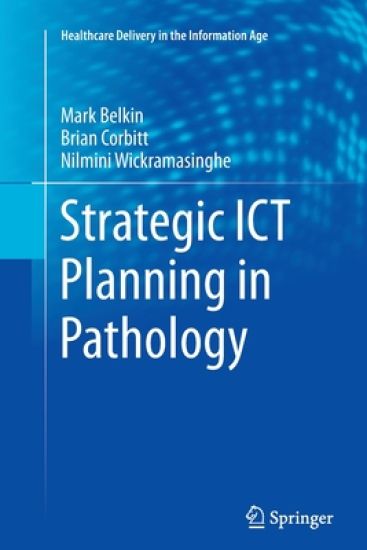
There is little doubt that information technology is a major force in transforming healthcare systems: physicians need to have considerable patient data at hand, even if diagnosis and treatment are relatively straightforward. But data are only as useful as ICT—information communication technology—systems make them. Inefficient handling of data can quickly lead to chaos, and possibly to fatalities. Strategic ICT Planning in Pathology illuminates these problems, as well as their potential solutions, based on a unique body of research from Australia. Focusing on core strategic factors such as laboratory information systems capability and effectiveness, business-IT alignment, strategic spending, research and education, and end-user involvement, the book explains why pathology labs lag behind other hospital departments. Survey and focus group findings pinpoint the importance of Strategic Information System Planning (SISP), and its relationship to quality service delivery and an improved bottom line [ok?]. Among the topics covered: Approaches to SISP and IS effectiveness measurement. The OpenLabs project and pathology practice. Development of a framework for SISP. Focus groups: the view from the hospital laboratory, the private pathology lab, and the experts. Key findings and their implications for strategy, planning, and business outcomes. Future research directions, including reverse SISP. Strategic ICT Planning in Pathology is a go-to resource for healthcare administrators and researchers in healthcare management, health policy, and health services research interested in troubleshooting systems, conducting surveys on IS, or better understanding how quality ICT works.
There is little doubt that information technology is a major force in transforming healthcare systems: physicians need to have considerable patient data at hand, even if diagnosis and treatment are relatively straightforward. But data are only as useful as ICT—information communication technology—systems make them. Inefficient handling of data can quickly lead to chaos, and possibly to fatalities. Strategic ICT Planning in Pathology illuminates these problems, as well as their potential solutions, based on a unique body of research from Australia. Focusing on core strategic factors such as laboratory information systems capability and effectiveness, business-IT alignment, strategic spending, research and education, and end-user involvement, the book explains why pathology labs lag behind other hospital departments. Survey and focus group findings pinpoint the importance of Strategic Information System Planning (SISP), and its relationship to quality service delivery and an improved bottom line [ok?]. Among the topics covered: Approaches to SISP and IS effectiveness measurement. The OpenLabs project and pathology practice. Development of a framework for SISP. Focus groups: the view from the hospital laboratory, the private pathology lab, and the experts. Key findings and their implications for strategy, planning, and business outcomes. Future research directions, including reverse SISP. Strategic ICT Planning in Pathology is a go-to resource for healthcare administrators and researchers in healthcare management, health policy, and health services research interested in troubleshooting systems, conducting surveys on IS, or better understanding how quality ICT works.
The purpose of Creating Knowledge Based Healthcare Organizations is to bring together some high quality concepts closely related to how knowledge management can be utilized in healthcare. It includes the methodologies, systems, and approaches needed to create and manage knowledge in various types of healthcare organizations. Futhermore, it has a global flavour, as we discuss knowledge management approaches in healthcare organizations throughout the world. For the first time, it is possible to have so many of the concepts, tools, and techniques relevant to knowledge management in healthcare in this one volume so that the reader can understand all the components required to utilize knowledge.
In global environments, healthcare organizations are required to be flexible and resilient in coping with uncertain and complex circumstances. ""Redesigning Innovative Healthcare Operation and the Role of Knowledge Management"" collects a compilation of chapters on how knowledge impacts the layout and design of the medical industry. A cutting-edge reference source within the field, this book provides comprehensive frameworks, constraints, and performances analyzed by experts within the healthcare sector.
Quality care of patients requires evaluating large amounts of data at the right time and place and in the correct context. With the advent of electronic health records, data warehouses now provide information at the point of care and facilitate a continuous learning environment in which lessons learned can provide updates to clinical, administrative, and financial processes. Given the advancement of the information tools and techniques of today’s knowledge economy, utilizing these resources are imperative for effective healthcare. Thus, the principles of Knowledge Management (KM) are now essential for quality healthcare management. The Healthcare Knowledge Management Primer explores and explains essential KM principles in healthcare settings in an introductory and easy to understand fashion. This concise book is ideal for both students and professionals who need to learn more about key aspects of the KM field as it pertains to effecting superior healthcare delivery. It provides readers with an understanding of approaches to KM by examining the purpose and nature of its key components and demystifies the KM field by explaining in an accessible manner the key concepts of KM tools, strategies and techniques, and their benefits to contemporary healthcare organizations.
Quality care of patients requires evaluating large amounts of data at the right time and place and in the correct context. With the advent of electronic health records, data warehouses now provide information at the point of care and facilitate a continuous learning environment in which lessons learned can provide updates to clinical, administrative, and financial processes. Given the advancement of the information tools and techniques of today’s knowledge economy, utilizing these resources are imperative for effective healthcare. Thus, the principles of Knowledge Management (KM) are now essential for quality healthcare management. The Healthcare Knowledge Management Primer explores and explains essential KM principles in healthcare settings in an introductory and easy to understand fashion. This concise book is ideal for both students and professionals who need to learn more about key aspects of the KM field as it pertains to effecting superior healthcare delivery. It provides readers with an understanding of approaches to KM by examining the purpose and nature of its key components and demystifies the KM field by explaining in an accessible manner the key concepts of KM tools, strategies and techniques, and their benefits to contemporary healthcare organizations.
The discipline of Knowledge Management (KM) is rapidly becoming established as an essential course or module in both information systems and management programs around the world. Many KM texts pitch theoretical issues at too technical or high a level, or presenting a only a theoretical prescriptive treatment of knowledge or KM modeling problems. The Knowledge Management Primer provides students with an essential understanding of KM approaches by examining the purpose and nature of its key components. The book demystifies the KM field by explaining in a precise, accessible manner the key concepts of KM tools, strategies, and techniques, and their benefits to contemporary organizations. Readers will find this book filled with approaches to managing and developing KM that are underpinned by theory and research, are integrative in nature, and address softer approaches in manifesting and recognizing knowledge.
The discipline of Knowledge Management (KM) is rapidly becoming established as an essential course or module in both information systems and management programs around the world. Many KM texts pitch theoretical issues at too technical or high a level, or presenting a only a theoretical prescriptive treatment of knowledge or KM modeling problems. The Knowledge Management Primer provides students with an essential understanding of KM approaches by examining the purpose and nature of its key components. The book demystifies the KM field by explaining in a precise, accessible manner the key concepts of KM tools, strategies, and techniques, and their benefits to contemporary organizations. Readers will find this book filled with approaches to managing and developing KM that are underpinned by theory and research, are integrative in nature, and address softer approaches in manifesting and recognizing knowledge.
This text provides a comprehensive introduction to the new field of knowledge management. It approaches the subject from a management rather than a highly technical point of view, and provides students with a state-of-the-art survey of KM and its implementation in diverse organizations. The text covers the nature of knowledge (tacit and explicit), the origins and units of organizational knowledge, and the evolution of knowledge management in contemporary society. It explores the implementation and utilization of knowledge management systems, and how to measure their impact, outputs, and benefits. The book includes a variety of original case studies that illustrate specific situations in which the absence or existence of knowledge management systems has been crucial to the organization's actions. Charts and figures throughout help clarify more complex phenomena and classifications, and each chapter includes review questions and a comprehensive index.