
Kirjojen hintavertailu – 12 859 824 kirjaa ja 27 kauppaa

Kirjailija

Nils Karlson

Kirjat ja teokset yhdessä paikassa: 23 kirjaa, julkaisuja vuosilta 2001–2025, suosituimpiin kuuluu Statecraft and Liberal Reform in Advanced Democracies. Vertaile teosten hintoja ja tarkista saatavuus suomalaisista kirjakaupoista.

23 kirjaa

Kirjojen julkaisuvuodet: 2001–2025.

Samverkan - en utmaning : lärdomar av KK-stiftelsens samverkansprogram

Samverkan - en utmaning : lärdomar av KK-stiftelsens samverkansprogram

Olle Vogel; Nils Karlson; Anne-Sophie Larsson; Henrik Malm Lindberg

Ratio
2015
nidottu
I rapporten presenteras resultat och analyser av KK-stiftelsens samverkansprogram företagsforskarskolor, forskarprofiler och expertkompetens, i vilka ca 2 miljarder kronor har satsats. En av de viktigaste lärdomarna är att det är svårt att åstadkomma varaktig samverkan mellan lärosäten och näringsliv, trots stora ansträngningar. De inblandade aktörerna har olikartade motiv, mål och verklighets-uppfattningar. Effekterna av samverkanssatsningarna är dessutom mycket långsiktiga och därmed svåra att mäta. Samverkan åstadkoms enklast där den redan fungerar, men är mycket svårare att åstadkomma där behovet kanske är som störst. Ett fåtal stora företag är återkommande samverkanspartners, och samverkar dessutom i ett flertal program. För nya, mindre och tekniksvaga företag är det väsentligt svårare att få till varaktig samverkan. Den viktigaste slutsatsen är att samverkan ska ses som en lärprocess. För att denna process ska kunna fungera krävs att aktiviteter, resultat och effekter, på kort och lång sikt, mäts och följs upp med större systematik och jämförbarhet i framtida satsningar. Det finns indikationer på att företagen bör få vara drivande i samverkansprocessen. Därmed finns också ett tydligt behov av policyutveckling, främst för att ge mindre företag möjlighet att medverka i samverkans-satsningar. Samverkan kan, rätt utformad, bygga kompetens. Samverkan – en utmaning. Lärdomar av KK-stiftelsens samverkansprogram (2015:17) publiceras inom forsknings-programmet ”Kompetens för tillväxt”. Läs mer på www.kompetensfortillvaxt.nu och www.ratio.se
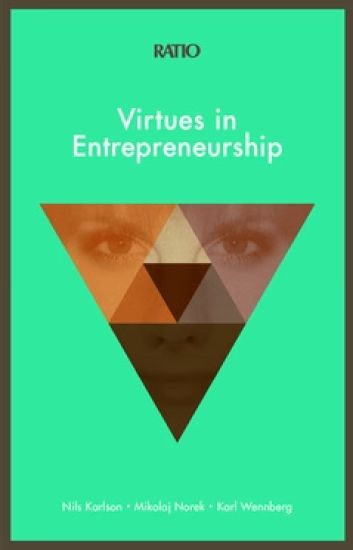
Virtues in Entrepreneurship

Virtues in Entrepreneurship

Mikolaj Norek; Karl Wennberg; Nils Karlson

Ratio
2015
nidottu
Does virtuous behavior contribute to business success? And is virtues ethics a superior alternative to corporate social responsibility in business ethics? This volume combines empirical and theoretical contributions from a range of different contexts on the role of virtues in entrepreneurship. It show the contemporary relevance of virtue theory in analyzing markets as well as business development. Virtues may be regarded as a kind of competencies, which are essential in an entrepreneurial society. This bears consequences for how we educate future business leaders, but also for how economists and policymakers should look on markets and for-profit firms. A special introduction is written by Professor Deirdre McCloskey. The editors, Nils Karlson, Mikolaj Norek and Karl Wennberg, are all affiliated with the Ratio Institute in Stockholm, Sweden.
The State of State

The State of State

Nils Karlson

Transaction Publishers
2001
nidottu
One of the most astonishing features of social, economic, and political life is that large-scale patterns, structures, and behavioral regularities sometimes develop without anyone intentionally planning their occurrence, or without anyone deliberately working to bring them about. They evolve as a specific kind of unintended consequence of human action. They are the result of invisible hands. Building on Adam Smith's classic concept of "the invisible hand," this study presents a general approach, based on the theory of games and evolutionary theory, to explain such large-scale unintended consequences within markets, communities, and the state. This analysis by Nils Karlson is further used to explain the growth of the modern "welfare" state. It shows how an unconstrained democratic state through two distinct invisible-hand processes, the logic of conceit and the logic of opportunism, may develop into a "equilibrium" state, "The State of State." His work moves classic political economy into the world of political sociology. A normative contractual model is presented and the relative desirability of the state, markets, and communities is discussed. A major conclusion is that it is a choice between imperfect alternatives, involving decisions about more or less, rather than absolute judgments of an either/or variety. It is nevertheless suggested that society ought to be radically depoliticized and that constitutional constraints should be introduced in the universe of policy-making.