

Kirjojen hintavertailu – 12 859 818 kirjaa ja 27 kauppaa

Kirjailija

Nina Möntmann

Kirjat ja teokset yhdessä paikassa: 2 kirjaa, julkaisuja vuosilta 2015–2023, suosituimpiin kuuluu Centennial – A History of the Renaissance Society. Vertaile teosten hintoja ja tarkista saatavuus suomalaisista kirjakaupoista.

2 kirjaa

Kirjojen julkaisuvuodet: 2015–2023.

Centennial – A History of the Renaissance Society

Centennial – A History of the Renaissance Society

Susan M. Bielstein; Bruce Jenkins; Pamela M. Lee; Nina Möntmann; Liesl M. Olson; R.h. Quatman; Aoibheann Sweeney; Hamza Walker

Renaissance Society at the University of Chicago
2015
sidottu
This major publication considers the Renaissance Society’s first hundred years. The volume features contributions from Davarian L. Baldwin, Susan Bielstein, Bruce Jenkins, Pamela M. Lee, Nina Möntmann, Liesl Olson, R. H. Quaytman, Anne Rorimer, and Aoibheann Sweeney. It also includes an interview between Susanne Ghez, Solveig Øvstebø, and Hamza Walker, and a comprehensive timeline of the institution’s programming over 100 years.
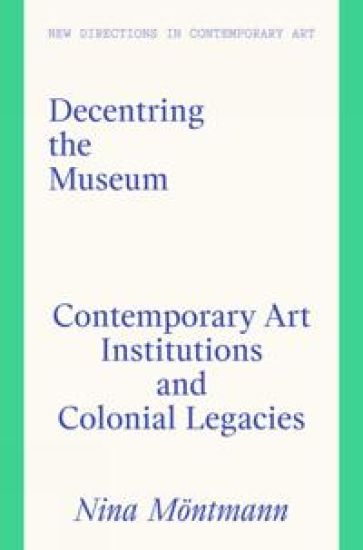
Decentring the Museum

Decentring the Museum

Nina Möntmann

LUND HUMPHRIES PUBLISHERS LTD
2023
sidottu
Nina Möntmann's timely book extends the decolonisation debate to the institutions of contemporary art. In a thoughtfully articulated text, illustrated with pertinent examples of best practice, she argues that to play a crucial role within increasingly diverse societies museums and galleries of contemporary art have a responsibility to 'decentre' their institutions, removing from their collections, exhibition policies and infrastructures a deeply embedded Euro-centric cultural focus with roots in the history of colonialism. In this, she argues, they can learn from the example both of anthropological museums (such as the Rautenstrauch-Joest-Museum in Cologne), which are engaged in debates about the colonial histories of their collections, about trauma and repair, and of small-scale art spaces (such as La Colonie, Paris, ANO, Institute of Arts and Knowledge, Accra or Savvy Contemporary, Berlin), which have the flexibility, based on informal infrastructures, to initiate different kinds of conversation and collective knowledge production in collaboration with indigenous or local diasporic communities from the Global South. For the first time, this book identifies the influence that anthropological museums and small art spaces can exert on museums of contemporary art to initiate a process of decentring.